Trout Fishing
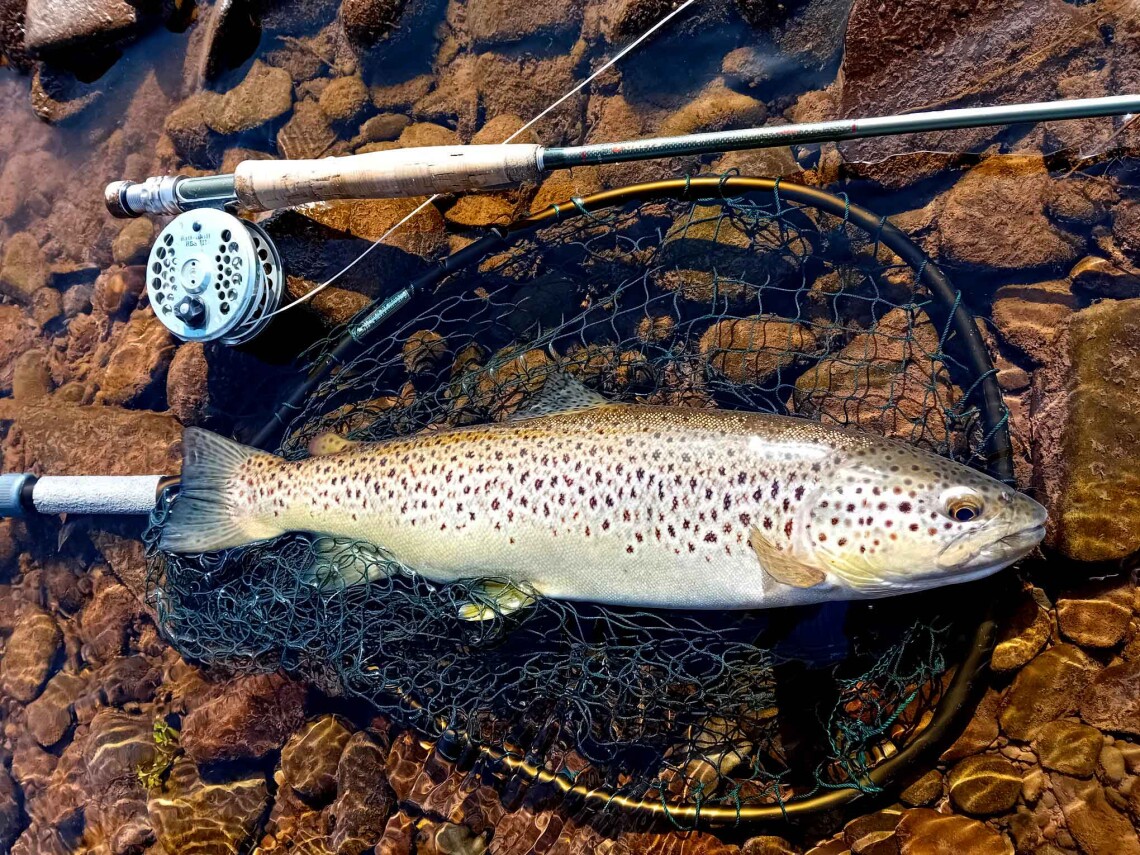
The last days of March were cold and windy and at that time the rivers were still full. RG from Freshford fished the Usk at Abercynrig just below Brecon: “Strong downstream wind made fishing difficult. Caught 7 fish to 1.5 pounds on March Brown dry, spiders and upstream nymph.” A quite creditable result for the conditions, I thought. PG from Gloucestershire found that the owner has cleared the path down to the river at Glan y Cafn, which is welcome news. Lucille Evans from Hengoed with a friend took 7 trout on the Usk Reservoir. David Baxter from Lancaster took 3 trout to 2 pounds at Abercynrig, but “…due to an administrative error the beat was overbooked with three anglers turning up.” I am not sure what happened there, but a couple of days later I was also on Abercynrig with two clients when yet another angler turned up, in his case lost because he couldn’t find the parking place for Dinas. Do print off the directions when you get them with the ticket rather than trying to rely on the satnav. What Three Words codes will eventually be added to the numerous sets of directions, but for now, please read and follow the directions just as our parents would have done in days of yore. It isn’t that difficult.
Christopher Griffett from Bristol fished at the Monnow Valley Studios, and reported taking 5 trout from 9-14 inches on a dry fly during a prolific caddis hatch. I found that interesting, having done well on the same beat a few years ago during another very early grannom hatch. And this year, actually on the same day as Mr Griffett was fishing (31st March), I was out with clients on the rainbow ponds of Big Well just above the main Wye at Redbrook and there was a hatch of what looked like grannom coming off one of the clear water pools. You don’t normally associate grannom sedge with still waters, although admittedly a powerful spring runs through this one which is also literally a metre away from a tributary brook running alongside one bank. Still, there they were apparently and we got a couple of rainbows from the surface on the strength of it.
 Neck of The Rectory
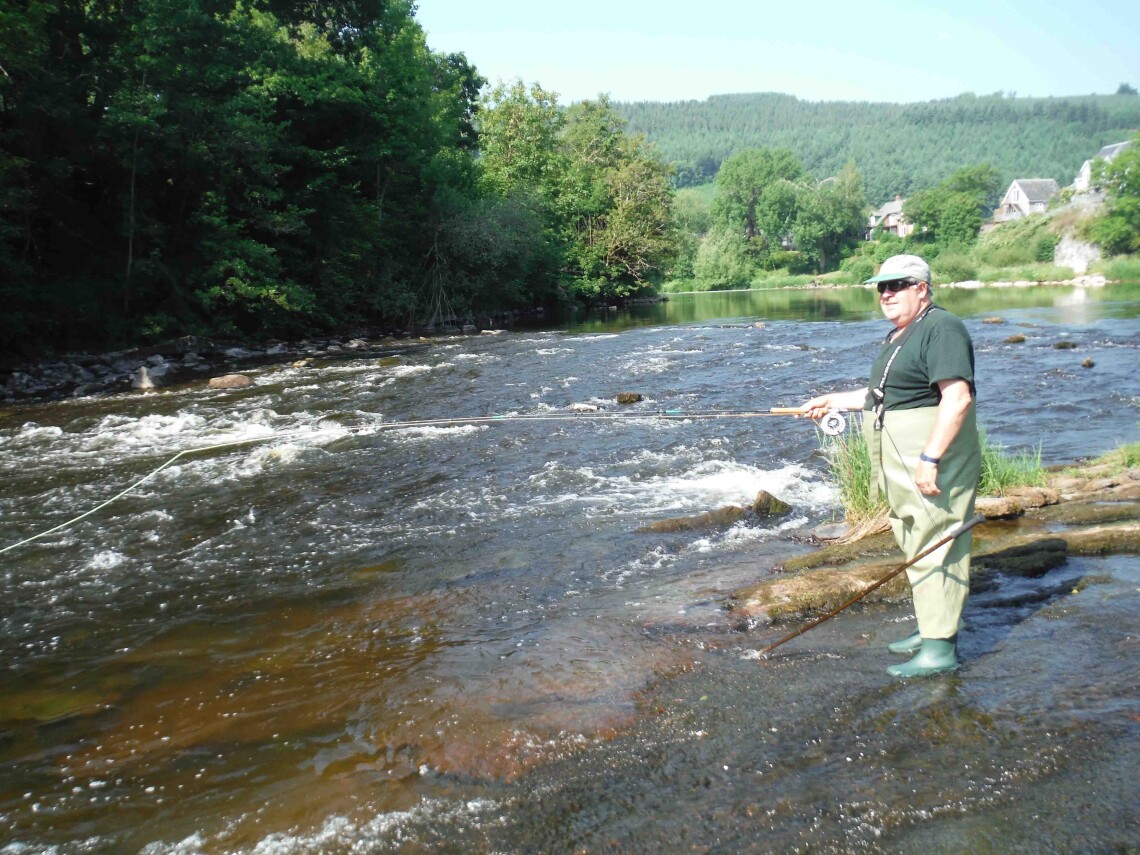
 The angling journalist and artist Charles Jardine fished at the Rectory on 1st April and took 10 trout from the Rock Pool and Bridge End Flats during a March brown hatch. He was using both spiders and dries. Rob Denman from Colorado was another who enjoyed hatching March browns at the Rectory; he took 9 trout during two consecutive visits. Rhian Bray from Redditch also recorded 9 trout from the Rectory. Andrew Penton with a friend from Haverford West caught 5 fish including a specimen brown trout from the Aberystwyth AA’s Llyn Rhosrydd. Johnny Colman of Bristol was confronted by a new padlock code on the gate to Llyn Bugeilyn, so he had to leave his car and walk in and later back – a long and lonely road across the moors. Apparently someone had changed the code, but neglected to tell the WUF, which must have been pretty annoying. A few years ago, a couple of anglers found themselves and their car locked in at the same gate during their fishing day, so they had to lift it off the hinges or face staying overnight in the wilderness. The WUF information for Bugeilyn is suitably updated now.
Nick Chandler from Hengoed reported 5 trout from Llwyn On Reservoir, while Craig from Machen caught 5 more with worm. As expected, there was a lot of activity around the Beacons reservoirs during Easter. Most of the reports were of two types. Some come from unsuccessful anglers, in which case the fishing and stocking arrangements are usually described as awful and the reporter swears that he will never return. Other reports arrive from successful anglers who apparently had a wonderful time. Gavin Evans from Porth was at Llwyn On and: “…caught 5 trout, all of a good size and healthy, with worm. Told the kids, when I die, scatter me here.”
James Lockyer with a friend from Street caught 9 Usk trout at Glan yr Afon, while Robin Guild from Freshford accounted for 5 more on the Usk Town water. Justin and Harry Scheck from the USA fished with me at Abercynrig and caught 10 trout to 16 inches on dries and spiders. Large dark olives and a few March browns were hatching and fish were reacting. Ben Garnett from Exeter fished at the Tower and was encouraged to see spring salmon moving nearby.
 Time for the tributaries
 Storm Dave blew up over the Easter weekend and most anglers found conditions difficult. Tim Martin with a friend from Bristol fished at Dan y Parc, caught a 2 pounds trout and experienced a close view of an otter. Adrian Grose-Hodge with a friend fished at Dan y Parc on 5th April and caught 7 trout on a day of “…March browns, grannom and blustery winds.” They had 6 more from Dinas on the 6th. Andrew Kelton from Churt fished at Abercynrig on the 6th and took 6 trout to 12 inches on a size 14 Adams and a Jingler. He also got a good view of a young otter. A Whittington angler was at the top end of the Wye at Clochfaen: “Five beautiful Wye trout on a lovely spring day.” Ian Gillard with a friend from Pontypridd came to Dinas the following day; there were hatches although ignored by the fish. Eventually they took a dozen trout on nymphs. John Fry from Bwlch experienced a rise between 12.15 and 13.00 on the Rectory and reported 5 trout, adding that: “…banks are well looked after – great hut.” Mark Harris had similar compliments about the banks of Gromain on the Wye, where he took 12 trout on wet flies and nymphs.
Once Easter was over, the weather became sunnier for a couple of days. Joe Alexander was out and about now and reported 5 trout from the Ithon at Llandewi. He fished the Edw at Cregrina on the 8th April, caught 4 trout and counted no less than 14 frog skins along the banks. The otters of this valley are famous for having learned to dress/undress a frog to perfection. Richard Sheen of Twickenham took 3 trout to 1.75 pounds from the upper Usk at Cefn Rhosan Fawr. LW from Kidwelly took his daughter fishing for the first time at Llwyn On and caught “…6 lovely rainbows.” Greg Boucher from Cheltenham struggled a bit with the access at the top end of Glan y Cafn on the Usk, but caught a brace on dry flies during a hatch of March browns and large dark olives. KP from Hereford had 12 trout on the Usk Reservoir: “…a really beautiful day on the water.” Richard Sheen with a friend from Twickenham had a good day on the Usk at Abercynrig, catching 6 trout: “Excellent hatch with many fish rising to March browns and large dark olives.” Callum Price from Brecon reported 5 trout from Cwmwysg Ganol. MH from Chepstow was not very happy with the Usk Town Water: “The river itself has suffered a poor winter and is obviously recovering, will be back again.” On the other hand Terry Phillips from Burscough caught 14 trout on the Abergavenny Town Water on the following day. For myself, I am quite a fan of the town waters, where you can have quite a good day’s sport if you don’t mind club fishing and other anglers around.
 Lunch by the Usk
 On 9th April PD from Cheltenham fished the upper Wye at Abernant and recorded 6 trout. The cold and stormy weather returned at the weekend, during which we saw rain, hail and snow with only occasional sun. Spring seemed to be going into reverse. Justin Layne fished at Penpont where he caught 4 trout: “Wow the weather! 35 mph winds funnelled in a downstream direction. Heavy downpours and hailstorms. I thought I might break my rods! Somehow it was still great fun.” The rivers were up again but MC from Guildford with a friend caught 15 at Abercynrig. David Valentine from Wrexham was on the Wye at Ty Newydd and caught 4 trout on a Copper John nymph and Black Spider, despite high water and a very strong wind. Ty Newydd is a quite open beat and any wind really gets a chance to accelerate where the river is wide and straight. Regular Dan Cristian Oprea accounted for 4 trout from the Usk at Dan y Parc. David Jackson with a friend from Halesowen also fished the Usk at Glanusk Ty Mawr / Canal and Rivers Trust where they caught 6 trout: “Rain and drizzle on and off all day with squally winds, not ideal but have endured worse conditions.” The mountain lakes experienced worse weather, but Gian Lois Concepcion with a friend from London caught 4 trout from the Usk Reservoir: “…caught 2 browns and 2 rainbows. Lots of chase. Used a small sinking minnow that I usually use in chalk streams and good ol Mepps.” Up in North Wales Nigel Salter from Brentford fished the Aberystwyth AA water at Llyn Craigypistyll and caught 7 trout.
By 14th April the weather was still cold and so it remained for a while. Rhian Bray from Redditch reported 9 trout taken at Dinas. Nigel Salter from Brentford took 7 trout from Llyn Craigypistyll on the 16th and came back on the 19th for 8 more. James Tutt from High Wycombe took 3 trout on Partridge and Yellow spiders at Greenbank. Ben Garnett, the cane rod fan from Exeter who is becoming a regular, had kind words for the improved access at Upper Tower provided by the new owners. He also experienced the interesting phenomenon of a hatch of sizeable flies such as large dark olives being ignored by the trout while they dined on something much smaller at the surface. He thought they might be iron blues, and I would bet that they were exactly that. These little inky dark flies delight to hatch in wet, cold, windy weather and for some reason trout seem to like them more than anything else which might be available. We have seen quite a lot of them this year. Ben caught 3 trout and the best of them was a 19 inch specimen.
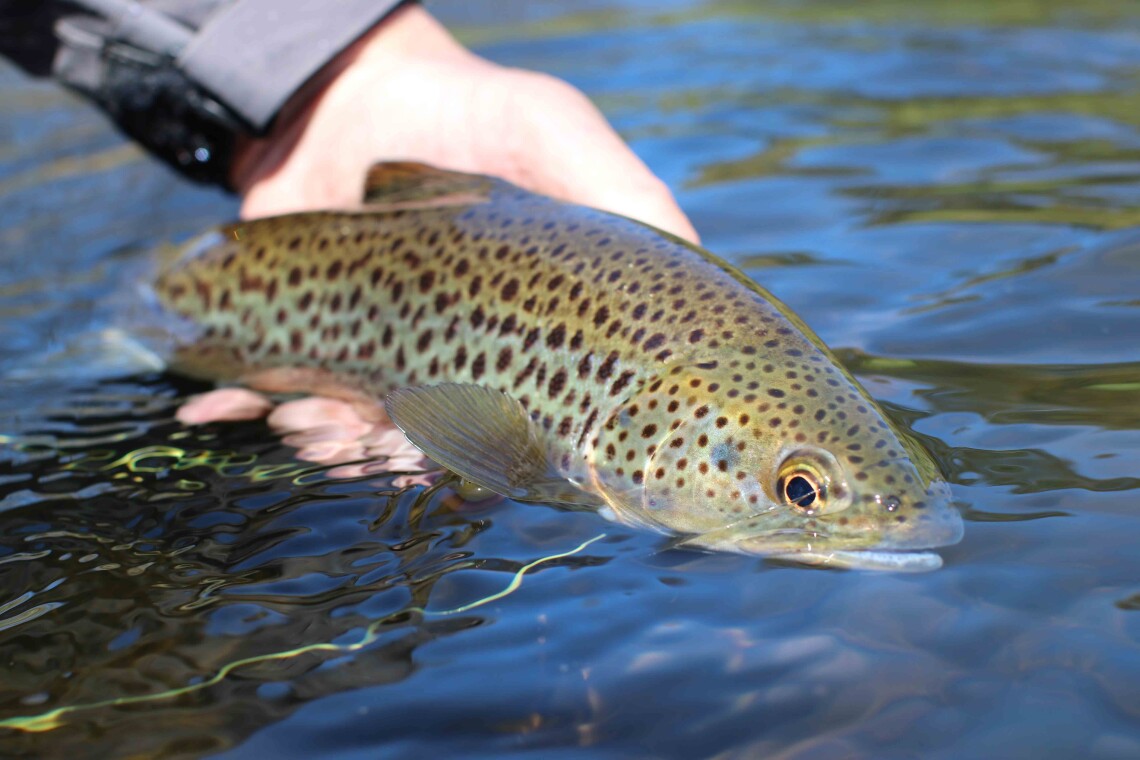 April Usk trout
 Richard Warren of Steyning had a very good day on the little Honddu at Pandy. He took 10 trout from 10 to 18 inches on a Hare’s Ear Nymph. Mark Atherton of Worcester with a friend fished the upper Wye at Ty Newydd and caught 11 trout to 14 inches. Next day they were at the Rectory, where they caught 6 trout, mainly from Gravel Catch during a brief large dark olive hatch. The flies they used were the John Goddard Emerger and various sedges. Dan Cristian Oprea from Redditch also fished at the Rectory and caught 11 trout. Alex Lloyd from Bristol was at Glanusk Ty Mawr and Canal and Rivers Trust where he caught 8 trout on heavy nymphs, warning of difficult wading in high water. Mike Smith of Brecon had criticisms to make about bad access to the Lower Tarrell. Mareks Doniks from Oldbury caught 10 rainbows from the Llwyn On Reservoir, keeping 6 and returning 4. He was using a gold spinner. On 20th April Peter Buckey from Stockbridge had a good day on Glanusk Ty Mawr / Canal and Rivers Trust, taking 17 trout, and 14 more the following day.
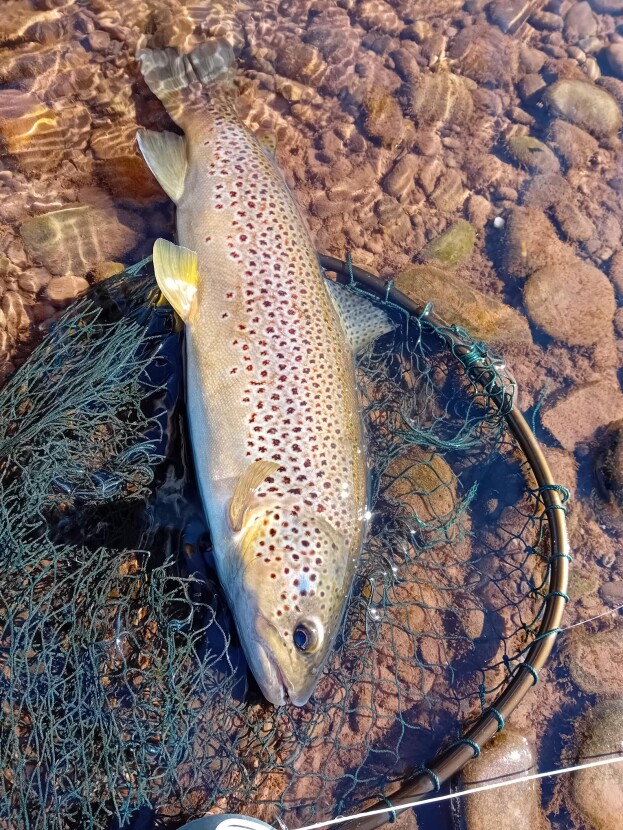 Middle Usk dry fly, 2.5lb
 David Ashworth from Newcastle under Lyme was disappointed in his day on the Hindwell Brook at Knill: “As a personal observation, fishing seems to be getting poorer year on year.” JC from Penarth was at Abercynrig: “Sand martins are back, but no hatch for them to feed on….pricked a number of fish but only landed one.” Guy Currey from Gateshead was upstream at Dinas, where little was rising but he caught 11 trout on euro-nymphs. He had 15 more from the Breconshire Fishery on the 22nd. Kevin Moran from Maidstone was at Abernant on the Wye where he took a brace of trout: “…did I mention it was very cold?” Joe Alexander was out on the Ithon at Llandewi, where olives hatched during the familiar middle of the day window. He took 5 trout to 11 inches on dry flies. John Anthony Brooke from Lincoln enjoyed himself on the beautiful Talybont reservoir, taking 3 trout on a traditional Black Pennell. Peter Buckey from Stockbridge reported no less than 30 trout from Dinas on the 26th and 13 more from Glanusk Ty Mawr / Canal and Rivers Trust the following day. BC from Penisarwaun warned others about numerous ticks in the undergrowth around Llyn Dywarchen in North Wales. JB from Kidderminster had a good day at Upper Tower while trout were rising to large dark olives and March browns. He caught half a dozen trout to a good size on Olive Emergers. Seth Johnson-Marshall had a very good day on his private middle Usk beat, using a dry fly to take 8 trout to 2.5 pounds.
Meanwhile Louis MacDonald-Ames, co-owner of the Rectory beat, took 5 trout on his salmon gear on the 26th April and noted that a shoal of barbel were in position above the bridge. I imagine spawning time must be imminent. Steffan Williams from London was out in the sunshine on the Usk Town Water where he saw good hatches, but no rises. He was able to take 10 trout on streamers, however. A lot of reports during this time were much the same: bright sun and some fly life about, quite warm once the east wind had dropped so good to be about, but trout not rising. The nymph fishers often had the best of it. About this time I heard from friends of disappointing results on the Wiltshire Avon, with fly on the water and even a few true mayfly already seen, but very few fish rising. Keepers on the Avon talk also about the lack of grayling these days, grayling being a truly wild species and “the canary in the cage” when pollution is suspected. Frank Sawyer would have been surprised; in his day, Upper Avon grayling were counted as vermin and very difficult to eradicate!
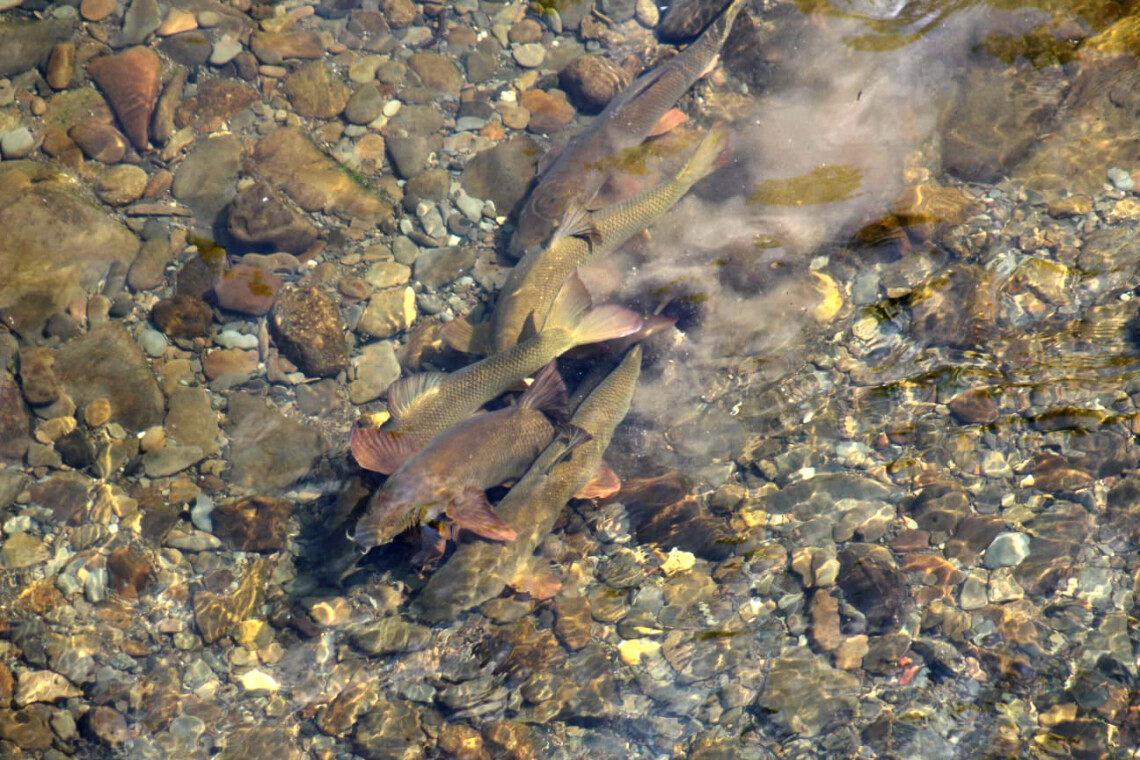 Barbel spawning at the Rectory
 Bideford Brook
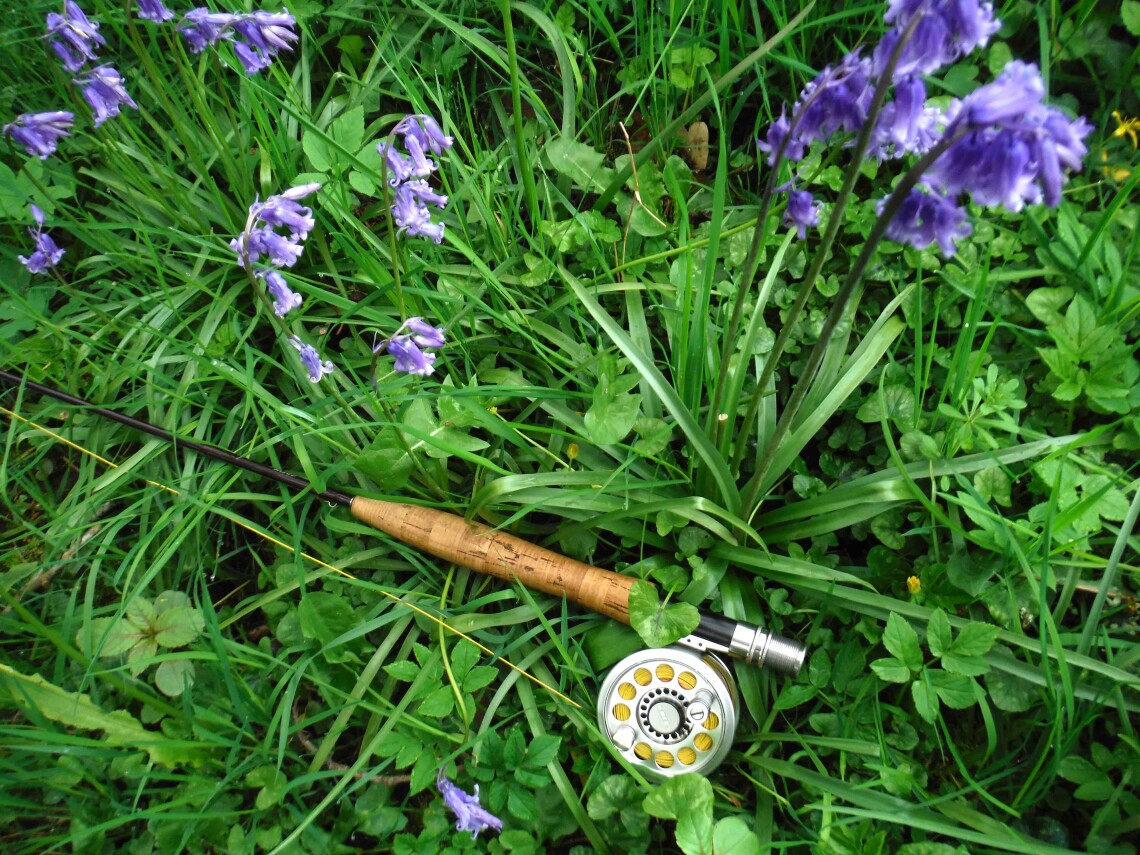
According to the diary 17th April was supposed to be an office day for me, but something persuaded me to take a few hours off to fish the Bideford Brook as well. The day was dull, not overwarm and with a bit of a wind, rain expected, so not exactly the perfect conditions to tempt small stream trout to the surface early in the year. However, the bluebells were out in a purple mist under the trees and that always seems like a signal to me. As soon as I looked over the bridge from the road I saw a ring from a rising fish on the corner upstream. I went up the channel with a 7 foot rod and a double taper 3 weight line, trying to get my eye back in for close range casting with tight loops and roll casting as seemed useful. The dry fly on the point, first time this year, was the accustomed Rusty Klinkhammer in size 16. This was hardly an exact match for the odd tiny olive I saw around, but even on a dark day this is a fly I can pick up in a bad light as it bounces down the runs or trickles under the bushes. I got half a dozen trout between 6 and 11 inches, and missed quite a few more. Despite the floods of winter just past, they all looked to be in fine condition.
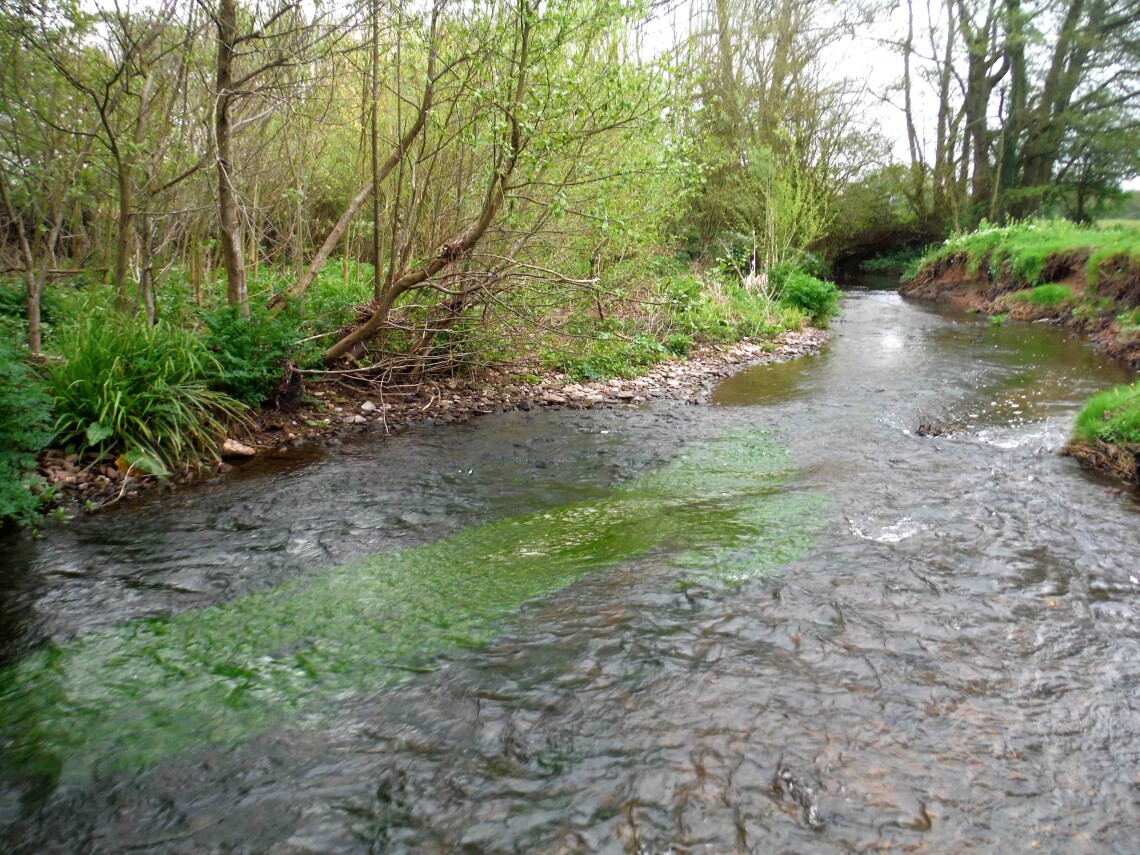 Bideford Brook
 Spring Salmon
On 8th April Gillie Stan Turner used a Flying C to capture a three sea winter springer from the Aramstone beat of the Wye and mentioned that others have been seen moving through. A second springer came from the Golden Mile, where Brian Joseph caught a fish of 21 pounds on a black Flying C. Wyesham reported a 12 pounder caught on a single hook Flying C during the storms of 12th April. Another two sea winter fish of 12 pounds was caught at Wyesham on the 17th, while the Wye continued to run high as it did through most of April. The upper river produced a 17 pounds fish on 19th April, taken on a Flying C by Tomasz Gorczya at Langoed. Alex Davies of Lyme Regis followed that up with a fresh fish of 8 pounds taken with a single hook Flying C at Holme Lacy 3 and Lechmere’s Ley. Bryan Owen was very happy with a 15 pounder caught on Ingestone on 25th April: “…beautiful silver.” He was using a yellow, black and silver Flying C. Simon Torkington had a 15 pounds sea-liced fish taken with a Cascade Tube the same day at Wyesham. At the bottom of the river, Simon MacLucas recorded a 13 pounds fresh-run fish, also on a Cascade Tube, taken in the Joe Sirley Run at Redbrook. Coedithel reported an 8 pounds fish taken on a spinner. I think that makes 12 for the Wye season so far.
Coarse Fishing
Trelough Pool, available via the Fishing Passport, is a Herefordshire lake open for coarse fishing during the spring and Warren from Weobley reported two carp and a bream on 3rd April. Otherwise, coarse anglers will have been overhauling tackle and preparing for the coming season. The Haven, a new Passport beat of the River Teme in the Malvern Hills area, looks as if it will be a very productive fishery when the season opens.
Smolt Trap
At the beginning of April Natural Resources Wales were due to place a salmon smolt trap for monitoring purposes in the neck of the Rectory Pool on the beat of the same name. I can imagine why that might be just the place to put it. This might interfere with angling for a while, but it is due to be removed after a couple of weeks
A Summer On The Test
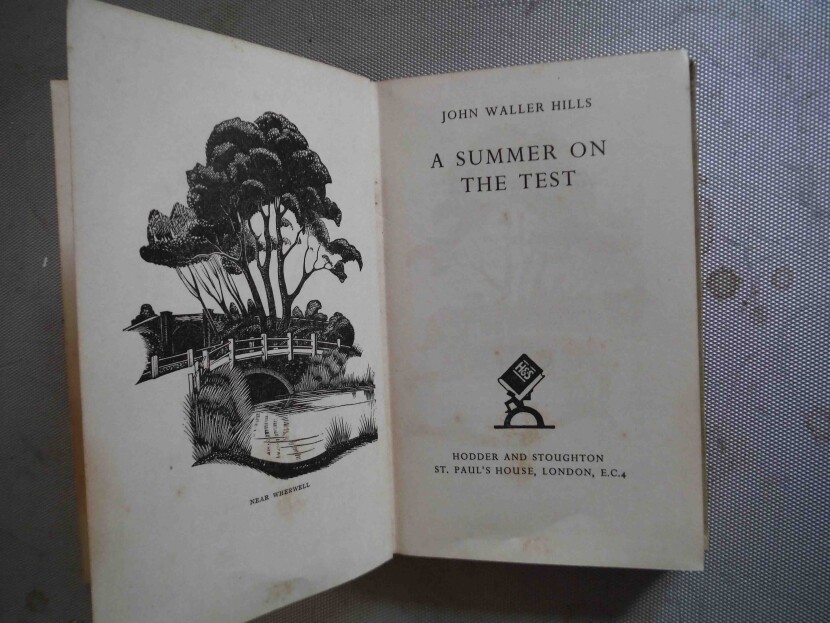 A Summer on the Test
 I first laid eyes on the River Test in the little Hampshire town of Overton, which is not far from the springs at the head of the river. A school friend and I were cycling a rather circuitous route from Surrey to West Gloucestershire and we had stopped for the night at the Overton youth hostel. We were 12 or 13, I think, and I was already mad keen about fishing. I certainly knew about the Test, the most famous river in Hampshire, possibly the most famous river in the world, and here it was! Up here near the springs it was still a modest stream, but it was the real Test and a chalk stream all right. Leaning on my handle bars, I stared wide eyed over the parapet of the bridge at a brace of 2 pounders hovering on the fin in crystal clear water. Imagine being able to fish for creatures like that!
Rather more than sixty years have passed since that day and I still have not fished the Test, or the Itchen for that matter. I never missed an opportunity to look at it and loiter on a bridge, at Stockbridge sometimes, or by the Bourne Rivulet at Hurstbourne Priors. I have eaten a meal beside it on a couple of occasions. Unfortunately the Test has always had a reputation as a river providing fishing for millionaires, a reputation which time has not diminished. I might have afforded a grayling day during the winter when I was back on leave in the UK, I suppose, but a proper summer dry fly day on the Test was well beyond my means. On the other hand, I have had the privilege of some wonderful days on the Wiltshire Avon, so I have some chalk stream experience to look back on and should not be feeling too sorry for myself. Chalk stream fishing, as we all know, is a rather different affair from angling on our rain-fed border streams. I would go so far as to suggest it is as different from ordinary trout fishing elsewhere around the UK as trout fishing differs from salmon fishing. In the use of the dry fly, pure and simple, there are comparisons to be drawn but the chalk stream will always have the advantage of those constant springs and clear filtered water.
Chalk stream fishing also has its own literature of course, both classic and modern. Some of this is technical, but much more can be better described as pure poetry. Happiness is being alone on a Hampshire chalk stream in May with hatching fly and rising fish! Of the classic books, Halford is quite a difficult read by modern standards and many of his theories now seem unconvincing to put it mildly. Skues was a better writer and a better angler too, I suspect. Of everything written about the chalk streams and particularly about the Test, Harry Plunket Greene’s charming Where the Bright Waters Meet takes the prize as far as I am concerned.
A close second and cited as a favourite by many readers is A Summer on the Test by John Waller Hills. This was first published by Hodder and Stoughton in 1924 (but went into two more editions) and the season described in the title was that of 1924 May to September (so clearly Waller Hills and his publishers were prompt in putting it before the public). At any rate, more than a century has passed and this one has stood the test of time. It is certainly worth looking at again.
The theme of “privilege” entailed in the history of Test fishing certainly applies to Waller Hills. He was born in 1867 at High Head Castle in Cumbria, and educated at Eton and Balliol. His military career in the trenches of the Great War was distinguished, beginning as a captain in the Durham Light Infantry, then major and finally acting lieutenant colonel, wounded in 1916 and mentioned in despatches. He spent much of his civilian life as a Liberal Unionist and then Conservative MP, later as a privy counsellor and even a director of Imperial Airways. He was awarded a baronetcy just before his death in 1938.
Waller Hills seems to have based his fishing on Mottisfont, and signed off the introduction to the first edition of his book at Mottisfont on 13th September 1924. One might thus presume he was connected to the family at Mottisfont Abbey. He signed off the second edition from London in 1930. He was certainly well connected via his wife, including to her half-sister Virginia Woolf, who once described him as being like “an excellent highly polished well-seasoned brown boot.” An unkind remark that, which I put down to Virginia Woolf showing off rather than any accurate insight. So much for the Bloomsbury Group. His own writing had elegance and charm, such that any angler at least would have enjoyed talking and fishing with him. John Waller Hills also had connections with the Houghton Club and Stockbridge fishing. This part of the river and the way it was managed by the Lunn family is much discussed in this book. He also wrote: River Keeper: The Life of William James Lunn, published in 1934.
Waller Hills was particularly interested in fly-fishing history and appropriately the first chapter of his book is devoted the history of fishing on the Test. Remarkably, more than surprising in fact, is that very little is known about angling sport on this particular river before the early 19th century. We know about London’s Lea because of Walton and we know about the Derbyshire limestone rivers because of Cotton, their respective accounts being written during the Protectorate and the reign of Charles II, but the known history of the Test really begins only with Colonel Peter Colonel Hawker at Longparish and the Reverend Richard Durnford at Chilbolton at the start of the 19th century. These keen sportsmen kept diaries beginning before the Battle of Waterloo and going on for decades. The chronicles of the Houghton Club, still carefully preserved, begin in 1822. These research sources were barely a century before Waller Hills’ own time in writing about the river. For his early history he is confined to the records of the great abbeys in the Test valley, which doubtless had attached fisheries although little is known about them. We do know that the method of “cross-lining” which is normally associated with poaching was used in Hampshire, and probably on the Test until the end of the 18th century. We can assume that fly fishing was then being experimented with on the Test, as it was everywhere else. Hills was much exercised by wondering if the early Test anglers were fishing with blow line silk or the heavy oiled line, upstream or down, wet or dry:
“The floating fly may have been used in the thirties of last century: we should be safe in dating it in the early forties: 1845 would be within the mark. From 1851 there is a continuous history. Francis Francis described it in the Field in 1857, and in 1867, in his Book on Angling, which went through numerous editions, he spread the creed far and wide. But it was not till Halford wrote Floating Flies in 1884 that it received its real impetus…”
And later:
“In 1857 Francis Francis had used it [the floating fly] for long on the Itchen, and yet in 1858 Kingsley knew nothing of it on the Test, and he was an equally good fisherman…Halford came to the river [Test] in 1877. A colleague of his says that in 1875 only half or less of their club fished it, and that it was not until 1882 that the large sunk fly, fished downstream, disappeared.”
Waller Hills himself remembered fishing the dry fly for the first time in 1890 at Whitchurch, where “…nobody dreamed of using anything but a dry fly, except occasionally when fishing still water on a windy day.” Perhaps we should be thankful that the rest of the book is about dry fly fishing, with some very occasional references to the nymph. We who fish the Welsh borderlands, used to our early season start on 3rd March, are inclined to forget that the chalk streams traditionally start in April and in some cases May. This makes for a short season if you don’t fish for grayling and historically most did not. Waller Hills then based his book on his own season of 1924 just passing, but in covering his subject he makes a number of excursions to other years and other rivers too, as befits an angler approaching middle age. It’s a meandering sort of book at times, much like the course of the Test itself in places. His friend Robert Gibbings provided wood cut illustrations. After nearly four years in the trenches, a full season of fishing in the Test valley with the added plan of producing a book must have been a soothing experience. Occasionally he feels the need to refer to other years on other streams:
“Hampshire was backward in April 1924. Not a kingcup was out, not a sign of white appeared on the dark twigs of the blackthorn, not a glint of green on the willows…if you were back from France in 1918, and keep a diary, turn up the month of April, and you will see that spring was a full month earlier than the spring of 1924. It was a very good April. I got fish from the beginning…”
You can’t blame a chap for enjoying his leave and Waller Hills’ own record of war service at command ranks should have been enough to avoid embarrassment. He had been fishing and loving the Test since 1890 and any time spent on a chalk stream must have been a wonderful contrast to the horror of the trenches. And again: “On the Kennet, when I stole a few days from other duties during the war, and fished for eight days between 11th and 22nd June 1915, then again in settled summer weather, there were sparse morning hatches…” This sort of wartime break would not have been available to those serving in the Middle East of course, but our eloquent guide Waller Hills makes a trip from wartime France to Hampshire seem like weekend commuting. The distance was not so great after all; an old man once told me that at St Martha’s Chapel on the Surrey Downs high above the Tillingbourne you could sometimes just hear the big guns like muffled thunder when the wind was in the south-east and blowing from the front.
John Waller Hills believed the Test to be the greatest trout river in the world and he fished it for more than 40 years. I am not sure that he was a tremendously innovative angler although his book is full of useful hints and wrinkles. He was knowledgeable enough to be dubious about some of Halford’s claims and to be impressed by GEM Skues, but also wise enough not to work his way too far into that quarrel. His book is probably mostly loved for its fine writing and descriptions of times past. Take this description of a mayfly hatch, actually on the Kennet:
“The hatch of mayfly at Hungerford in the old days is difficult to write of without seeming to exaggerate. As you went down from London in the train you saw the river and carriers covered with fly as with a mist: the engine was plastered with their bodies: your carriage got full of them, blown in through the window: as you drove from the station your horse’s hoofs stamped them into the road. I remember particularly 7th June 1901. It was a warm cloudy day with a violent north-east wind. No fly appeared until six in the evening, but between then and nine they came up in incredible numbers. They floated down in flocks, almost touching: as you looked into the air the droves of them carried along by the wind gave you the impression of being out in a very heavy snowstorm: your clothes and your hat were covered: they perched on your rod: as you walked the bank you had the feeling that you were pushing your way: the greedy trout were gorged, and the greedier swifts retired replete. Nothing made any impression on their numbers. They were there in hundreds of thousands, and still they kept hatching out and still the surface got thicker and thicker with them.
You do not do much in these great falls…”
I think he was right in his last remark. I would rather see a steady trickle hatch than a blitz if hoping to have an artificial pattern noticed. Waller Hills was anything but a “one fly angler” although interestingly his Lakeland contemporary and beck fisher Richard Clapham was exactly that. The limpid chalk streams of the South were and indeed still are something quite apart from the stony rivers and becks of the North and West. I wonder how Waller Hills would have got on with the Usk? In fact he carried a lot of patterns, although not as many as Halford recommended:
“The next, rising a few yards above him, had a good, steady, concentrated look at my olive, and then deliberately turned way. When shy trout do this, I am convinced that you should change your fly at once – change it either for one of a different pattern or for a smaller one of the same or for one which is both different and smaller. If you do not, if you keep on passing over the trout’s nose an imitation which he has already examined and rejected, he may end by taking it. He may. But what usually happens is that at the next cast he gives it half a look and at subsequent ones disregards it altogether. And there is the danger that the fact of seeing a suspected insect continually floating over him may make him discover he is being fished for. It often does. And remember, too, that the more casts you make the more likely you are to bungle one. So off with the fly at once. Do not even make one more throw. It is a bore to have to change a killing fly, but do not be lazy.
I put on a ginger quill, also ooo, but actually smaller than the one I had fished with. He ate it as though he had been waiting for it since daybreak…”
It is interesting to think that the writer and New Zealand trout fisher Bob Wyatt, author of What Trout Want, would completely disagree with that idea. He would have the angler work on his presentation until the trout took.
I already remarked that John Waller Hills’ book meanders about a bit, like his river. There is a chapter on the tributaries. He remarks much on the weather, although some of his ideas on the subject do not seem to chime with conventional ones:
“A south-west wind, low, heavy clouds and warm air usually mean a bad day…the best sky is one that is cloudy and clear together, blue mixed with silver; and the next best, one that is grey with blue patches. Cloudless blue comes next, and then come different shades of grey with no blue, and last of all, one that is the same grey all over, whether the colour be heavy and dark, or light and steely. That is the very worst.”
There is a chapter on the Houghton Club at Stockbridge in which, like Harry Plunket Greene, he expresses his concern about the level of artificial stocking which had become normal on chalk streams, another chapter on the blue winged olive and evening fishing, and one entitled Good Days and Bad Daysduring which he introduces, modestly enough but quite neatly, the capture of his best trout on the dry fly – 4 pounds and 8 ounces!
Axolotl
A little girl has found an axolotl, a sort of Mexican salamander, hiding under a bridge over the Ogmore in South Wales. I suppose it was here on holiday? We do get these strange visits now and then. One year there was a terrapin to be seen swimming around in the Usk Town Water.
Fishing Outlook
Let us be optimistic about the salmon fishing for 2026 and embrace a hope that numbers will build up as we go on through May. Let us also be optimistic about the trout fishing and the true mayfly. Mayfly hatches vary from year to year, but the last two weeks of May and the early part of June can produce sport of a very high order if you are ready and waiting, fishing in the right place.
The important point to remember is that mayfly nymphs need silt to live in, so the purely rocky areas of our freestone rivers do not produce very many of them. Some of the tributaries, however, have deep holes in which the silt collects in quantity. Noted mayfly streams for that reason are most of the Monnow system, the Llynfi and Llynfi Dulas, the Lugg, Arrow and Hindwell Brook, parts of the Edw, the Teme and even some of the little Forest of Dean streams.
We have suffered from cold winds and big temperature swings so far this spring, but if you have any choice in the matter, warm cloudy weather, humid and even a little drizzle, is usually better for the mayfly than a clear bright day. I start the morning with some kind of olive imitation, assuming occasional hatches of olive uprights or similar might tempt the odd fish to the surface, but I am ready to switch to a large fly and a slightly thicker tippet as soon as mayfly duns start to hatch, usually from late morning on. You won’t have to wait long for the fish to react and once they become used to the big white flies they begin to lose most of their caution. You have a huge choice of artificial mayflies to choose from, but personally I don’t think the pattern matters that much, provided you have scaled up to hook size 10 or 12. For myself I generally use a Monnow Gosling or alternatively the Grey Wulff or Mike Weaver’s Hackle Mayfly usually work.
Tight lines!
Oliver Burch http://wyevalleyflyfishing.com
For the full Oliver Burch Report visit https://wyefishing.com/monthly-fishing-report