Uncensored
In the interests of free speech, a subject which I like to claim is dear to me (to a fault some people would say), I am going to quote the whole of Mr Christopher Beckwith of Caerphilly’s report on his 22nd June fishing trip to Llwyn On:
“Fished all day with worm as we have done many times in the past over many years. Had no bites or “knocks” and caught no fish. Saw no fish “rising.” I consider this a very sad state of affairs. Paying £24.50 to catch no fish! I am convinced that the lake is not being stocked with fish. I am sure that you will edit this report or not show it, which is very disappointing.”
I hope I haven’t left anything out Mr Beckwith? I wouldn’t want to make it worse by disappointing you further now. However, spare some sympathy for me, because I am a sometime salmon angler and on occasions I have paid a lot more than £24.50 to catch no fish. Why do we do it, eh?
Heat wave begins – three hot days in June
The start of this reporting period was marked by red alerts and three very hot days: 23rd, 24th and 25th of June, after which, UK records having been broken up to 37 degrees, the air temperatures very gradually dropped away towards normal summer levels for a time. Later, as we shall see, the heat came back with a vengeance.
Now my wife comes from a city notorious as the hottest town in former Yugoslavia, while I worked for years camped out in desert countries of the Middle East, so that you would think we might be well enough used to high temperatures. (Don’t talk to me about air conditioning, by the way. For air conditioning you need to have electricity). The fact is that you can become acclimatised to living in hot places without modern services, but only over time, and you can also become de-acclimatised by a few years of temperate weather and civilised living.
I think that this time round we were as uncomfortable as everybody else during the hot days and nights at the end of June and on into July. Even our old cat didn’t like it and he normally spends his days and nights in the warmest place he can find. Early risers as we are anyway, during the heat we made do with some morning walks by our Forest Pool and in the relative coolness of tall pine woods. That was followed by a cup of coffee when the village post office / cafe opened and before the day’s humid warmth began to build.
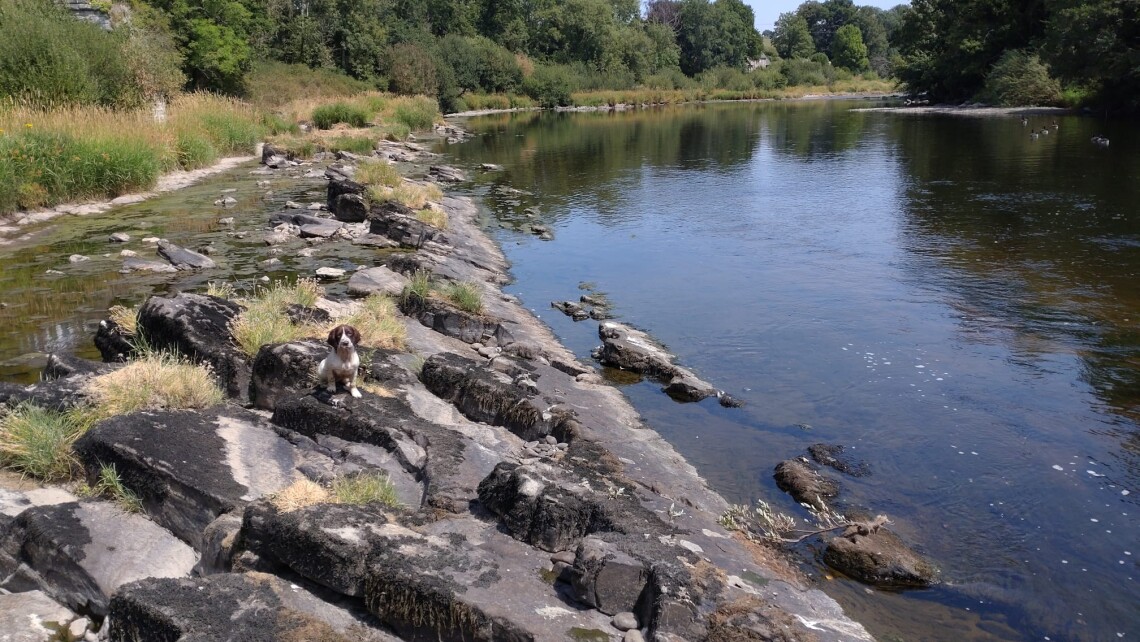 Upper Wye during the heatwave
 Southern Europeans traditionally know how to deal with the heat even if they moan about it while they do so. The people of Spain used to complain that their climate was: “…three months of winter and nine months of hell,” which rhymes rather nicely in Spanish. However, today it’s more commonly the British who can be relied upon to dramatize a bit of warm weather and 2026 has been no exception. At first yellow and then red extreme heat warnings were issued. The Government advised us not to take journeys by road or rail on the basis that something might go wrong, leaving us stuck. The BBC devoted a whole evening of news to a “heat-wave special,” which seemed to be an opportunity to invite on air the advocacy people from various climate change quangos to lecture us about the need to divest ourselves of carbon fuels and reach net zero as soon as possible. COBRA met and deliberated. A thousand schools decided to close. And I presume hundreds of thousands of parents wondered how they were going to get to work now that their children, hot and bored, were kicking their heels at home. As time went on without sign of rain, however, there were plenty of reasons to become concerned.
With all this going on, the condition of our local rivers and the risk to the fish swimming in them seemed a relatively minor matter at first. However, the EA’s sondes beneath the surface of the Wye told the story of steadily rising temperatures, running up through 20 and 25 degrees eventually to reach over 27 degrees as we came to the end of the third and fourth hot days. For local anglers this did not seem so much of a burden to begin with: “Not to worry, I will go fishing next week instead, or maybe wait for a bit of rain.” You might call that the wise man’s approach. In most genuine cases the WUF is able to agree a “temp-off” delay to booked fishing, just as a “wash-off” can compensate for beats unfishable due to flood. “Temp-offs” due to hot rivers have unfortunately become a more familiar factor during the last three years. It isn’t so easy when visitors from abroad and expensive hotel bookings are involved. It is usually the unfortunate guide who has to break news to clients that the planned fishing programme cannot go ahead.
Salmon Fishing
When the first heat wave arrived at the end of June, we had 42 Wye salmon recorded for the season, the bulk of them from below Monmouth. At this point most Wye game fishing was at a standstill due to the high water temperatures. News of salmon catches from the Towy came in at this time with fish of 9 pounds reported from both Golden Grove and Abercothi before arrival of the hot weather.
Night time fly fishers also had some bright sewin in the 2-3 pounds class. However, while the Towy seemed to have attracted some migratory fish, not much was reported from the neighbouring Loughor or the Teifi, South Wales rivers which according to expectation should hold a stock of silver tourists by this time of year. We also had a late report from the Nyth on the Upper Wye, where Matthew Oliver had caught a salmon on 5th June. Another late report from the Upper Wye came in from Upper Caerwnon (the caravan site just above Builth) where Bill Samuel had taken a hen of 8 pounds on 17th June. These were the only interruptions during a long spell of “nothing to report.” By July 31st we were still holding a total figure for the Wye rod-caught salmon catch of just 44 fish, with the heat wave predicted to rebuild again, a few extra degrees each day, no real sign of rain in the offing and the river warm and low. To some surprise and considerable relief, and despite that recorded maximum water temperature of 27.7 degrees, there was so far no widespread die-off off salmon reported. It was even posited that the Wye may be developing a race of salmon more heat tolerant than others.
Trout Fishing
During the first heat wave days, most anglers tested the water temperature, found it to be 20 degrees or more, and so declined to fish. The high temperature was less intense in the North. On 22nd June Martin Harris from Stapleton caught 21 trout on the Raby Estate water of the upper Tees. RM from Hexham accounted for 15 more trout on the Strathmore Estate of the same river and the Maize Beck. WO from Ludlow drove up to Llyn Bugeilyn on the 24th and found the high altitude conditions on the moors more or less normal. Trout were active and he took 5 on dry flies: “Always a great trip to Llyn Bugeilyn.” On 25th June, final day of the heat-wave’s intensive phase, GR from Abercynon caught 4 trout from Llwyn On. The reservoir went on to fish reasonably well through the rest of the month when the temperature allowed. On the 26th Mark Nunns from Chesterfield with a friend took the upper Wye temperature at Craig Llyn and found a reasonable 17.3 degrees. The weather was still hot but they went on to catch 10 trout and 16 grayling to 2 pounds. A couple of days later they fished at Dolgau for 5 trout and 10 grayling. Damian Morris from Wetheringsett tried the little Edw under the trees at Aberedw and while trout were reluctant to rise he took 13 on nymphs. BG from Newcastle on Tyne made a first trip to the Darlington Brown Trout Association’s North Bank fishery on the Tees, but found a farmer objected to his parking on the designated spot – hopefully somebody from the club will be making a call to resolve any misunderstanding there. Joe Alexander was out on the Clywedog on Sunday 28th June, measuring the water temperature at 14.5 degrees and taking 9 trout. He fished the Llandewi beat of the Ithon on the 29th and had 8 more trout.
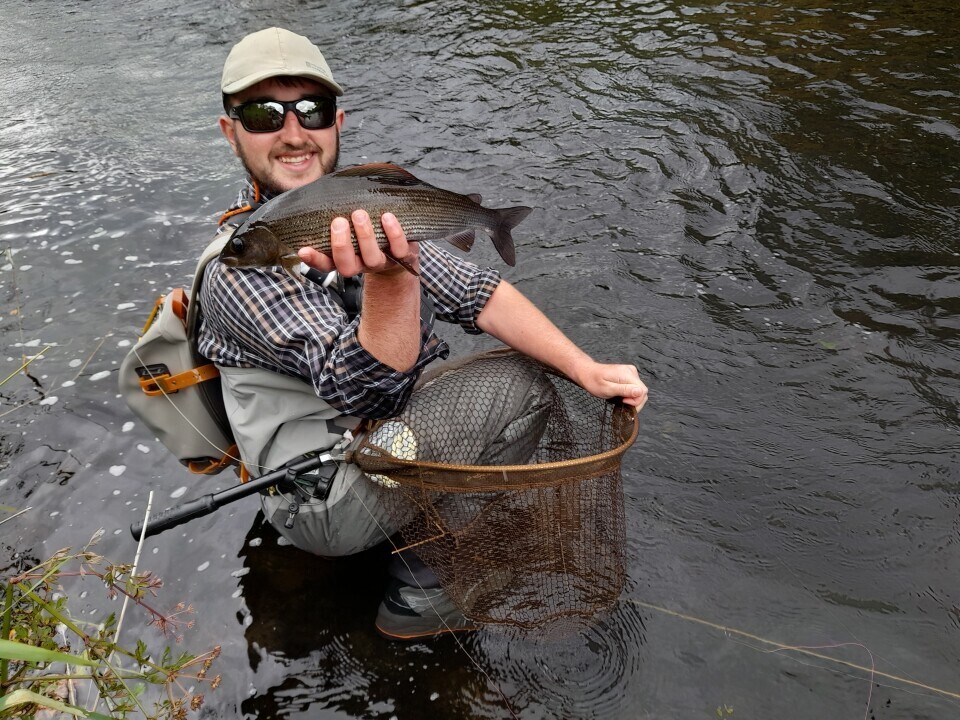 Craig Llyn - Andrew Kelton
 By Tuesday 30th June even the main rivers returned to something like normal summer temperatures for a while although water levels had become quite low. Trout were now quite lively in fast water of the Usk and took both spiders and dry flies. Andrew Kelton of Hereford had a good evening at Cefn Rhosan Fawr with a late hatch of what he guessed were blue winged olives. He caught 4 trout to 16 inches on a CDC Dun and Elk Hair Caddis. Russell Dadson from Lower Bodington had 8 trout by fishing morning and evening at Ty Newydd, having previously been kept off the river by heat – I imagine he was staying in the associated accommodation? Richard De Wit of Medemblik in the Netherlands was full of praise for the Passport scheme and the Aberedw beat, where he caught 6 trout with a 7 foot rod.
Sam Newcombe of Bognor Regis fished the Lower Tarrell above Brecon on 3rd July and blanked, finding the little stream full of small children and dogs! He did much better the following day under trees at Aberedw, catching 9 of the little Edw fish: “…this beat was heaving with trout. I loved every minute of it. I ended up throwing the whole fly box at them to see what they would take.” “Almost anything” seemed to be the answer to that question. He followed this up with a slower day on the Middle Llynfi Dulas, by which time increasing temperatures were again affecting water exposed to the sun. Barry Hoban from Oxford headed up to investigate the peat-stained depths of Llyn Bugeilyn and accounted for 9 trout. Regular Dan Cristian Oprea fished the Upper Wye at the Rectory and caught 4 trout and 4 grayling on Perdigon nymphs. Joe Alexander fished the Edw at Hergest and described the stream as very thin and difficult to fish. He caught half a dozen from a few deeper pools. Dale Johnston from Norwich fished the Monnow at Skenfrith on 6th July and caught 3 trout and a grayling. In the North, Peter Charlton from Beaconsfield fished the Tees at Eggleston Hall, catching 4 trout and 2 grayling.
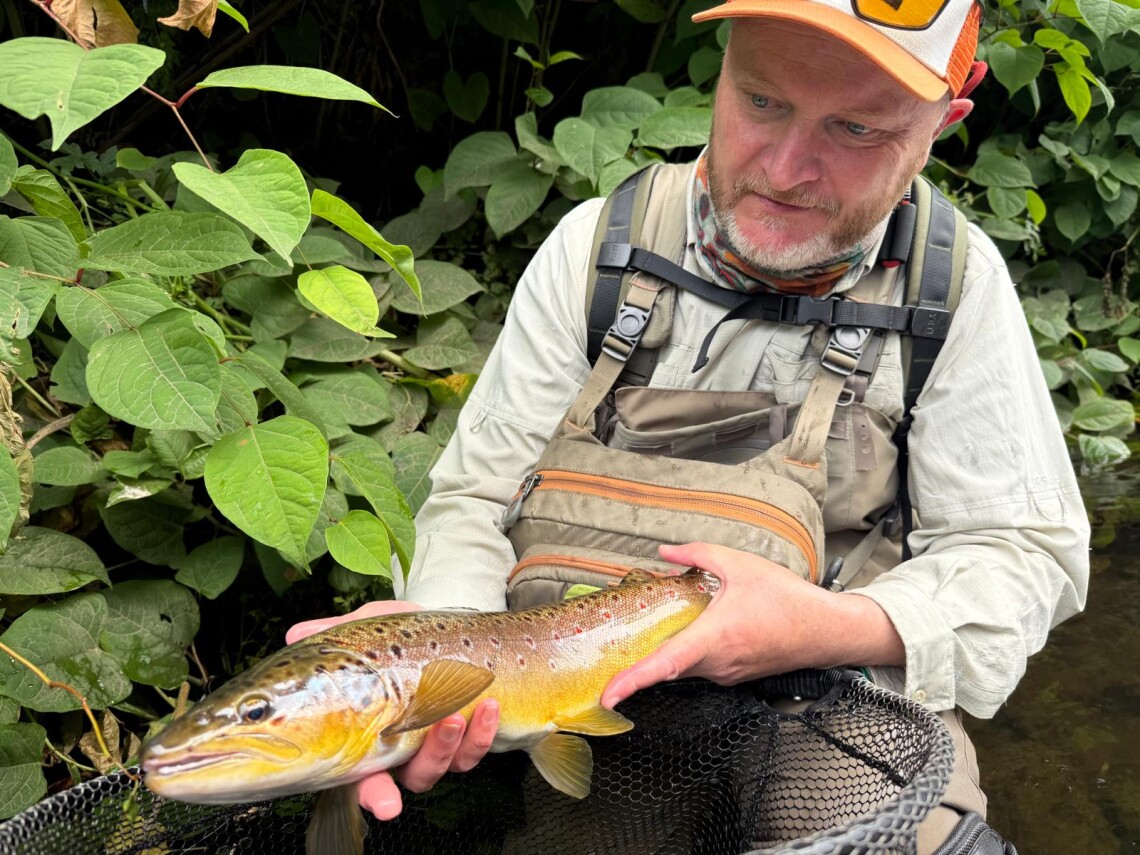 Lyn Davies with a Loughor trout
 I had a pre-arranged morning session with beginners at Big Well, which is spring fed, and I was pleasantly surprised to record the water temperature at 15 degrees in various parts of the fishery although flow from the spring had almost ceased. Weed has been left in to provide cover. After practising casting on grass we went on to the pools and pupils caught a couple of rainbows with a Damsel Nymph and a Killer Bug, although by midday it was becoming a torture to stand out in the sun.
On 11th July with the weather now hotter ever, KL from Bristol had a surprisingly good time on the Forest of Dean’s Cannop Brook. There were barbecues smoking on the banks and people stirring up mud while swimming in the pools, but he caught 24 trout and a roach. The water temperature on this shaded stream was 18 degrees and he was using a Klinkhammer dry fly. Lalit Man Gurung from Bulford in Wiltshire didn’t catch at Talybont, but he was full of praise for the beautiful scenery of the lake and the Four Waterfalls trail earlier: “The peace, tranquillity and natural beauty of Wales made for a perfect day.” I have an idea that Lalit might be serving with family members of mine at Bulford and I am truly glad that he and his wife had such a nice day. Luke Turner of Swansea had a very good time on the Usk reservoir, releasing 11 rainbows. Sol Sanchez of Builth Wells was, I suppose, trout fishing at the Rectory on the evening of 13th July. He did indeed catch 4 trout but he also found a shoal of barbel lying on the flats above the bridge and persuaded two of them to take a Goldbead Hare’s Ear nymph. Both of the big fish went back strongly after a hard fight and release in the net. JL from Merthyr Tydfil caught 4 trout at Llwyn On, although many other anglers reported blanks during the hot weather. Nick Reeves from Solihull blanked while fishing an evening ticket at Cwmwysg Ganol but reported much improved access measures by the farmer. He fished the Arrow at Titley the following evening, without seeing much in the way of trout but plenty of swifts and swallows on this charming beat. Richard Sheen from Twickenham had “excellent evening fishing” at Buckland and reported 8 trout. There was some good fishing at Craig Llyn: a Gloucestershire angler reported an afternoon catching 4 trout to 12 inches and 5 grayling to 15 inches, while Dan Cristian Oprea of Redditch caught 8 trout and 15 grayling. Two Hereford anglers fishing Craig Llyn on the 26th shared a truly remarkable catch of 10 trout and 58 grayling, all taken on nymphs. Andrew Kelton fished Craig Llyn on the same day and recorded 11 grayling to 17 inches and a trout of 13 inches, using dry fly as well as heavy nymphs. He recorded the water temperature at 18 degrees and pointed out that Craig Llyn is rather bucking the trend at the moment. This very attractive beat has a good gradient, deep salmon dubs, fast runs, pocket water, gradually sloping gravel flats – something for every method in fact.
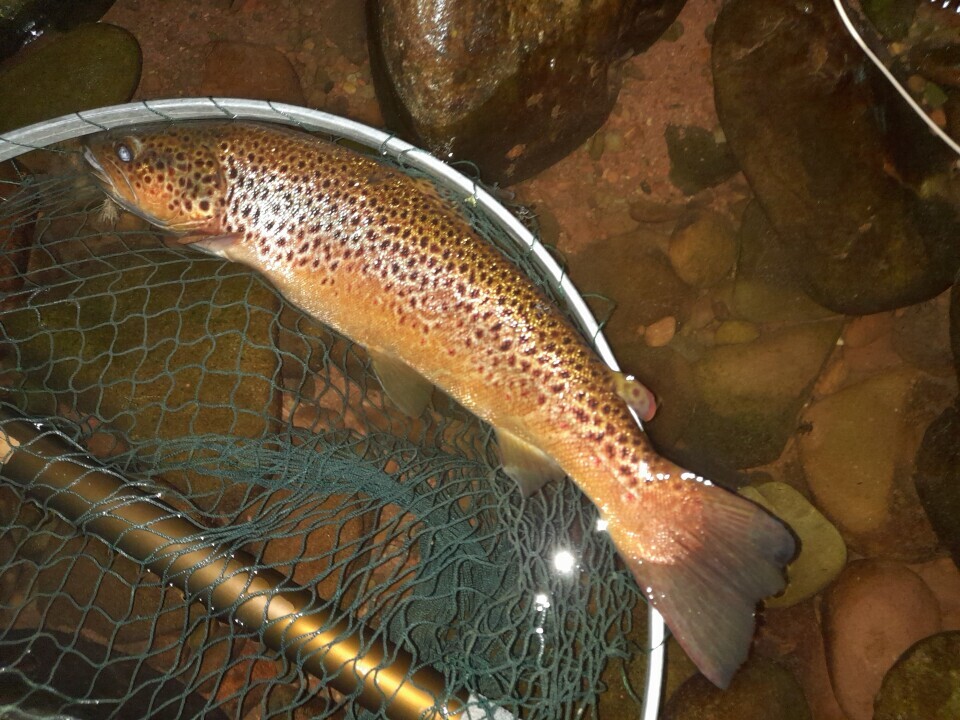 Cefn Rhosan Fawr - Andrew Kelton
 The 26th was a Sunday, and also a slightly cooler day than we had been used to of late. We were certainly aware that it was already raining in the north. A Ludlow angler took a trip up the Aberystwyth Association’s Llyn Lygad Rheidol and reported 8 trout caught by short-lining along the bank. He was adamant that you do need a FWD to access this remote mountain lake or else be prepared for a walk. Mark Harris made his regular trip for an evening session at the Rectory on the upper Wye, and found, of all things, a rubber duck race taking place at the bridge. I will let Seth explain that one! Mark went to the lower end of the beat and caught 4 small trout by nightfall. Meanwhile two Worcester anglers found heather flies and later small flying ants blowing onto the surface at Llyn Bugeilyn and fish rising everywhere. Small, dark dry flies were successful; they lost count of the catch but estimated over 30 trout. A Stourbridge angler tried Llyn Bugeilyn and found trout taking heather flies and ants. He was able to catch 21 trout and commented with relief that his elderly Ford Mondeo could manage the access track – recently improved now, I believe. Up at Barnard Castle on the Tees two Market Rasen anglers reported 4 trout and 9 grayling.
Coarse Fishing
The barbel and chub fishers were less restrained by the weather and fish of the cyprinid type are usually prepared to feed in warmer water than salmonids. My garden pond goldfish seemed quite keen to feed at 27 degrees water temperature during the heat and what looked like late spawning continued with enthusiasm. Even so, while water was warm the Wye chub were more in evidence than the barbel, and we didn’t see many of the very big barbel which were so forward at the end of last season. On 22nd June Andrew Todd from Grimsby with a friend accounted for 1 barbel and 33 chub from Middle Ballingham and Fownhope No 8. David Ashworth from Monmouth found the barbel were still in the fast water at Home Fishery and took one of them along with 9 chub on spam. Chris Hinton with two companions from Bridport reported 5 barbel to 7 pounds and 29 chub to 4 pounds from Middle Hill Court. A number of anglers decided not to fish during the heat-wave, but on 29th June a party of 4 anglers led by Ben Andrews of Epsom also visited Middle Hill Court. They recorded the water at 21.3 degrees and caught 5 barbel and 49 chub by concentrating on the faster, more oxygenated water. JP from Birmingham and a friend were on Lower Symonds Yat, another beat with plenty of fast water, and caught 13 chub to 4 pounds on the float. SH from Tonbridge fished for the evening at Lower Canon Bridge and caught a barbel and 6 chub on feeder and boilies. AM from Bristol roamed around the swims of the Home Fishery and caught 12 chub to 4 pounds. Stephen Keay of Ross was also on the Home Fishery, but in his case was visited by a huge bull wishing to drink from his swim. I find that kind of encounter very unnerving.
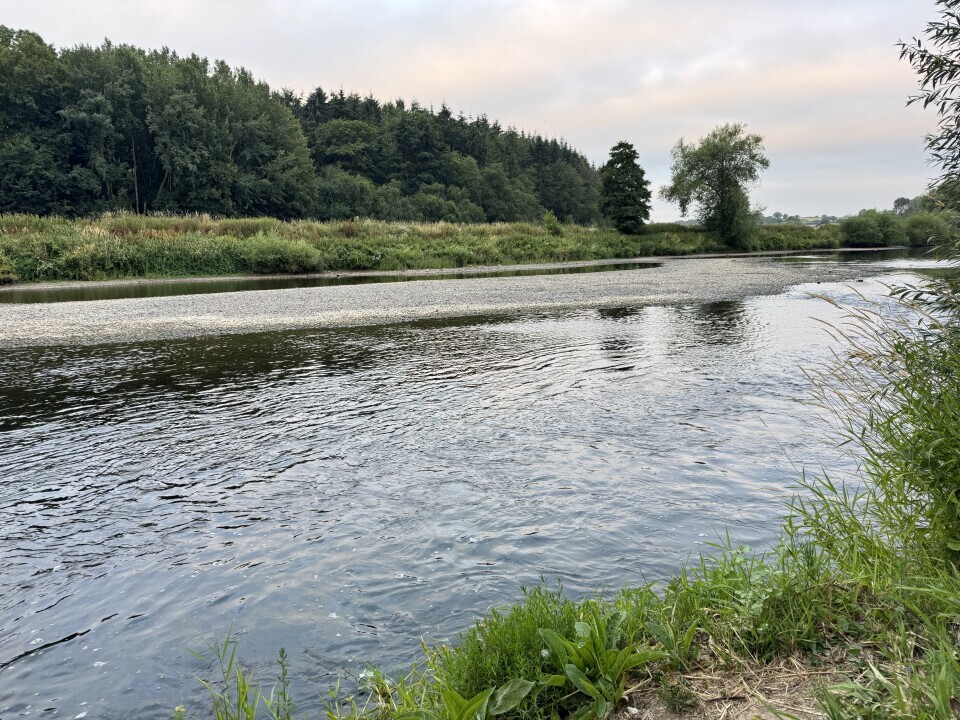 How Caple Court - Alan Trevett
 Tom Harbinson of Woodbridge reported “a wonderful day’s fishing” at Wyebank which is a kind of nursery for young barbel in a fast shallow run beside which the old Severn trows were once pulled into harbour while waiting to be hauled upstream. He caught 25 barbel up to 6 pounds along with 53 chub. This lovely bit of water gives a view downstream to a rather Italianate looking church and it used to be known for occasionally holding transient grilse also. See my photograph taken this spring.
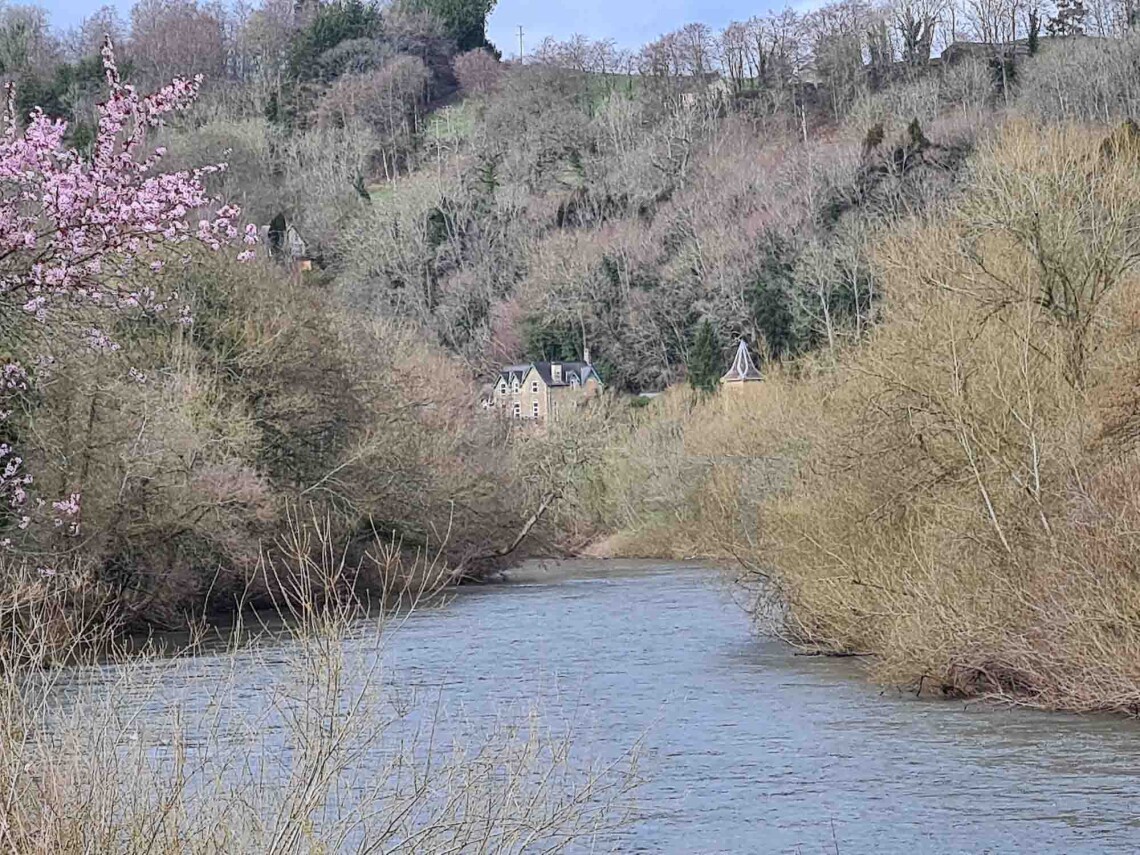 Wyebank in early spring
 Christopher Arnold from Taunton with two friends accounted for another barbel and 50 chub at Middle Hill Court. Alan Miller of Rugby caught 13 chub on float and leger at Fownhope 5, but found the fishery much neglected with overgrown brambles causing access problems. Stuart Dyson with a friend from Oldham reported 10 barbel, 7 chub and 2 big eels all taken with meat at Lower Carrots and Luggsmouth. Incidentally, several anglers who caught eels this month were surprised at how they were prepared to take during the heat of the day and in bright sun-shine. From what I remember of juvenile eel-fishing expeditions, midday in the sun is exactly when they are likely to take. Now, of course, accidental eels must be returned unharmed as a protected species.
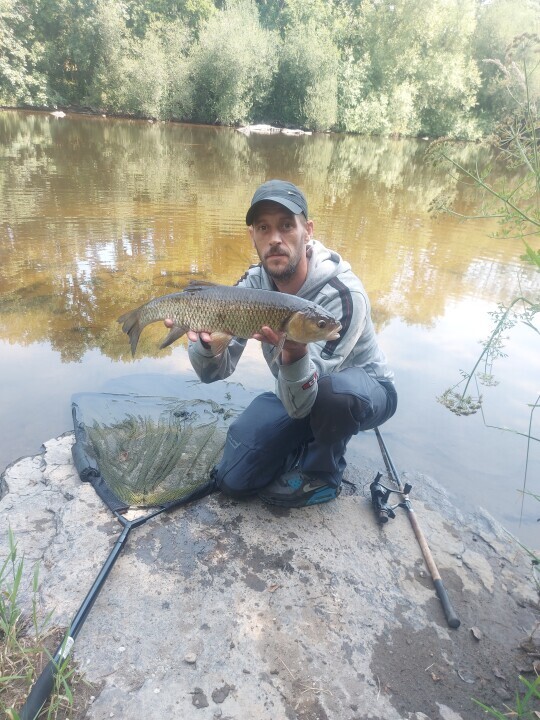 Boughrood Bridge - CR from Pontypridd
 Kevin Willis from Birmingham had 12 chub at the Foy Fishery. Martin Day of Slough accidentally left a net and a pole at Thomas Wood on 3rd July and will gladly pay the postage if the finder contacts him via the WUF. SM of Bristol had 3 barbel and 50 chub at Holme Lacy and Lechmere’s Ley with a pellet feeder, while Ian Powell of Torquay also had 50 chub from the same beat. Martin Day of Slough caught 7 chub on rolling meat at Middle Hill Court. Mick Newey of Stratford upon Avon with a friend reported 30 chub from Middle Ballingham and Fownhope No 8. SH of Tonbridge fishing at How Caple Court reported 5 barbel to 8 pounds and 8 chub to 4 pounds while Richard Park from Warlingham had 25 chub at the Creels. Tony Cline from Hull caught 3 barbel and 10 chub at How Caple Court. On 6th July Dan Connah from Norwich measured the water temperature in Middle Hill Court at 23.2 degrees and caught 3 barbel and 10 chub. Joe Seck from Lichfield with a friend was at Middle Ballingham and Fownhope No 8:
“River on its knees and you can see the bottom in pretty much all the stretch…when the sun gets up.” For all that they caught 36 chub, 1 barbel, 2 eels and a dace. This was one of the few decent catches during these hot days, and while the chub kept feeding, the barbel were beginning to make themselves noticeable by their absence. Game fishing by this time had virtually stopped due to the temperatures.
Louis MacDonald-Ames, co-owner of the Rectory, sent in a report of trimming undertaken to improve access to their coarse fishing beat, Boughrood Bridge. Robert Gooding from Penarth reported 9 chub from the Home Fishery on 8th July. Alan Errington from Welshpool fished at Upper Breinton for 6 barbel and 16 chub: “…feeder with hemp and meat on the hook…fished 6am to 2pm, too hot after that…water gin clear…could see the barbel flashing as they moved up and down stream.” Robin Shepherd with a friend from Coventry caught 1 barbel and 10 chub from Middle Ballingham and Fownhope No 8. Alan Miller from Rugby displayed a thoughtful approach to fishing the Wye at Fownhope 5: “Fished in the woods and decided to fish on the float and not leger at all. I guessed I would stop fishing early afternoon given the temperature was rising through the day and had gone above 25 at Holme Lacy Bridge the previous day. I fished for chub and that’s what I got. I didn’t want to target barbel in the very hot water conditions. As it happens the water temperature was slightly under 25 when I packed up at 1pm and by then I was too hot and needed a rest from the constant activity.” He caught 38 chub. Darron Marr from Hemel Hempstead fished with a float during the early morning at Boughrood Bridge and accounted for 8 chub, 2 dace and a bleak.
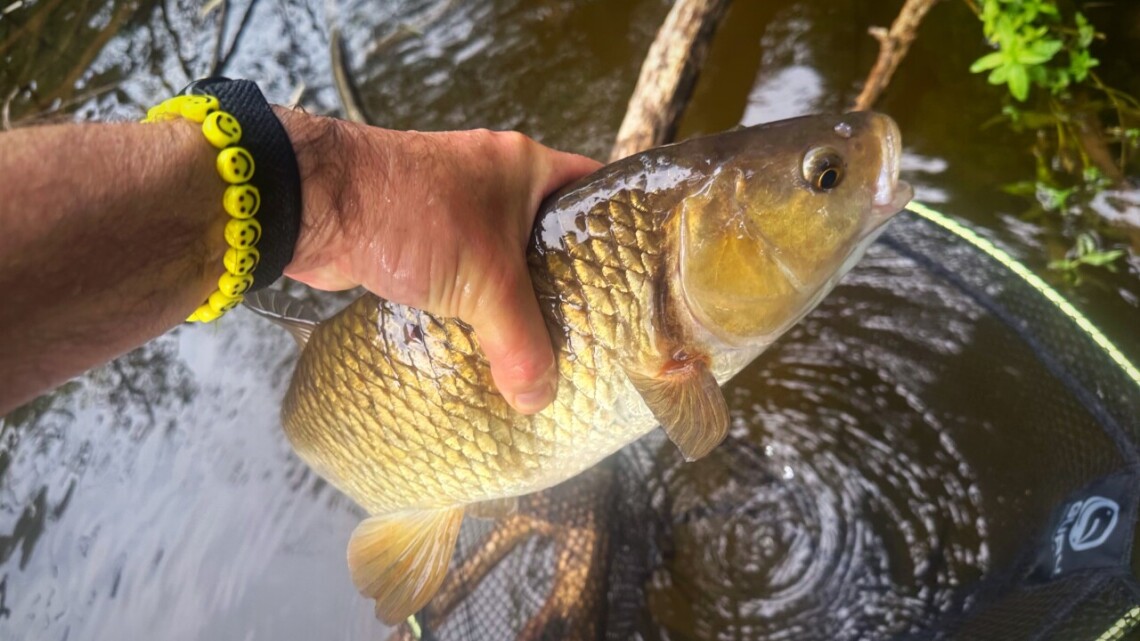 Middle Ballingham and Fownhope No 8 - Mick Newey
 On the 12th, by which time we had experienced 9 more hot days, TD from London had 2 bream at Trelough Pool in Herefordshire plus a large carp which produced “a screaming run” at dusk. Alan Trevett of Basingstoke had an early morning session at Holme Lacy 3 and Lechmere’s Ley, fishing with a feeder and catching no less than 65 chub to 5 pounds 8 ounces. He was another who mentioned that the path to the lower part of the beat is becoming very overgrown with brambles. Several anglers including ACE from Charlbury and AB from Hagbourne were at Middle Ballingham and Fownhope No 8 and reported chub taken on meat from under the streamer weed. It is nice to hear about a beat which has much streamer weed these days, something which reminds us of classic Wye fishing. They described sharing the bank with “a giant bull and his harem.” Liam Casserley with a friend from Cheltenham reported 3 barbel, 8 chub and a 2 pounds eel from Middle Hill Court. “Another amazing day at Holme Lacy:” Alan Trevett reported a remarkable time at Holme Lacy 3 and Lechmere’s Ley, catching 77 chub to 6 pounds 2 ounces on feeder with pellet and hemp and meat on the hook. GH from Salisbury with a friend took 10 chub on the Lower Ballingham beat and recommended staying at the nearby Nature’s Nest. They had 2 barbel and 32 chub at Fownhope 5 the following day. PR from Newbury blanked at the Creel, complaining that silkweed all over the river bed was fouling the hook. Three anglers led by Steve Jones from Solihull took 25 chub at Holme Lacy 3 and Lechmere’s Ley. Philip Robert Burke from Pevensey was pleased with 5 chub taken on the Home Fishery.
A Ross on Wye coarse angler considered conditions too hot to continue with fishing booked at Holme Lacy 3 and Lechmere’s Ley on 28th July and claimed a temp-off. However the WUF declined to grant this on the basis of a water temperature reading at Holme Lacy Bridge of from 20.3 to 22.5 degrees on the day in question. The present situation is that rather than react to the heat-wave by closing off the whole river – which some local clubs have done – the WUF is asking anglers to take a thermometer and make their own responsible decision on the spot, 20 degrees being deemed the safe maximum for game species and large pike, and 25 degrees for coarse species such as chub and barbel.
On 29th May Colin McSherry and a friend from Keynsham fished at Holme Lacy 3 and Lechmere’s Ley and reported 24 chub. David Giles from Church Fenton, Tadcaster, with two companions reported 43 chub on sweet corn from Fownhope 5. Later they caught a barbel and 8 chub at Lower Canon Bridge. This team recommended staying overnight at the nearby Falcon House. James Shepherd from Worcester was another who fished at Lower Canon Bridge and found the Wye very low, but thankfully without the brown tinge which has become so common recently. He caught 2 barbel and a chub. “The Wye always reminds me of a slightly larger version of the Teme fishing from many years ago.” I imagine that would be a good memory.
The big heat continues
By the middle of July the UK weather had, not exactly changed, but certainly moderated slightly. Mornings were cooler, with cloud cover holding the air temperature back in the teens of degrees. There were some gentle breezes. And while the days were warm after the sun had burnt off the clouds, air temperatures during the afternoons were in the high twenties rather than the low thirties. So hot summer weather was the order of the day, but this was no longer technically a heat wave. Fish were still sometimes prepared to feed when water temperatures permitted. However, there was still no sign of rain in southern Britain although it was desperately needed.
Meanwhile temperatures approaching 40 degrees were being recorded around the rest of Europe and the ongoing lack of rain was even more significant on the continent. By 25th July major forest fires had developed near Avila and Madrid to a situation beyond the control of local fire-fighting capacities. Civilians were evacuated as Spain declared a national state of emergency and asked for help from the EU. Further north in France fires were burning in the Gironde and the Landes with the city of Bordeaux threatened and more than 200,000 of the population evacuated. Parts of Algeria were affected by wild fires. In the UK Scottish firefighters took 10 days to extinguish a huge brush fire in the Cairngorms and there were reported to be 19 ongoing fires in England and Wales. The flat top of Blorenge Mountain above Abergavenny was burning for a week with a loss of livestock and reportedly the smoke could be smelled in Cardiff. Brush and heather fires are notoriously difficult to extinguish as dry roots continue to burn underground even after the surface is apparently secured.
Minor fires in the Forest of Dean area were being dealt with by the local fire services. It’s interesting how the fire risk in the Forest is regarded by the authorities today. During my childhood the fear of fire amounted to something like paranoia. Wide fire breaks were maintained between stands of trees, tanks of water and racks of beaters with wooden flaps were maintained at strategic points and a series of high wooden towers were occupied by fire watchers during dry periods. At one time during the school holidays teenagers could earn half a crown in return for spending the day in a tower with a pair of binoculars tasked with sounding the alarm if they saw smoke. In those post-war years much of the Forest was newly planted with close ranked and fast growing larch (destined for newsprint pulp) and any fire would have moved quickly. Today we are back with cultivating a more open and natural woodland of slow growing oak and beech according to the traditions of the Dean and although dead wood is mostly left to lie on the forest floor I suppose the risk is therefore less, despite the increased access by visitors and picnickers.
By the end of July, although temperatures were slightly lower, beyond a few drifting clouds there was really no sign of rain in our area. A drought was officially declared for the whole of Wales. Now and again the smoke from distant fires could be smelt in our valleys and while the reservoirs were relatively full after a wet winter, there was little water to spare in our rivers. Farmers already facing poor harvest yields were worrying about the next planting and how to feed live stock over the winter.
10 years in Turkey
On 15th July I realised that it was exactly 10 years since I returned in darkness to the car after an evening on Talybont Reservoir and switched on the radio to find that a military coup was ongoing in Turkey. Tanks were briefly on the streets, but the coup attempt had failed by morning and the arrest of thousands of known dissidents and liberals followed with alarming speed, a purge which has continued and enlarged for years. I was never absolutely sure to what extent the coup attempt was genuine, but the arrest lists were real enough. Altogether it is estimated some 3 million Turks may have since been dismissed from their positions, arrested, interrogated or imprisoned. Today, Turkey’s human rights record, never the best, is sadly reduced. But President Erdogan is more than ever confirmed as the strong man of the Middle East, called upon by diplomats of all sides.
Dainis Ozols
I was saddened to read that we lost Dainis Ozols earlier this spring. Dainis was once a close protection specialist for the Metropolitan Police and he used to squire John Major around on his visits to wartime Bosnia. I never bumped into Dainis then as I can recall, but we knew each other later as we were both volunteers for the Wye and Usk Foundation with a specific mandate to prune the small wild streams over the winter months. I think this came about because there was a general assumption that we were all over retirement age and therefore had lots of time on our hands. I don’t know whether that was strictly true or not, but certainly we were a collection of greybeards interested in fishing the brooks and generally known as “Dad’s Army”. Dainis co-ordinated the northern team looking after streams like the Edw and upper parts of the Lugg and Arrow. 15 years on, it strikes me it wouldn’t be a bad idea if a slightly younger generation would care to resurrect this scheme. Dainis had a finger in several other pies due to his deep affection for the landscape and wildlife of Central Wales and the Borders. He was as likely to be laying hedges or building stone walls as trimming streams. The name of his website, Kites Country, was a homage both to the great broadcaster and angler Oliver Kite, who had strong connections to Wales, and the role of Central Wales as a breeding reservoir to restock the rest of the UK with the once rare red kite. Our sincere condolences to Dainis’ family.
Another species
A shooting pal Monty Bowman and I met on a Herefordshire estate lake the other day. The heat-wave was still on but the main idea was to experiment with some different rods and lines and see how they matched each other. For me this began with the ever beautiful drive up the Monnow Valley through countryside which is always a joy to look at, even though the thick growth of this spring had narrowed the road in places so that oncoming traffic became a hazard. Once beyond the main Abergavenny to Hereford road and on the estate we were in a private world of oak trees and pastures where cattle clustered in the shade flicking flies with their tails. Here and there was a half-hidden pool and one such was designated for our own fishing session.
Unfortunately it rapidly became obvious that in this constant heat the chances of actually catching a trout (on a catch and kill ticket) were quite low. I took the water temperature in several places and found around 25 degrees. This pool contained not only trout but also carp which in the way of their species had stirred the silt to make the water opaque with a strong reddish brown colour. Carp when enclosed in a mud bottomed pool are very like hogs – they root about and make a mess. Willinghurst in Surrey, which back in the day had both trout and carp, used to be the same. As the sun rose above us in a clear sky carp were also showing more and more regularly with a jump and a crash which indicated to me, not feeding but irritation. An occasional rainbow trout showed in the same noisy way, crashing down on its tail after a brief flight in the sunshine. We had our casting practice and later put on proper hooked flies to be fished through the soup at different levels, even progressing to dry flies for a while before leaving mid-afternoon. We had the trout in mind but nothing came to disturb our flies on this occasion.
In this kind of hot weather, which has been sadly much more common in recent years, many fly-fishers have turned to taking other species more seriously. The accepted tactics with carp these days are first to ground-bait with floating dog biscuits to attract the big fish and then, when fairly confident feeding is established, lob in a dog biscuit imitation made with trimmed deer hair, try to keep calm and wait for the action.
I remember a time many years ago when Nerma and I looked after Gloucestershire’s Beanhill Fishery while the owners went on holiday. For us it was rather nice to be living on a farm for a while; for the owners, a holiday made a change. I was on UK leave and apart from some grass cutting I just used to laze about and fish the lake most evenings. Some hot weather occurred during that time and a large number of koi carp kept by our neighbour in the mill-pond downstream swam up the Cone Brook, under the boundary fence line and a tractor bridge and so into a small pool created at the point where the water drained from our own lake’s dam to join the stream. This clearly placed these visitors on our own territory by a number of yards, a significant point as it seemed to me. I presumed that cooler oxygenated water flowing down the brook was the attraction.
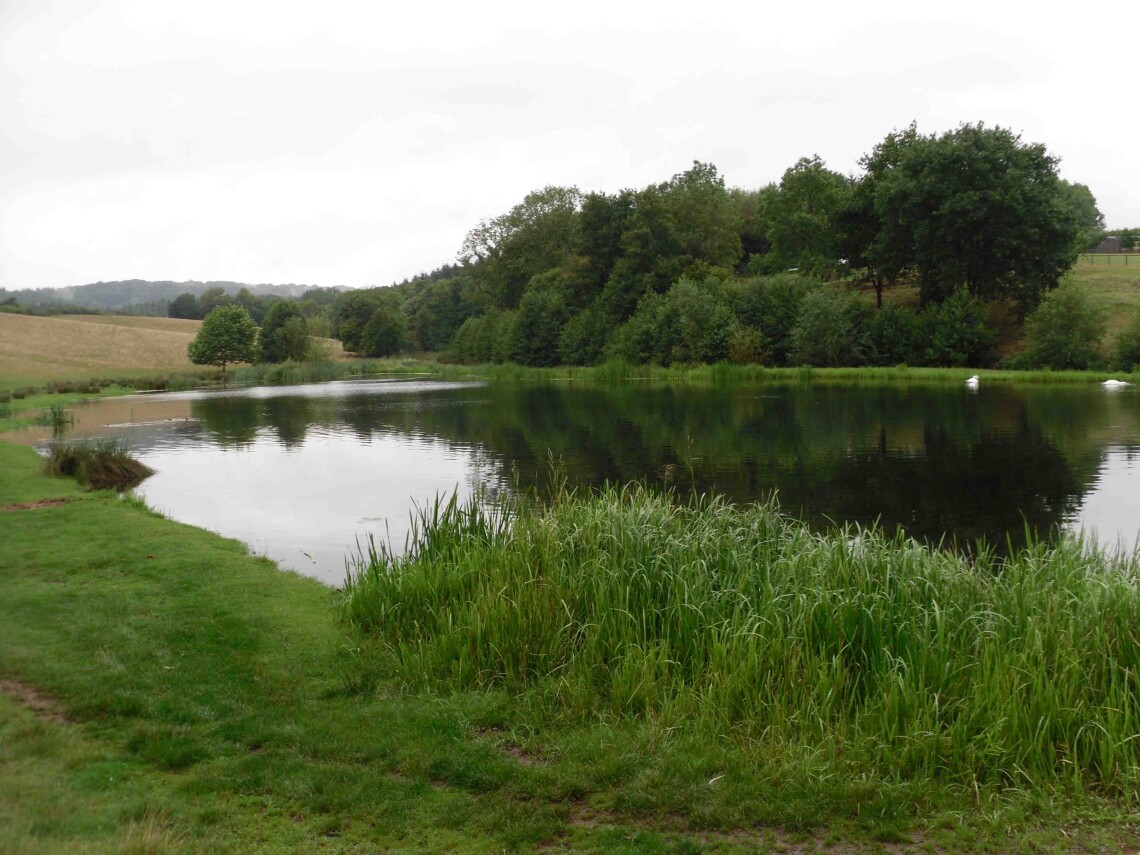 Beanhill Lake
 For a time while hiding behind a useful screen of reed mace I watched these carp circling the pool in “our” stream and then an idea occurred to me. I went up to the farm-house and negotiated with Archie the dog (a gentleman if ever there was one) for a loan of some of his biscuits and then came back with these in a bag and also a fly rod. Having scattered a handful of dog biscuits over the surface of the pool, which attracted almost instant attention from the carp, I went behind the reeds to put the rod together. Even if real dog biscuits are used as ground bait, the convention is that a fly-fisher should fish for carp with an artificial imitation, which usually amounts to a ball of brown deer hair mounted on a size 10 hook. Unfortunately a Deer Hair Nymph was not to hand, so a real dog biscuit was what I used, mounted to a hair-rigged hook. Crouching down behind the reeds, a position from which I could not actually see the surface of the pool, I carefully lobbed the biscuit into what I hoped was the right place and stayed watching the leader. After about 5 minutes it gave a twitch and then began to move purposefully forward through the reed mace stems. I struck and all hell broke loose. It was close quarters combat. The hooked carp tried to go everywhere, except (fortunately) back through the low bridge arch.
At the end of it all, having become rather wet and muddy, I was left with a brightly coloured koi of about 6 pounds in the net. I did for a moment think of taking it over the dam and popping it into our own lake to join the trout. However, it struck me that our lake is normally absolutely clear, that the markings on a koi are very easy to identify in such circumstances and that it wouldn’t do to be falling out with a neighbour accusing us of fish theft. So I popped it back whence it came.
I did have one more experience with carp during that holiday and on this occasion proper artificial flies were involved. We were up late one evening in the farm kitchen drinking wine and polishing off a paella which my son Malcolm had made. About midnight and well into the second bottle of red it struck me that I had not fished at all that day, not even for an hour, so to rectify that I picked up a rod and down to the lake I went. It seemed like a good idea to me, but nobody else wanted to come, strangely enough. I was casting from the dam and using the northern technique known as bustard fly fishing which I had discovered worked there after dark. The Bustard Fly is meant to represent a large sedge and the idea is that you cast it to the far bank or as far as you can with a 6 weight rod and then bring it back through the surface with a fast figure of eight retrieve until something attacks it. You can do this on rivers, where there must surely be some connections to sea trout fishing with the surface lure, or it works on lakes just as well. On this occasion the line went heavy during the first retrieve, but that fish came off as is often the way. However, the fly was attacked again during the second retrieve and this time I had a good old tussle in the darkness with a strong fish. It was a very hot and black night with cloud cover and it was not until the end as I drew the net in towards me that I saw a silvery flank with large lozenge-shaped scales. It was not a trout at all, but a grass carp of 8 pounds!
Two of these had been put in a several years before in the hope that they would eat the weed - which incidentally they totally failed to do! Since then they had hardly put in an appearance although they would eat grass cuttings if somebody was strimming the bank. A couple of winters later while fishing a sinking line I accidentally foul-hooked one which had been lying on the bottom in the root of the dorsal fin, and that resulted in a very difficult “pull you, pull me” struggle until I was fortunately able to release it unharmed.
Whatever you fish for, tight lines!
Oliver Burch
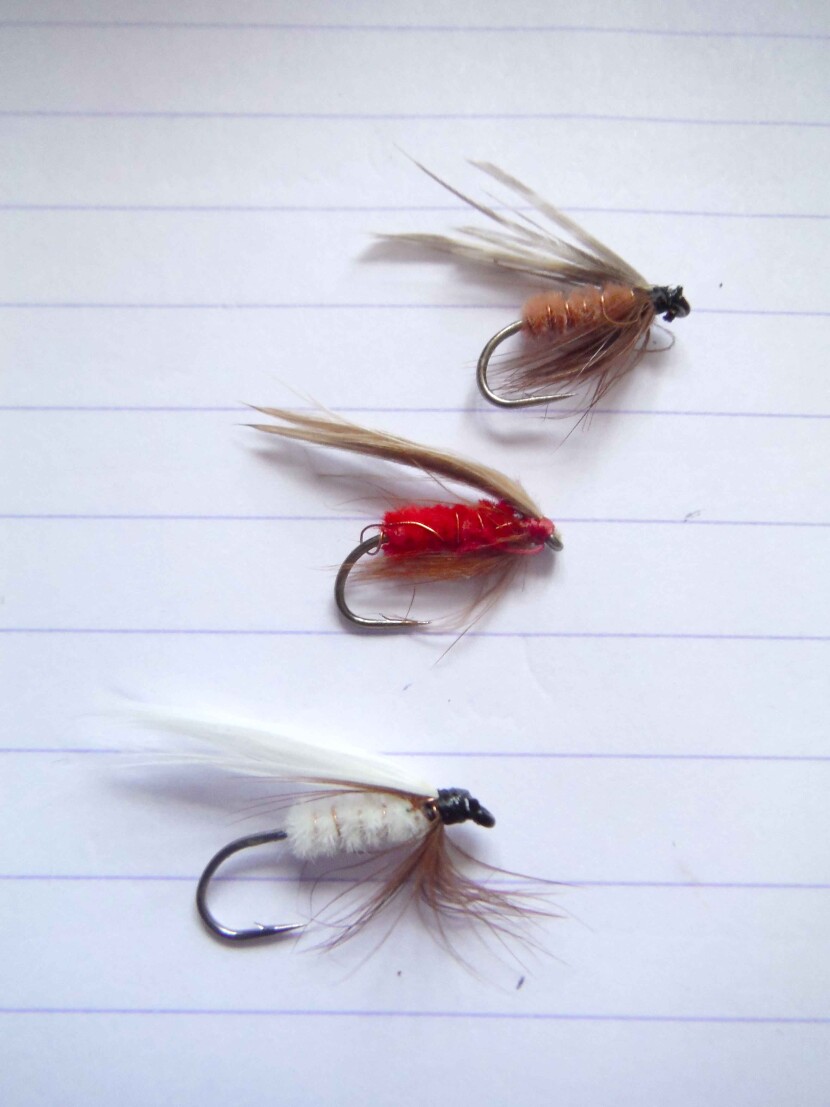 Bustard flies