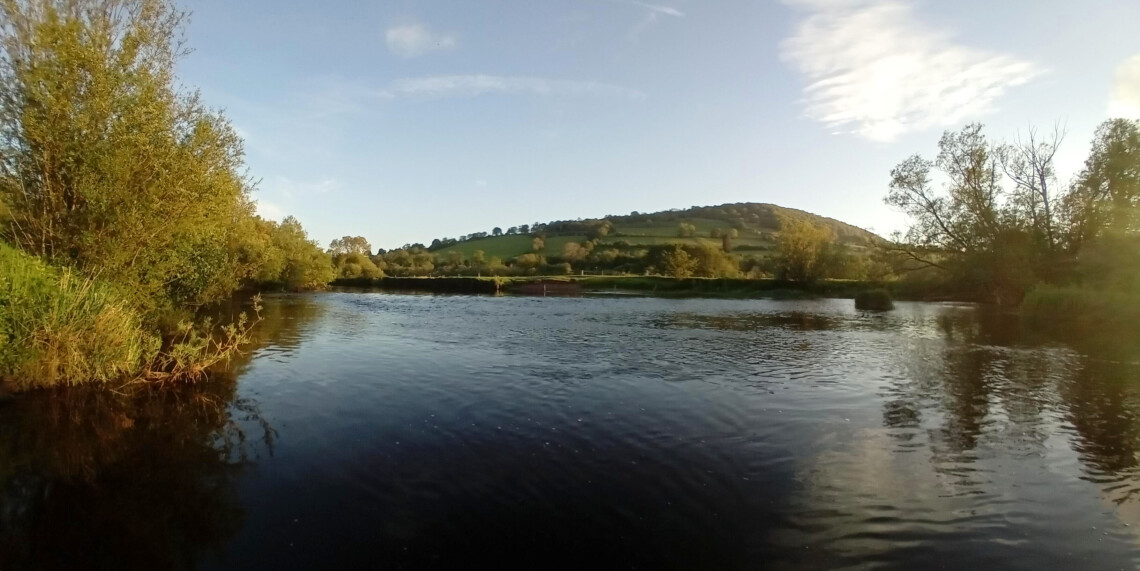
Spring came on steadily at first, marked by those little way-stations which exist for those of us who like to look out for them: the sight of different trees coming into leaf at different altitudes, spreads of wild flowers arriving in seemingly an almost miraculous way but in their accustomed order, then the first bracken under Forest cover. On 1st May by the stream at Redbrook I saw the first true mayfly of the season, about two weeks early by my reckoning. On 2nd May before dawn, a cuckoo, also the first one of its season, was calling from the copse across the New Grounds so that I could hear it clearly from the open bedroom window.
April had been very dry and by the end of the month wild fires in the Welsh hill country were being seen, burning in the Elan Valley as reported by Joe Alexander and smoke across the water at Llwyn On in the Beacons as described and photographed by Mark Payne.
Trout Fishing
The Usk continued to yield up its trout, just a few in some cases, but quite generously in others. Pete Buckey recorded 8 fish from Dinas while NS from Macclesfield had 7 at Glan yr Afon. He wasn’t as troubled as some have been by paddlers or stick throwers arriving by the footpath along the beat: “…Thursday during term time, though.”
NG from Dilwyn caught 5 trout from 12-14 inches at Fenni Fach. Wesley Carter from Llanelli caught 4 from the Usk Reservoir at the head of the river.
News from the North: Gary Clewes from Newcastle on Tyne reported 13 trout during a day on the Raby Estate. Alexis West from Redditch with a friend took a day on Llyn Dulyn, the Dolgarrog Fishing Club water and they reported a dozen trout between 15 and 20 cm.
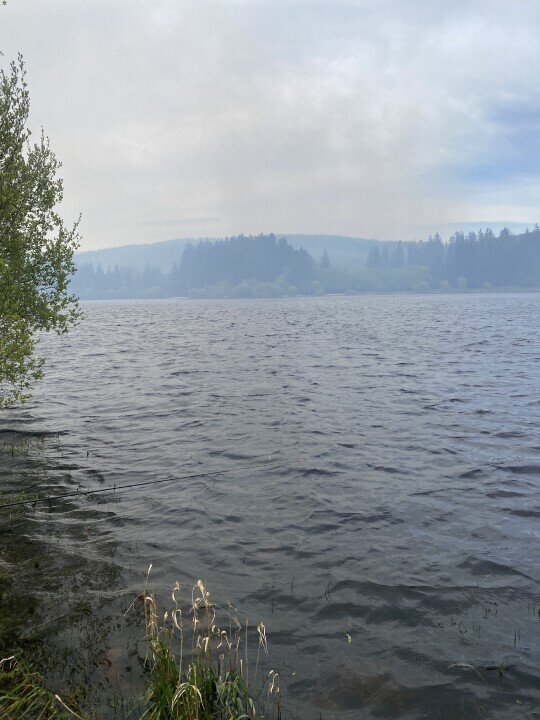 Smoke across the water - Mark Payne
 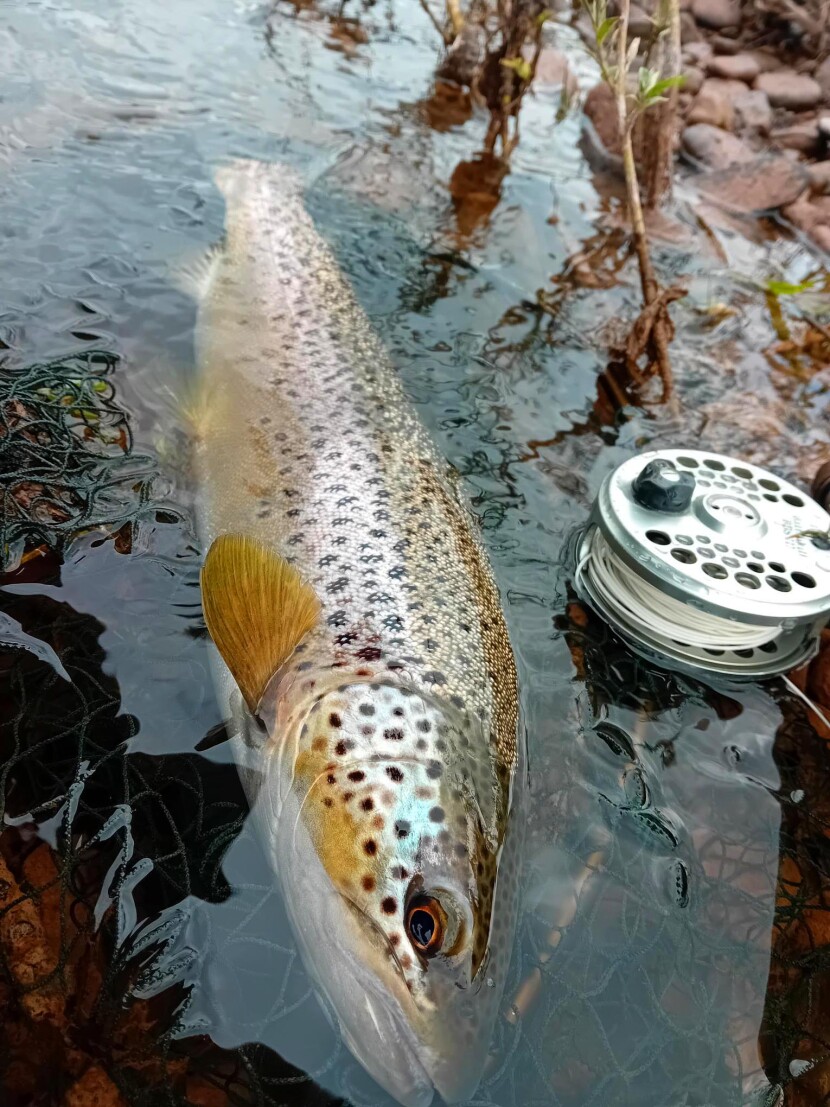 Before the mud arrived in the Usk on the 4th.
 Patrick Hemming from Bath worked hard in a ripple on the Talybont reservoir to take a brace of trout, but one of them was a deep-bodied 18 inch hen. Glen Edwards from Aldington took 6 trout from the Rectory on the upper Wye, while Joe Alexander reported 9 trout between 5 and 11 inches taken on the Ithon at Llandewi. Andrew Kelton from Hereford reported an 18 inch trout caught on the shallows at Greenbank on the Usk. Meanwhile Brendan Adair with a friend from Victoria Park reported a very good day, taking 18 trout on the upper Usk at Cwmwysg Ganol.
A Torrington angler was not very happy with the Cannop Brook in the Forest of Dean, having been troubled by rubbish thrown on the bank and people throwing sticks for their dogs. I remember that when we first opened this little brook to trout fishing, it was completely surrounded by thick forest. The only way to progress along it was in chest waders, up the channel. From a fly-fishing point of view, this was excellent. Fallen trees were the main problems likely to be encountered as you looked forward to the next rising fish in the next pool. But after a while some community-minded people from the local village decided to open up a footpath along the mile of brook, “…to make a nice riverside walk,” as they put it. One could hardly object to that idea expressed in that way. They worked away clearing a path and even the Forest Ranger decided not to object. However, the results are as you see and the little brook path can become quite crowded now, especially on high days and holidays. My best advice is to go early and get ahead of the dog walkers and stick throwers.
4th May was an odd day, at least in the region of Brecon, which experienced some localised but quite intense showers. I arrived at Abercynrig to find the main river Usk hardly risen more than inch or two, but already running a thick muddy yellow colour. However the Cynrig brook draining the Beacon hills to the south remained quite clear. I concluded the muck was probably coming out of the Honddu upstream following a cloudburst on lonely Mynd Epynt to the north. Sadly we were washed off, but downstream on his private beat Seth Johnson-Marshall had a good morning taking 12 trout to 18 inches on a CDC Olive Emerger while a mixture of natural flies including yellow mays, olive uprights and a few early blue winged olives hatched off. The action stopped when the mud reached him during the afternoon.
Further downstream still, Ben Garnett was fishing at Dan y Parc where again a mixture of flies were hatching. He took a dozen trout between 9-14 inches, mostly on some very traditional patterns in size 16 and 18: Lunn’s Particular, Greenwell’s Glory and Grey Duster. He also took some fish on a size 20 Black Gnat. JL and a friend from London were on Dan y Parc next day, found some colour still left in the water, but after 2.30 found rising fish that would take Comparaduns or CDC Emergers. They reported 14 trout to 17 inches. SG from London was on Dufnant where he took 6 trout on various olive emergers and duns. He described the wading as very difficult, but worth it. Joe Alexander fished the Clywedog again and took 8 trout during hatches of olive uprights and some baetis olives. Kenny Robbins from Ferndale caught 5 rainbows by fishing with worm 3 feet below the float at Llwyn On.
JL and his friend fished on to the 6th, which they spent at Ashford House:
“Lots of insect activity and surface action right from the start. At times it was difficult to know what fish were taking as there was such a variety of fly on offer. The best of the fishing was when they were firmly locked onto olive uprights…7 nice fish to 16 inches.”
David Plumpton and a friend from Fordingbridge were on the Glanusk Ty Mawr / Canal and Rivers Trust water of the Usk where they caught 9 trout during a rise in the afternoon. Peter Charleston with a friend from Beaconsfield tried the River Tees on the Darlington Brown Trout AA water and reported 10 trout between them. Tom Horrox of York fished Monnow Valley, the studio beat at the bottom of the Monnow system and reported a low river and a quiet day, although a handful of fish were rising. Upper Wye salmon regular Mark Harris from Swansea tried Ty Newydd near Erwood where he took 4 trout:
“First time on this beat…there are some lovely long glides, and back in the day when there were good salmon runs, some of the pools must have offered good fly water and would have been a joy to fish…I would say it deserves a return visit but my day was ruined by a nasty fall. The high, steep banks on the right bank near the top are extremely dangerous in places. Part of the bank collapsed when I was exiting resulted into a drop onto rocks and a serious shoulder injury, which rather soured the day.”
I am not exactly sure of the spot Mark is describing, but possibly it is on the path below the new holiday letting cottage? Do be careful.
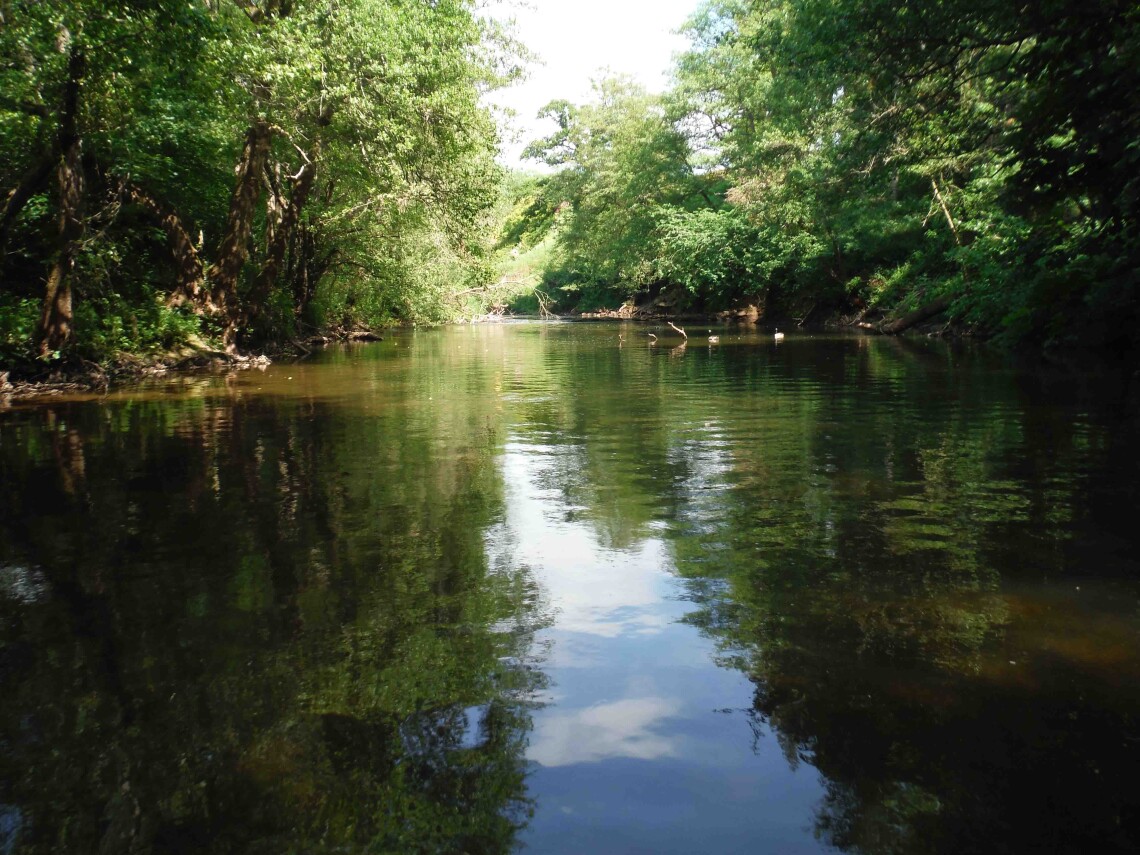 Monnow Valley
 On 7th May Peter Charlton with a friend reported 14 trout from the Eggleston Hall beat of the Tees. RC from Ross on Wye tried an evening session on the Usk Town Water and was rewarded just before dusk with a fish of 2.25 pounds on a Yellow May Emerger. Philip Sheehey from Hereford took 6 small trout on nymphs from the Upper Wye at Abernant. David Plumpton and his companion from Fordingbridge were out again on the Usk at Abercynrig, where they found hatches trickling off after midday. They shared 12 trout, mostly taken with a Jingler. Leigh Jones from Cardiff with a friend fished at Llwyn On Reservoir:
“Great day fishing. 8 nice sized rainbows caught on the bottom with worm.”
We were now in for a spell of quite cold weather by May standards, with biting winds gusting from the north and east. Cold nights tended to discourage early morning hatches and rises. Still there was a great deal of angling effort and some very good catches were made, particularly on the main Usk. Most of these trout were taken with dry flies. Judging from direct observation and the photographs I have looked through, it was initially quite noticeable how much better conditioned the Usk trout have been this spring in comparison with those from the Wye, which were nevertheless catching up as fly hatches increased. On 7th May Stuart Tanner from Thatcham fished late on the Usk Town Water while multiple hatches were occurring: various olives, large brook duns and yellow mays. He caught 5 trout on dry flies. JL from London had a very good day at Buckland, catching 14 trout to 17 inches on dries: “…insects hatched and fish rose all day.”
MS from Birmingham with a friend shared 6 trout from the Ithon tributary of the Wye at Disserth, and had complaints to make about the very poor access and indeed about access to the Foundation beats in general. In my view, the complaints about Disserth are fully justified, but the others less so. In any case, it’s always good to hear the voice of the customer, whether raised in criticism or in praise for the standard of maintenance carried out by fishery owners. Meanwhile Peter Charlton from Beaconsfield with a friend recorded 14 trout from the Eggleston Hall beat in Teesdale. They had the same number again at High Coniscliffe the following day.
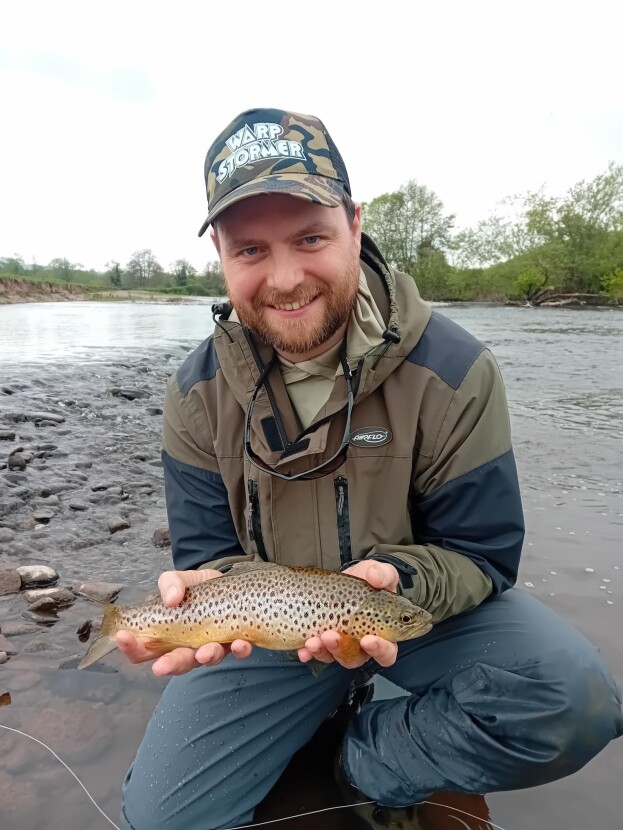 Rory McLaughlin with his first ever wild brown from the Usk.
 8th May was a good day for trout fishers. Julian Erbsloeh with a friend had 10 trout from the Abergavenny Town Water: “Most excellent day with great sport on dry flies.” Two anglers were fishing at Dinas: Andy Lane from London had 17 trout and SB of Worcester had 9. Andy Lane later had 15 at Cwmwysg Ganol and SB of Worcester reported 8 from Fenni Fach. Rhian Bray from Redditch caught 14 at Penpont. Steven Russell from Llangynidr fished the Wye at Abernant and caught 7 small trout on spiders. Jo Alexander from Rhayader fished the Cammarch brook for 6 trout and voiced some suspicions about algal growth near farm buildings. Alastair Sayell of Newent, who used to be very much a regular, fished the Middle Llynfi Dulas on 9th May and caught 7 trout to 12 inches, mostly on nymphs. As he stated, the upper part of this one badly needs a trim. Joe Alexander was out again, this time on the Arrow at Kington where he caught 8 trout. Paul Davis from London tried the Teme at Bucknell in South Shropshire and was very disappointed: “…almost no water to fish.” The great weakness of this beat is that it is vulnerable to low flows; when rains fail the water table quickly sinks below the stream’s bed, and overall this has been a very dry spring. Given enough water it can fish very well and the Teme here runs in a particularly beautiful valley. Back on the Usk, MK from Bangor in Northern Ireland caught a brace of 18 inch trout at Cefn Rhosan Fawr, while Robin Guild from Freshford took 10 trout from the Usk Town Water. Regular Dan Cristian Oprea had 9 trout from Dan y Parc on what looked like a Jingler. Paul Lewis and his grandson fished the Usk Reservoir, sharing 6 rainbows. Louis MacDonald-Ames, co-owner at the Rectory, reported 4 trout from an early morning trip, but recommended hatches during the late evening. Lampreys are already nesting in the gravel.
On 12th May GM from Whittington caught 9 Usk trout at Glan yr Afon, using the duo and dries. Stephen Potter complained about the well-known access problems at Monnow Valley: “…ropes needed, but not present.” This is not a bad suggestion and ropes secured on trees might be a cost effective way of finding our way in and out of the channel at Monnow Valley. By its nature it is always going to be a “wild” beat. On the other hand Eric Griffiths from Bromyard caught a nice brace on dry flies at the same Monnow Valley and complimented the owner for some good advice including about the access. Robin Guild from Freshford reported 6 more Usk trout from Greenbank. Remaining on the topic of access for a while, RG from London with a friend reported two trout on nymphs at Dinas and described access to this beat as “challenging” due to bank erosion. That strikes me as odd. Although I am in my mid-seventies, I would say that Dinas is one of the easiest accessed beats I know, with open banks everywhere and plenty of ways up and down to all the pools. In dry weather you can even drive to the river margin. What more could one expect?
We had a lot of reports of successful fishing on the Beacons reservoirs during this period, but somehow the “unsuccessful” reports reveal more than the writers probably intended. Here is a report from the Usk Reservoir:
“Caught a small perch with a worm about 10 minutes into the day. Blanked for the rest of it, a bit annoying as I had paid for 6 trout.”
It might be worth reminding that you pay the supermarket fish counter for trout, but you pay Welsh Water via WUF for the right to fish and try to catch some trout if you can. That is where the fun lies, or supposedly that is the idea. Another report from a Bargoed angler on Llwyn On deserves repeating in full:
“Another 10 hours spent doing nothing. Not even a bite. Turning out a disaster this year. About 5 or 6 times fishing with not even a bite each time. Not sure how long I’ll keep coming to Llwyn On. It seems certain people are in the know as to when the reservoir is being stocked. I went on Thursday and only 2 or 3 people booked in. The following day it looked like 23 people were booked in. Seems to say something.”
It might say that Friday and weekend fishing at Llwyn On is more popular than in the middle of the working week, but what would I know?
14th May on the upper Wye and we wondered at just how cold we felt while contriving casts in a strong wind gusting downstream. Compared to the air the river water felt distinctly warm and even the trout we caught felt warm to the touch. Towering black cumulus clouds raced overhead from the north and every now and then one would jettison its cargo of hard, cold rain. Once there was lightning and a crack of thunder persuaded us to put down the rods before hail blotted out the view in a shower of falling ice. There were also moments when the sun shone with some warmth. It was a very strange day. Still, quite a variety of flies were hatching when they had a chance, up-wings of every size from occasional true mayflies to pale wateries, and from midday on fish in good condition were rising, showing enthusiasm for both dry flies and spiders. They were good looking fish too on this occasion.
The strangely cold spring weather with heavy clouds and rather unpredictable showers coming and going continued. While the showers were strong at times, to my surprise the rivers didn’t rise or colour much for several days more. The ground was still dry enough to absorb most of the water and the sap was still rising in the trees to swell their newly sprung leaves. There certainly wasn’t enough water to make salmon fishers feel particularly optimistic. Even more surprising was just how good the dry fly fishing was during these days of cold rain and winds. All sorts of duns were hatching on the rivers. The weather must have been particularly difficult at high altitude but two anglers from Bath showed an intelligent approach while fishing Llyn Bugeilyn at the top of the Dovey where the little trout look up for flies blown off the land. They took 15 trout between them: “All but a couple taken off the top with usual small black flies. Bibios and Hawthorns working well. Later in day a couple taken on wets, Bibio again and Haul y Gwynt.” The last named “Sun and Wind,” for which dressing you need pheasant breast plumage, is about as traditional a Welsh mountain lake fly as you can find.
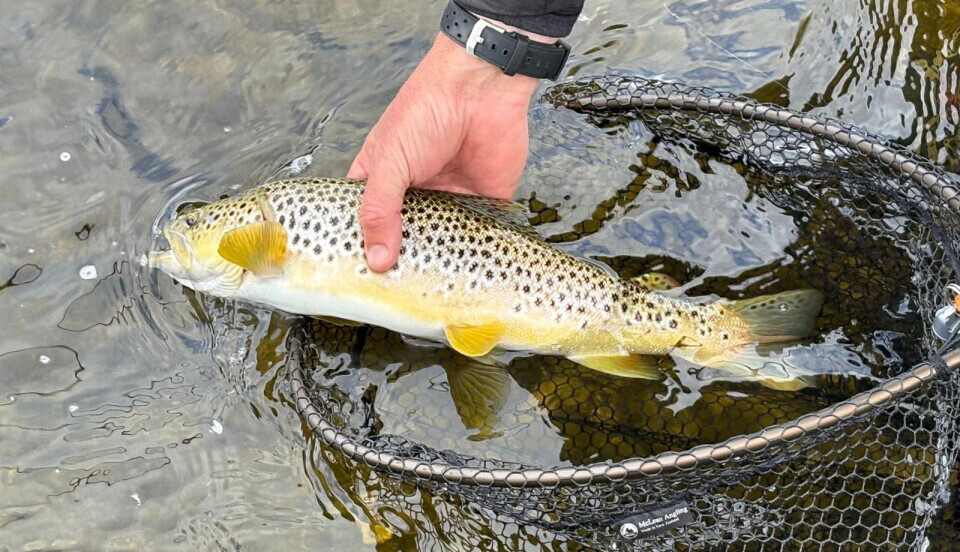 Ty Mawr - GM from Whittington
 On 15th May PD from London reported 4 apparently very good Usk trout taken on a French Partridge mayfly pattern on the Chainbridge beat. Ondrej Toman from Belfast was on Glanusk Ty Mawr / Canal and Rivers Trust where he caught 6 trout: “…lovely day’s fishing.” Stephen Tennant reported 6 trout from Cenfn Rhosan Fawr: “Stunning section of river.” If I read the reports correctly, James Lockyer from Street with a friend caught 48 trout from Dinas and Abercynrig which had been booked together. James Lockyer had 14 trout at Cwmwysg Ganol the following day. Rhian Bray of Redditch took 12 trout on the Breconshire Fishery while Shaun Wakeham from Looe reported 7 from Glanusk Ty Mawr / Canal and Rivers Trust. PH from Kirkoswald had 5 trout at Fenni Fach:
“Superb day’s fishing on a really varied and interesting beat. Highly recommended.”
Our friends in the North were reporting similar successes and fine days on the river. On the Tees SW from Whitley Bay had 23 at the Raby Estate, Harry Chance from Exeter had 15 on the same water, Richard William with two friends from Northallerton shared 30 from the Strathmore Estate, and Eric Hampel from Newcastle had 6 (including 2 over 12 inches) at Barnard Castle. JG from Manchester caught 4 on the Raby Estate:
“Dry fly…walked into the Cauldron Snout – fish active the whole way back to Widdibank.”
Meanwhile in Central Wales, apart from out of season grayling James Lockyer from Street reported 15 trout caught from the Serendipity House Upper Irfon beat. That intrigued me, because this is mostly a rather shallow beat and the river was quite low at the time. Maybe things are looking up for the Irfon? Joe Alexander had 19 trout from Llandewi on the Ithon: “A sublime 3 hours.”
Paul Thomas from Kingstone fished the Dore at the notoriously overgrown Chanstone Court:
“The difficulty getting in is almost impossible, but once you find a way the fishing is very good.”
My only advice is, don’t risk your best pair of waders in the thorns and barbed wire. He caught 5 trout from 10-14 inches on a size 14 Adams. Shaun Wakeham from Looe in Cornwall had 6 trout to an impressive 2 pounds from Llwyn Corner. Ground saturation inevitably arrives sooner or later and by the morning of 19th May the lines of showers coming out of the West were catching up with us at last. Significant rises now began on the upper Usk, the upper Wye, the Irfon and a proper flood on the Loughor which has its source on the western flank of Black Mountain. More to the point, the water was very dirty. Anglers on the 19th caught the odd trout on the upper rivers, but by midday most of them were forced off by thickly coloured flood water. Mark Atherton with a friend from Worcester were fishing with nymphs in the long gutters of Chapel Catch and apart from out of season grayling caught 5 trout and a shad, but colour in the water had killed the river by midday. Up in North Wales, AR from Usk with a friend caught 10 brown trout and a sea trout from the Seiont in the Cwm y Glo section.
By the 20th a Hereford angler was struggling to catch 6 trout from a slowly falling river at Abernant. An angler from Whittington had a splendid day on the top of the Wye at Ty Mawr and took 10 trout from a river now clearing of brown peat stained water. Graham Ash from Chelmsford had problems with fishing the Irfon at Llanfechan:
“Access to the lower part not possible due to two broken stiles…too deep to wade around.”
Llwyn On Reservoir was fishing well enough it seems, and JL from Merthyr reported 4 rainbows. A somewhat unusual report came in from Seth Johnson-Marshall, who had caught a specimen brown trout of 22 inches from a middle Usk beat. This would have weighed around 4 pounds, but the strange thing was that he caught it twice during the month! I am not claiming that this proves the fish enjoyed the experience of being played, but it does say something for the catch and release technique!
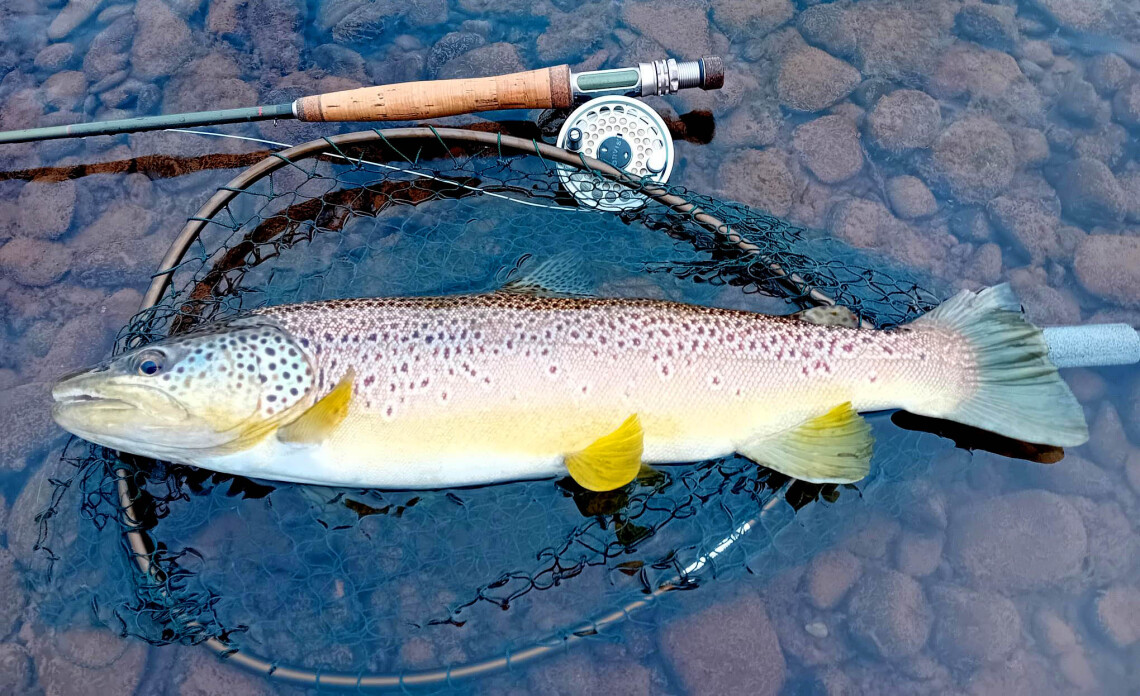 22" Usk trout - Seth Johnson-Marshall
 The weather changed into a period of growing warmth and eventually a heat-wave. Showers of hail now seemed far behind us. On 21st May Stuart Mears from Port Talbot with a friend took 20 trout at Talybont. Matt Whalley from Stourbridge caught 2 trout at Lyepole and had a lot to say about the poor access and rotted stiles, particularly the one upstream of the bridge with barbed wire trained across it. I defy anybody to get over that one without ripping their waders and I usually avoid it by going under the bridge.
Simon Tarpey from Crickhowell reported 10 trout taken during an evening session at Penpont, while Andy Lane from London also reported 10 trout from Cwmwysg Ganol: “…pretty tough day.” He had 10 more at Cefn Rhosan Fawr the following day. Brian Skinner from Brecon took trout on his salmon gear while fishing at the Rectory: “…lots of mayflies hatching…Mill Stream was alive with trout.”
Peter Buckey from Stockbridge caught 12 Usk trout at Upper Tower. JP from Kidderminster reported 3 trout to a very impressive 22 inches from the same beat. SM from Liverpool also described fishing at Talybont where he caught 4 to 2 pounds by “plopping down a Coch y Bonddu” where fish were seen rising. It is certainly the right time of year for the red and black beetles. Ben Garnett from Exeter fished the new Usk beat at Llanwysg above Crickhowell Bridge, where he took 8 trout to 16 inches. He also saw a small dead salmon in one of the pools which is slightly worrying. I would not expect a kelt to be in the river this late and it’s a long way to spawning time. Finally Ben was locked in by the farmer, which is a hazard to bear in mind if you are fishing late. GW from London was fishing downstream at Greenbanks, where he expressed a hope that bullocks can be persuaded not to lick his car. My advice is that bullocks can do a lot worse than slobber over your car, so as a general rule don’t leave your car in a field with cattle.
By Monday 25th May the heatwave had reached a record-breaking height with afternoon air temperatures in the low 30s. Fish were still being caught. SM from Liverpool caught 12 trout at Dinas while Joe Alaxander from Rhayader had 21 trout from the little Clywedog. He measured the water temperature at 13 degrees. Salman Momer from Hereford was not very happy with his booking on the Lower Serenity House beat of the Irfon:
“Very sadly, the river level appeared too low to fish. There were no signs of activity (no rises and little insect activity as well). I walked the length of the beat and did not see any fish (I am normally very adept at spotting fish) despite the water being very clear. So it was not a good day for fly fishing unfortunately with the river so low and shallow. I fast turned and left it.”
The adept Mr Momer was equally unhappy with the Serenity House Upper beat on the same day, as much of it was busy with splashing swimmers and paddlers. He has asked the Foundation for a refund. Meanwhile a Weobley angler liked the condition of the Irfon downstream at Llanfechan where he caught 5 good-looking trout. On 26th May Joe Alexander was out on the Edw at Cregrina where he caught 13 trout. John Dudfield from Malvern caught 7 trout on dry flies from Hergest beat of the Edw. The water temperature was now 16 degrees. A Liverpool angler enjoyed the upper Wye at Craig Llyn where he took 10 trout during an evening session. By now the heat was back with us and water levels were dropping. With fish welfare in mind the WUF issued one of the heat warnings which have become so familiar during recent summers. Guto Hari from London had 5 trout on a small brown nymph from the top of the Rectory along with some accidental shad. David Hannon with a friend took a brace of trout from the Serenity House Lower Irfon beat along with some out of season grayling.
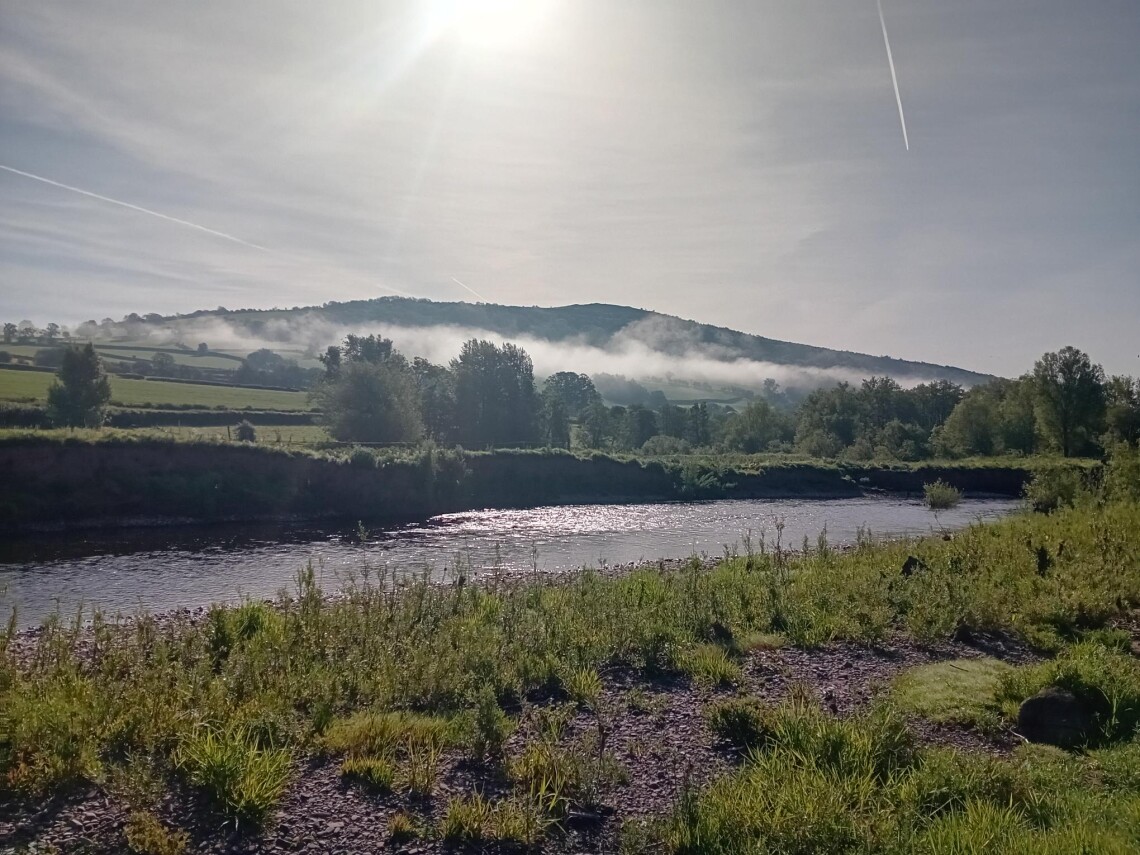 Morning mist on the Usk
 Salmon Fishing
The Abercothi beat on the Towy reported their first two salmon of the season: a 12 pounder on 1st May and an 8 pounder on the 3rd. Wyesham kicked the month off with a pair of salmon, both fresh sea-liced fish of 12 pounds, one on a fly and one on a single hooked Flying C. On 2nd March Richard Woodhouse took an 8 pounds salmon spinning with a Mepps on the Ross Angling water. I am reminded that Ross Angling have reported a few sea trout from their section of the middle river in recent seasons and these used to be considered a rarity on the Wye. Curtis and Lockie Roberts were fishing at Caradoc the following day and caught a 7 pounds salmon with a Willie Gunn. In the process they also accidentally caught and then returned a twaite shad, the first reported from the Wye this year. On 8th May Jack C Davis from Edinburgh caught a spring salmon of around 10 pounds from the Nyth on a Rapala, along with 10 trout. The river was low and clear with the sun bright, so this represents quite a feat.
On 10th May Kevin Elley reported a 12 pounds fish from the Usk, taken below Newbridge on the ISCA water. Robert MacDougall-Davis fished at Goodrich Court, but only had some accidental chub and shad to report. More to the point, perhaps, no salmon were seen during the day, something quite unusual for this beat.
“The river was looking beautiful despite the agricultural / water industry eutrophication that was evident.”
Wyesham reported a fish of 10 pounds on 13th May and another of 8 pounds on the 15th, both on fly. An angler from Ross on Wye fished Middle Hill Court on the 13th, blanked for salmon, but caught 3 accidental shad, noting “…a large shoal of shad swirling in the Rope Pool.” (If this was towards night fall, I imagine he very likely witnessed the spawning ritual with males and females coming together rather violently from their separate shoals. Sex for the shad is a group activity and they don’t make individual nests; the eggs, fertilised or otherwise, fall where they will).
A lot of shad were being reported from various parts of the river as the month went on. Also on the 13th, Swansea University were capturing shad for their research tracking project up at the Ty Mawr pool of the Rectory beat. Jonathan Jones reported a fish taken on a Green and Black Snaelda at Bigsweir on the 17th May.
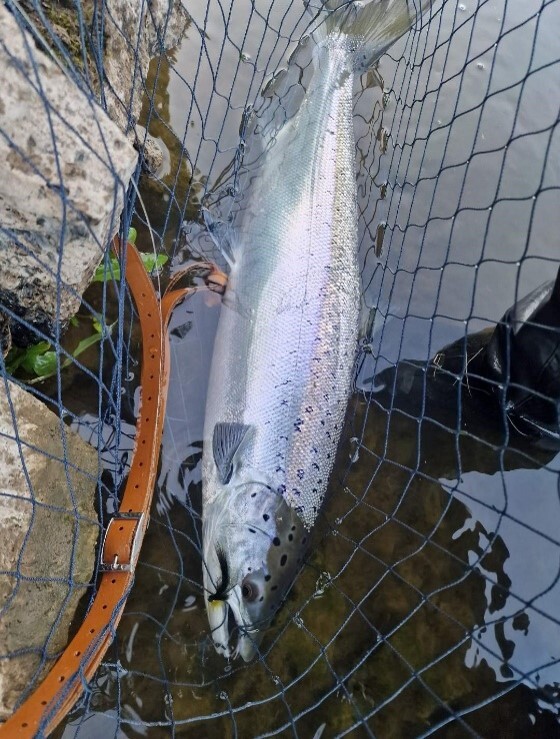 11lb Wyesham 24th May 2026
 The high water on the 19th May sparked up the salmon fishing again. Charlie Egerton caught his first Wye salmon, a fresh 10 pounder, at Wyesham. The fishery had three more that day, one at 14 pounds and two at 12. Simon McLucas caught a 10 pounder from the Rapids Pool at neighbouring Redbrook on a Monkey Fly. Could this be the beginning of the much-awaited run of two sea winter fish into the lower river we wondered? Richard Woodhouse reported and photographed a distinctly tired looking 18 pounder from the Ross Angling water which had taken a single hook Flying C. Wyesham reported a 15 pounder on a Mepps spoon on the 21st and a 12 pounder on fly on the 22nd: “Encouraging numbers of fish showing and moving through.” Abercothi Fishery on the Towy reported a 12 pounder. Another fish of 9 pounds came to Wyesham on the 23rd and one of 11 pounds on the 24th. The water temperature was now climbing as the heat-wave took hold and the WUF issued one of the heat warnings which have become familiar in recent years. In short, the month of May which had begun rather too chilly for most anglers ended rather too warm. At the time of writing we have 29 Wye salmon recorded by the rods this season.
Loughor Brown Trout
On 1st May Craig Treharne caught a 25 inches brown trout from the Pontardulais Angling Association water of the Loughor in SW Wales. As you can see from the photograph it was a wonderful looking fish which realistically might have weighed 6 pounds, caught by day and on a dry fly I believe. There have been a few remarkably big browns from this little river over the years, and inevitably the suggestion is made that the fish in question might actually have been a sewin. I do not think there is much doubt about this one which has apparently achieved its handsome condition in fresh water, not in the sea. The river was low and clear at the time it was caught and I know the pool very well, although in my case I used to fish it in darkness looking for the silver ones. Several other browns over 3 pounds have been reported and photographed this spring. It’s a delightful mystery! Incidentally NRW have been seen operating against illegal fishing nets taking mullet and bass in the estuary of the Loughor during May.
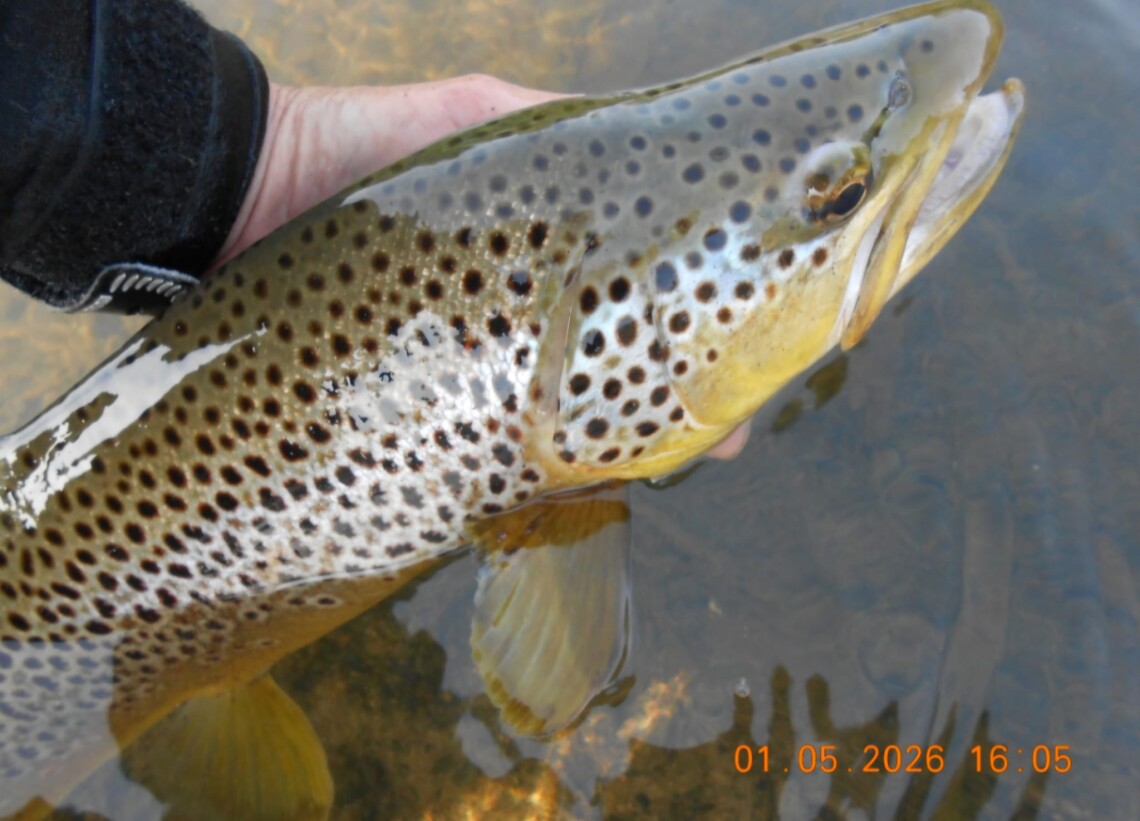 Loughor trout - Craig Treharne
 Coarse Fishing
David Entwhistle from Barry was another who fished at Trelough Pool, taking 8 carp from 3 to 12 pounds. It was the first time he had used the Fishing Passport and he had much praise for the booking system and clear directions. David Mathews from Staffordshire also visited Trelough and reported a carp of 11 pounds 4 ounces and a bream of 3 pounds 2 ounces. J Hughes from Lichfield tried the bream at Trelough on the 18th using worm and feeder and caught two “dinner plates” along with a perch and a bag of 9 good roach. Very similar, PA from Usk tried the Pool on the 21st and caught 7 bream to 3 pounds, 2 carp to 10 pounds, and lots of small roach.
Brian Clarke
We lost the angler and writer Brian Clarke back in March. His writing was a familiar influence in my early fishing days. Now consider these names for a moment: Peckham’s Copse, Avington, Damerham, Willinghurst, Sutton Bingham, Kempton Park, Chew Valley. It’s a list of mostly small still waters plus the more intimate waterworks reservoirs of southern Britain, all of them cited as his regular haunts by Brian Clarke in The Pursuit of Stillwater Trout (Adam and Charles Black, 1975).
I re-read this book recently and it provoked some memories. Fifty years on, I realise that I fished most of the same waters as Clarke, and also during the same period of the early seventies. I think I talked to him once. There was certainly a huge difference between us. Brian Clarke was already writing articles for Trout and Salmon and had been appointed angling correspondent of the Sunday Times.
This was due to early recognition of his very original thinking about this fascinating business of trying to catch trout with the fly. I was stumbling along on the same waters with inconsistent success, but I suspect I was equally fascinated.
Fifty years is a long time in fly-fishing and re-reading Clarke’s early book reminds me how much has changed, particularly in our approach to fishing stocked still waters. The remarkable thing about Clarke was that he insisted on working out nearly everything for himself. Although his journalism eventually brought him into contact with some of the angling luminaries of the day such as Richard Walker and John Goddard, with whom of course he shared ideas and experiments, this first book contains almost no historic references to past angling writers or dwells much on accepted theories. That was very much to the good, given that he was writing at a time when many were still trying to apply traditional methods developed for fishing Scottish and Irish natural lakes with wild brown trout to southern reservoirs and pools stocked with rainbows.
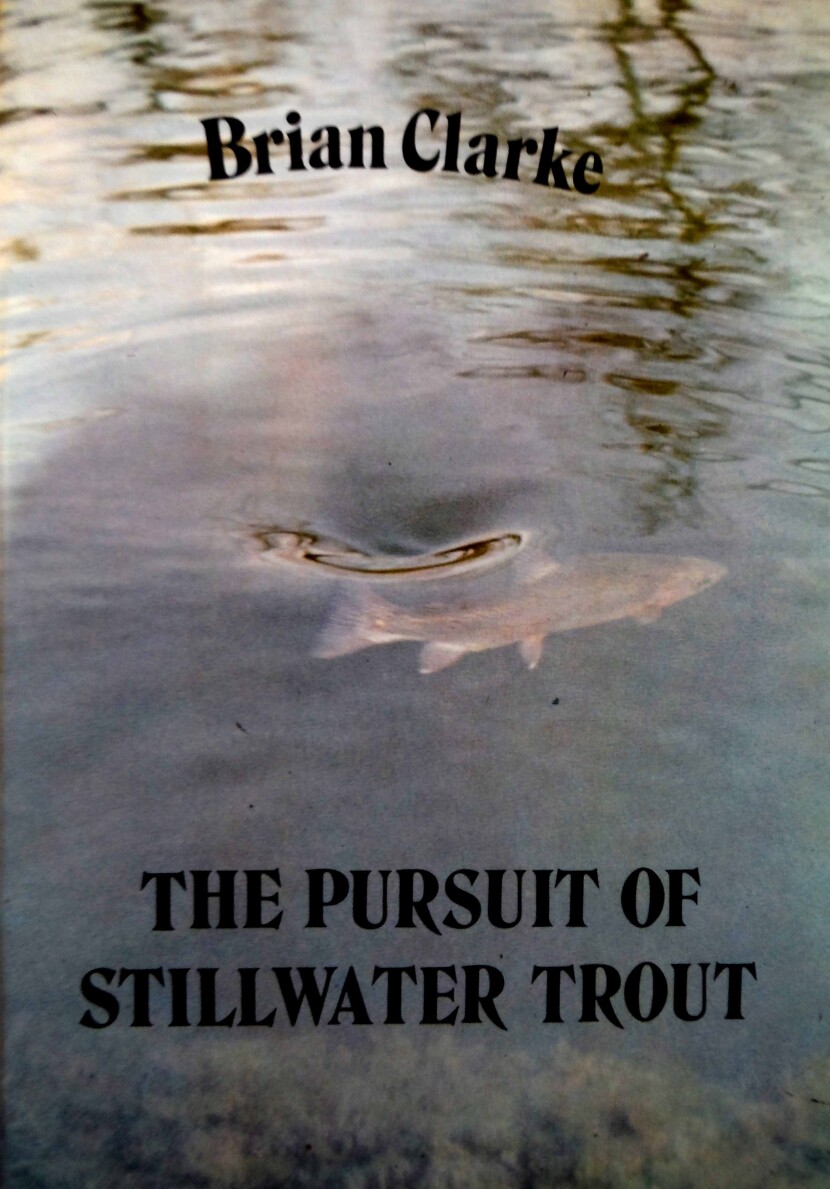 The Pursuit of Stillwater Trout
 Of course these tactics didn’t work so very well on the smaller English waters. This was the great age of expansion in still water fly angling and in southern Britain new commercial fisheries, some of them not much more than holes excavated in the ground, were springing up almost monthly. The fact was that many anglers (including me) didn’t know how to fish them. Clarke began his fishing at a time when the more senior anglers who had been schooled by youthful holidays in Scotland were still insisting on casting a short leader with two droppers armed with wet flies like Butcher, Mallard and Claret or Invicta into clear rainbow pools and stripping them briskly back. Clarke was already experimenting with fishing a single nymph on a 15, 20, or even 30 foot leader, usually fishing it very slowly, and you can guess which was more effective.
Clarke’s suggested list of useful nymphs is relatively straight forward: midge pupae, sedge larvae, sedge pupae (including Dr Bell’s Amber Nymph), olive nymphs, corixae, shrimps, damsel fly nymphs, Walker’s Chomper and his own Ombudsman, which was intended to imitate bottom crawlers like the alder nymph. Given that 50 years have passed, I find that Clarke wrote some material which I disagree with now, or would at least wish to moderate. Of course the tackle has changed; as always we should make allowances for that. There was already another school of angling focussed on the big midlands reservoirs led by such figures as Bob Church and (right at the beginning) Tom Ivens, anglers who explored lure fishing at least as thoroughly as nymphing.
One very noticeable difference is that the smaller gravel pits and pools today seem to have much less insect life in them than when they were young. When we were young, come to think of it. Those were the famous days of sponging squashed summer bugs from the number plates of our Ford Cortinas. It’s a sad fact that fertile ground when newly flooded generates superb crops of insects to feed trout in the first few years, but this abundance fades over time. Where are the massive midge hatches of yesterday, the regular late evening rises to sedges or the frustrating experience of the calm atmosphere filled with tiny white caenis flies and fish gulping them down all over the surface of the lake but rarely taking even a small Grey Duster? Such an apparent opportunity and you might come away with just one lucky fish! For one reason or another, many of these early still water trout pools have not stood the test of time and are now carp fisheries or have even become playgrounds for “wild swimmers!”
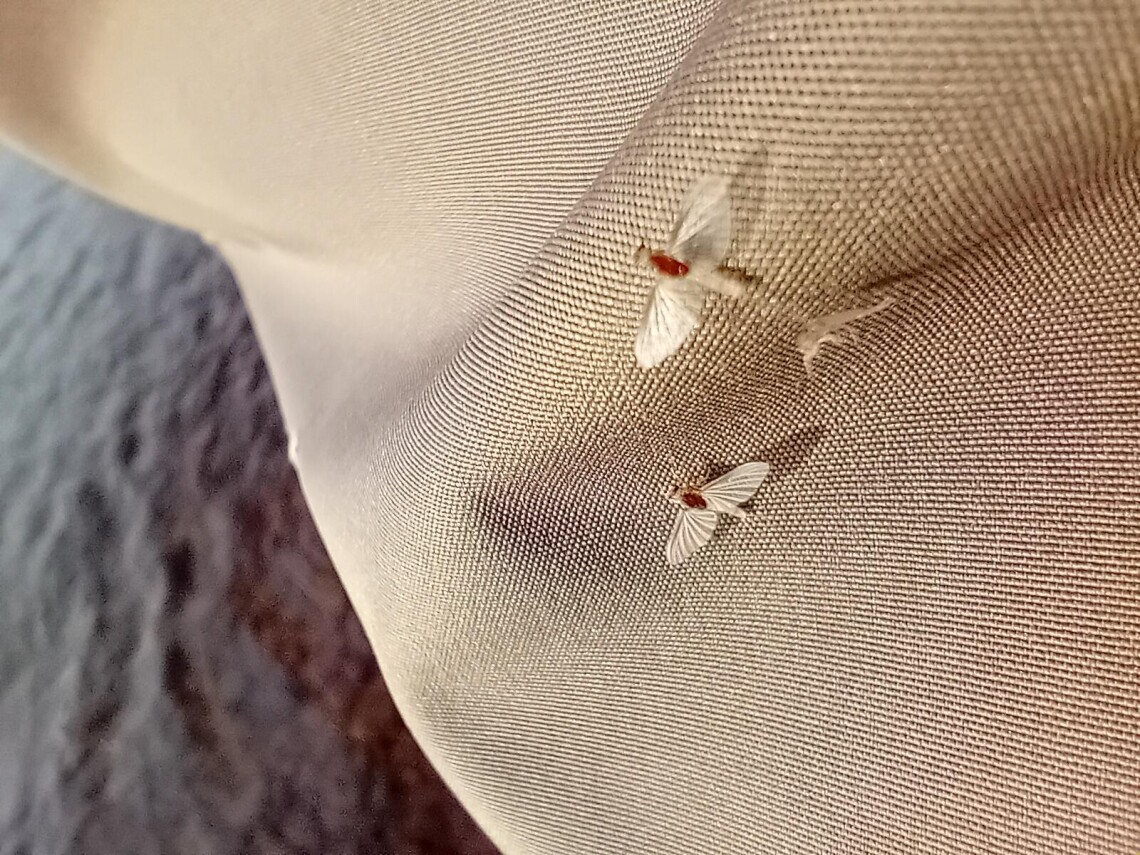 Caenis
 It tends to be forgotten today, but during the early period of reservoir and still water fishing, stocking was much less frequent and involved much smaller fish than now. Grafham Reservoir when it opened in 1965 stocked 28,000 brown trout at 5-7 inches and 6,000 rainbow trout at 7-10 inches. All the larger fish caught during the season were naturally grown on, produce of the lake itself. I see from the records that during the 1950s our Forest Pool was stocked once during the winter (usually November) with 10 inch brown trout and once during the early summer with brown trout of a similar size. All the larger fish caught above the size limit of 12 inches during the April to September season were therefore grown on. Sizeable fish were acclimatised and hard work to catch in those days and consequently valued. Now everything is stocked at 2.5 pounds and in some cases the stocking lorry visits almost weekly.
Returning to Clarke’s early fishing, his angling approach to still waters relied heavily on the nymph and long leaders and he went to great pains to explain how his leaders were constructed, greased and de-greased as appropriate to act as bite indicators and often to fish just under the surface. This is where Clarke is at his best and there is much good advice about how to watch for quite subtle movements of the leader and how to strike. He is also particularly good, in this book and in his articles, about how to spot the movement of large trout in still waters: the momentary calm patch at the surface interrupting the marching lines of ripple created by the wind. Some other anglers of the period, for example Arthur Cove and the motor-cycle tuner Ray Petty, were also concentrating on their long leaders while inching back nymphs in the same way. Clarke’s book discusses the taper and colour of floating lines in detail, but there is nothing about sinking or intermediate lines. A little space is devoted to lures intended to appeal to the aggressive or curious instincts of trout, but he clearly reserved their use for when he was quite desperate for a take! For example, he admits to keeping a Whisky Fly in his box for when he felt the need to strip something bright orange past the fish (and I can remember doing the same). Elsewhere he mentions a canny trout which refused every natural looking nymph presented before showing no hesitation in grabbing a Monday’s Child. (For those who don’t know, the MC was a large concoction of bright orange fluff like an overgrown Blob which certainly looked like nothing in nature. If anything, it reminded me of an egg yolk dropped in the water). Almost reluctantly Clarke confesses that there are times when curiosity and aggression are the main factors of importance when selecting flies, particularly where rainbows are involved.
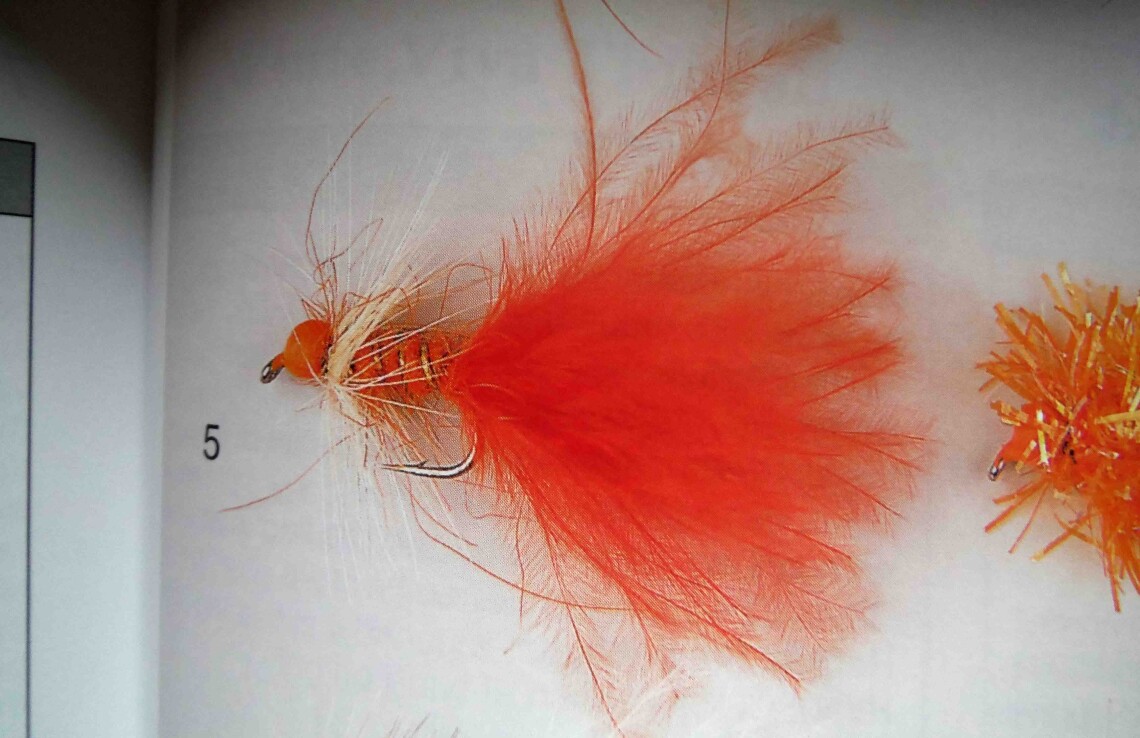 Monday's Child
 While he was very much focussed on the surface and casting nymphs to fish which he saw moving there, he was surprisingly reticent about use of the dry fly. There is a chapter on dry fly fishing in which he begins: “The dry fly does not have a major role to play in still water trout fishing.”
I think some of us today would take issue with the idea that the dry fly is a “minor tactic” on still water, although Clarke did go on to advise that the floating fly had its moments. He was a great believer in slow striking when a dry fly is taken, although I would argue that sometimes the opposite is required. Incidentally, he recommends strip striking hard with the retrieving hand as well as raising the rod when trying to set a hook at distance. To give Brian Clarke his due, he revisited this subject and revised his view in an article for Salmon and Trout in 1994, when he recognised later developments with the dry fly on reservoirs: “In the last couple of years, though, I have fished Chew, Blagdon and Bewl with acknowledged experts in fishing the dry fly from a boat.”
My own experience during the early years at Bewl was that the dry fly fishing could be spectacular, particularly if there was a good evening hatch at the end of a hot and difficult day. We had a wonderful time, starting on the very first season, when I think Bewl was opened for fishing on 1st May. Mike Doyle and I would drive down part of the newly opened and still almost deserted M25, wearing googles and crouching behind aero screens in my open cockpit Triumph TR2. This machine looked and sounded rather like a low-flying aeroplane and was by any standards truly anti-social, but well suited to a couple of young idiots. We came back in that open car from a day in the open boat, sometimes with bags of trout, but whatever the method and whatever the weather, we looked pretty windswept on return to our families. I remember a spectacular summer evening anchored in Dunster Bay during which we took our limits in short order as trout chased hatching sedges around the boat and were just as keen on attacking the artificials on the surface. Believe it or not, and without knowing any better, we were both using a size 12 Red Tag on well-greased leaders. We finished the evening with a pint just before last orders in The Brown Trout at Lamberhurst.
Clarke’s writing is sometimes inspired: for example his description of the Metropolitan Water Board reservoir at Kempton Park where I also fished 50 years ago: “… a fishery designed by the Ministry of Truth: a concrete dish, twenty acres in extent, twenty feet deep from side to side, down to its concrete bottom; with fish in it. There is not a tree on its concrete banks, and you stand on concrete. If you back cast clumsily, your fly will catch on concrete, too. But if you live in London, or near London, and you are aching to throw a line – any line – then you will put up with anything. And because I ached, I went.”
I can’t better that description, and I do remember the bleakness of those surroundings. I usually tried to find a corner where I could fish buzzers on a floating line round with a cross wind. The larger Queen Mother Reservoir at Datchet which we fished from a boat provided more of the same concrete-based scenery with the additional sight of the jetliners coming down to land into Heathrow with their undercarriage dropping, flaps extended and trailing black kerosene smoke.
Clarke barely mentioned chalk streams in The Pursuit of Still Water Trout. Fair enough, because this was not intended to be a book about rivers. However, there is a feeling that, at this earlier stage in his development, the separate world of the chalk was one he was yet to explore in detail. He does discuss Sawyer and Kite’s “induced take” method at some length, at least to the extent that it affected his own nymph fishing. However, all this changed during the years to follow and along with his friend the angling entomologist John Goddard he went on to make the chalk streams his main focus. The pair of them researched and published The Trout and the Fly in 1980 and Clarke’s environmental novel The Stream, published in 2000, has been compared in importance to Rachel Carson’s Silent Spring. Clarke’s articles for The Times and other newspapers included most aspects of fly fishing and many exotic foreign destinations, and the prose was often quite lyrical.
Fair Oaks, Raven’s Nest, Broadstone, Woolaston Court, Beanhill Farm, Sandford Pool. All these day ticket waters once used to be available in the lower Wye valley area, encouraging newcomers into the sport and incidentally enabling anglers to cast a fly at a trout when the rivers were out of sorts. Alas, they are now gone, and apart from two private syndicate lakes in the Forest of Dean, only Big Well near Redbrook, on the former site of a tin plate works, remains locally as a commercial fly fishery open to the public.
Afonydd Cymru
The umbrella organisation for Welsh rivers trusts addresses the new government in Wales, in the hope that more attention will now be paid to defending and improving the environment and in particular the rivers of the principality. Environmental problems, say AC in one of their May news items, are what a majority of the Welsh public are concerned about.
Sir David Attenborough
celebrated his hundredth birthday this month, as everybody must know by now. It’s difficult for most of us to remember a time when Sir David wasn’t entertaining and enchanting us with his films and commentaries on the natural world, but I can just about remember when he was a relatively new phenomenon. His son Robert was in my class at school, and I remember him as a very nice and rather shy boy, who was probably better known amongst the rest of us for his famous uncle, the actor Richard Attenborough. For heaven’s sake, Uncle Richard had been in The Great Escape, hadn’t he? Plus The Sand Pebbles and with Steve McQueen in both cases. However, Rob’s father David was also becoming very well known for his nature programmes on television and our headmaster took his chance to invite him to address the school. I can remember a very confident and athletic figure who positively leaped up onto the stage and proceeded to enthral and amuse us for the next hour with a talk about searching for and filming the creatures of Africa and Borneo.
I can’t add much to the knowledge we all have, except that I have heard there was once a sort of informal agreement at the BBC Natural History Unit that the Attenborough team would concentrate on filming international wildlife while another group including Hugh Falkus would deal with British natural history. If that story is true, the arrangement cannot have lasted very long. There were other great nature film makers and presenters in those early years of television, such as Hans and Lotte Hass and the oceanographer Jacques Cousteau, but Sir David surpassed them all. For myself, I believe the Blue Planet series of programmes were among the best films Attenborough ever made – but as I was once a boy who imagined himself as a marine biologist, probably I am biased. Besides, Sir David has not finished yet by all accounts.
Oliver Burch