There isn’t much to report on the fishing front for late November and indeed for most of December, simply because floods were pretty well continuous. Some of the grayling and coarse anglers did brave the conditions and try, but the water levels ensured that results were meagre. One exception was Chris Duller from Ystrad Meurig who on 27th November found the Wye falling at Fownhope No 5. Fishing alternatively with bread and cheese, float and feeder, he managed a dozen chub. The weather was mild, even if the rain would not let up, and river levels continued to hop up and down. BJ from Bristol with a friend fished at Middle Hill Court on the 6th December and caught 2 barbel and 6 chub. On the same day Peter Cook from Derby blanked on Sugwas Court: “River rising fast, no bites.” Floods continued to 14th December, when Gerald Allsopp from Bristol caught 2 barbel and 2 chub on meat at Middle Hill Court: “River was rising with a bit of colour, blowing a bit.” On the same day RN from Swansea blanked at White House and informed: “It’s worth noting that there is a sign in the farmyard that states no vehicles other than 4x4s are allowed beyond the farm buildings area, which when you see the track down to the fields and river you’ll understand why as it is exceptionally muddy and on a slope.”
By 19th December we had flood warnings all over the border counties and even lakes and ponds had become muddy. One sad result was the collapse of the Llangollen Canal bank at Whitchurch, where narrow boats were grounded and even sucked into the landslip gap. A build-up of water leaking through the raised embankment led to a sudden mudslide which emptied the canal section. The Canal and Rivers Trust are now faced with a massive engineering job to repair and refill the channel. It was Christmas and the last days of the year before the river levels had subsided to an extent and, incidentally, the weather forecasters informed that 2025 had been the warmest year on record. That will be the latest of a number of record years. However, the weather as December ended was dry and cold, just as you might expect from a traditional winter.
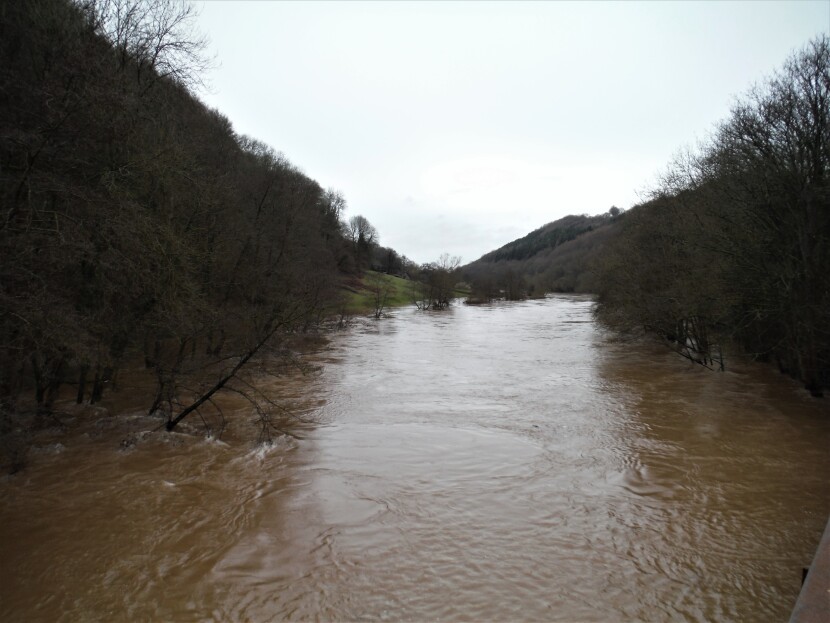 The lower Wye showing its power at Redbrook
 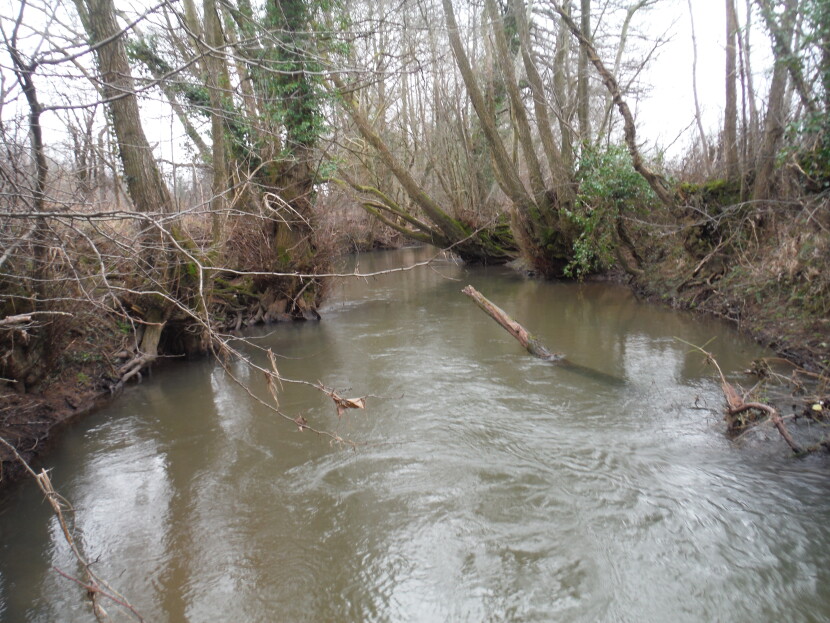 Dore in winter
 On 4th December Monmouthshire Council announced the early assessment and feasibility phase of the Resilient Rivers Monnow Project, which will involve a partnership between the Wye and Usk Foundation, Monmouthshire County Council, Natural Resources Wales and Network Rail: “…we will be bringing a consortium of funders together to share the cost of delivering land use change starting at the end of 2026.” The idea behind this is to build on the understanding which has been acquired of the geology, soils and agriculture of the Monnow valley in order to modify the release of rainfall into streams and rivers through the catchment. WUF field staff are already meeting and discussing with farmers to explain what advantages are likely to accrue to them from the scheme. I imagine the WUF teams will be doing most of the heavy lifting in terms of implantation, while the motives behind the engagement of the partners are obvious: sudden flash floods are immensely damaging to wild life, agriculture and property. Network Rail pointed out that they spent 4 million pounds in 2022 on flood defence measures in the Monnow valley, yet still “…events like Storm Claudia pose a threat to our railway.” From an angler’s point of view, the beautiful Monnow truly is a river in need of rescue. It is hoped that if successful this project based on hydrological monitoring could provide a template for other catchment solutions, including the neighbouring Usk and main Wye.
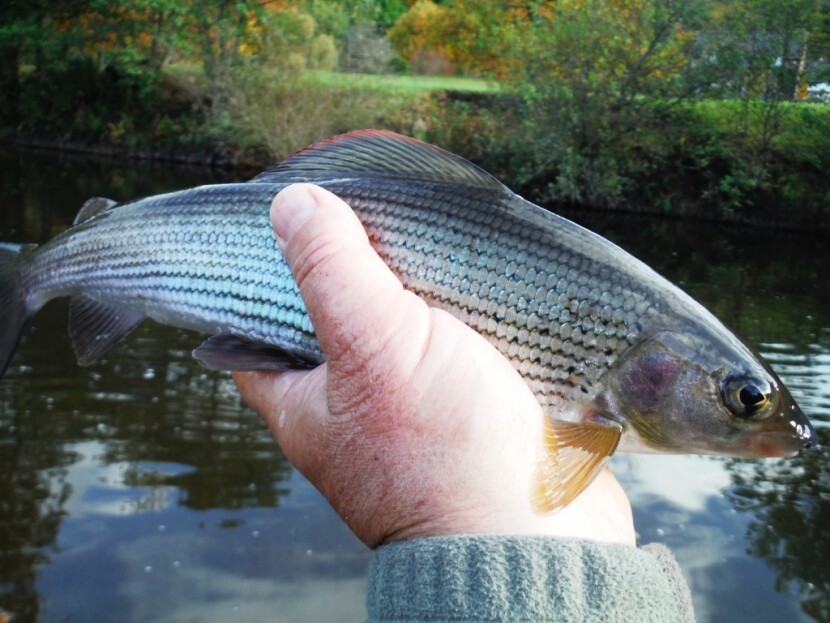 Monnow grayling taken in autumn - note the blue tinge
 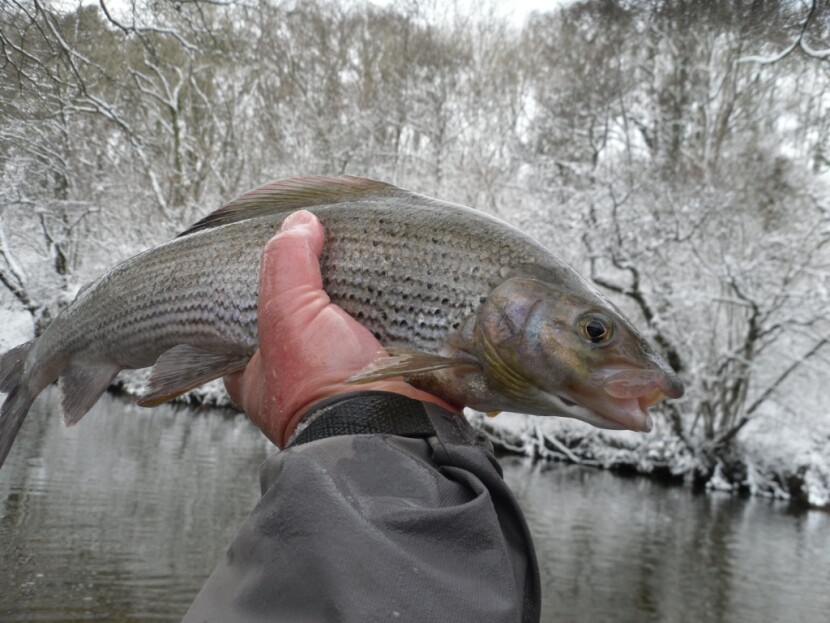 Irfon grayling
 I noticed that the January edition of Trout and Salmon carries a photograph of a grayling caught in the Arundel Arms water in Devon by one “Ozzie” Gough, which he found remarkable for its bluish tinge. This got me thinking again on the subject of the colouration of the fish we try to catch, a much discussed subject usually involving trout, which as we all know can vary tremendously in their markings. Much has been written also about the delightful colouring of grayling, but they can vary too. The Lyd grayling in Mr Gough’s photograph is surely a handsome one, but I don’t think the blue tinge is unique. I often notice a similar silvery blue sheen on a Monnow grayling (when I can catch one). Have a look at this autumn photograph of a grayling taken at Skenfrith (above left). The origin of our Monnow grayling is that supposedly they were stocked by Canon Eagles, who put in a few during the 19th century. The grayling of Devonshire streams would also probably have arrived by human intervention. (Read Grayling Fishing by William Carter Platts for some interesting theories about why grayling are in some rivers and not others).
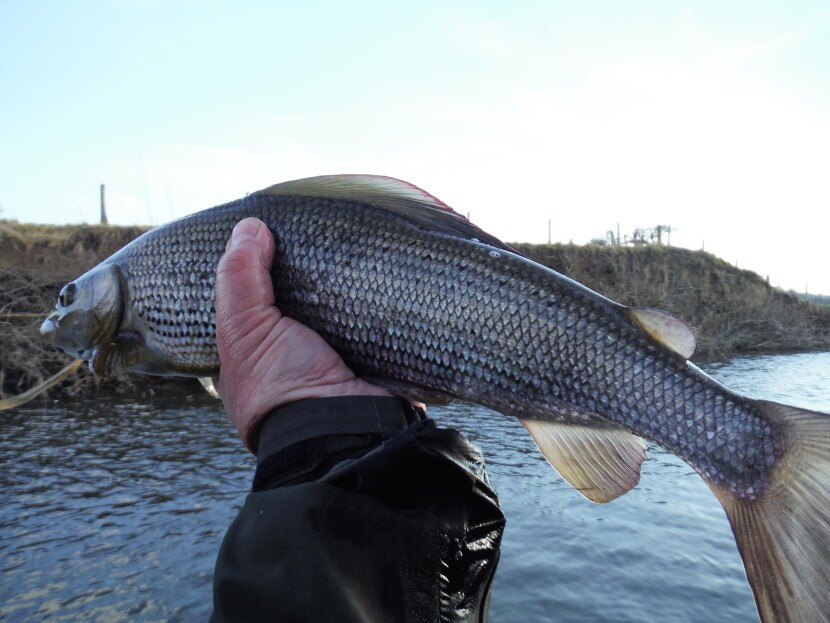 Ithon grayling
 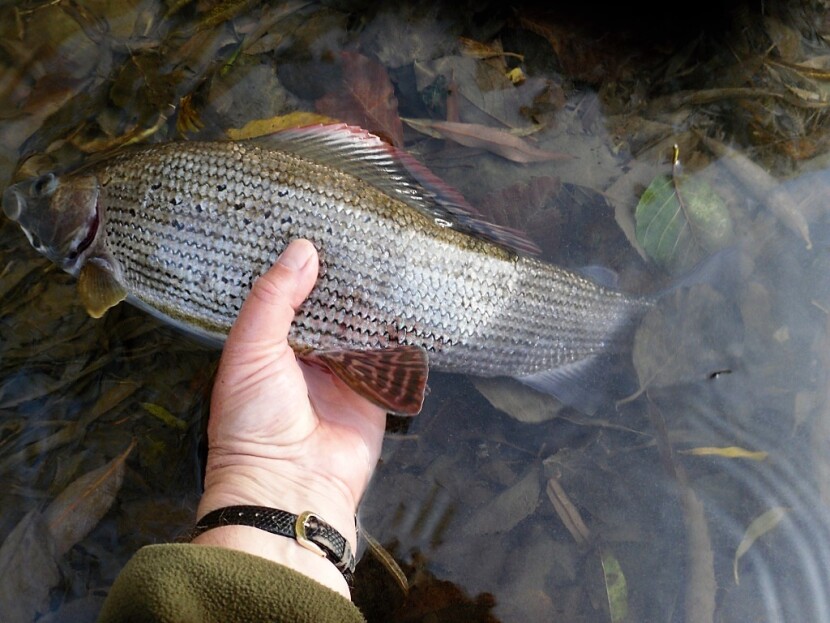 Lugg grayling
 Otherwise, main river Wye, Lugg, Arrow, Ithon and Irfon grayling are assumed to be natives and all these, apart from the famous coral coloured fins and gold streaks on the belly, tend to have flanks in various tinges of gun metal grey, and sometimes in the case of large ones, almost black. Chalk stream grayling also tend to be fairly dark. A lot of the charm of our sport is that revelation of colours at the moment of capture, even if the quarry is out of the water only for a moment. Children learning to fish revel in this. While on the subject of the Monnow, rumour has it that a new fish pass is planned for Osbaston weir, by-passing the turbine of course. The old one has certainly not been very successful recently at moving salmon upstream. Winter grayling fishers very occasionally come across the odd salmon which has made the passage.
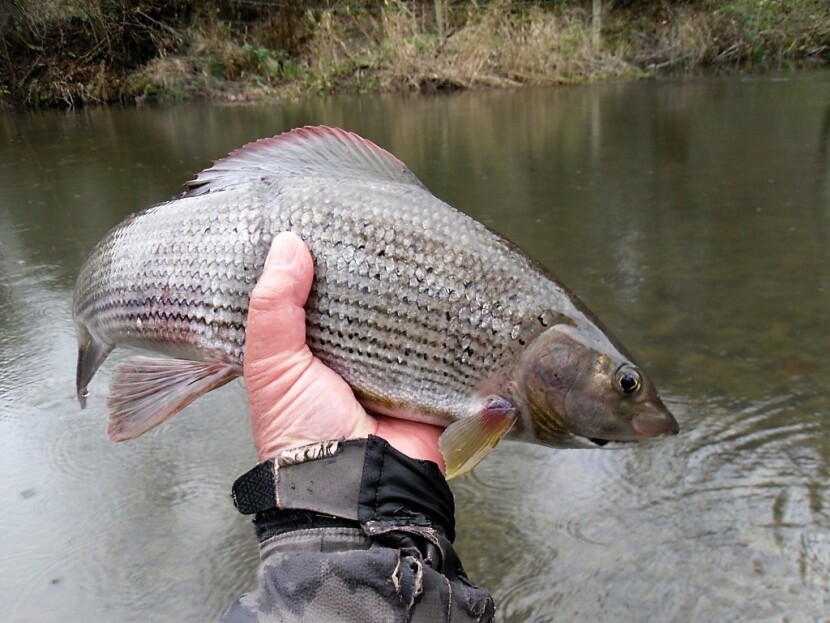 Arrow grayling
 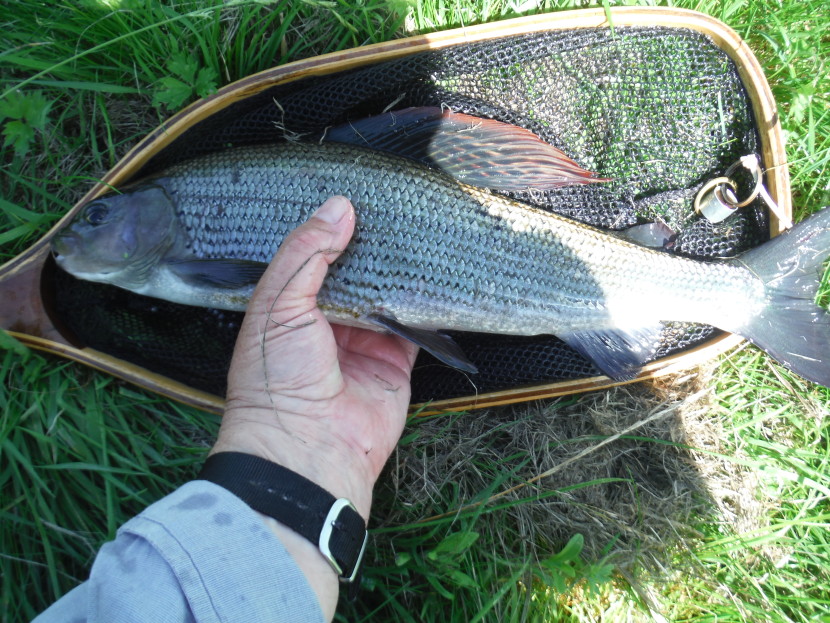 Avon grayling
 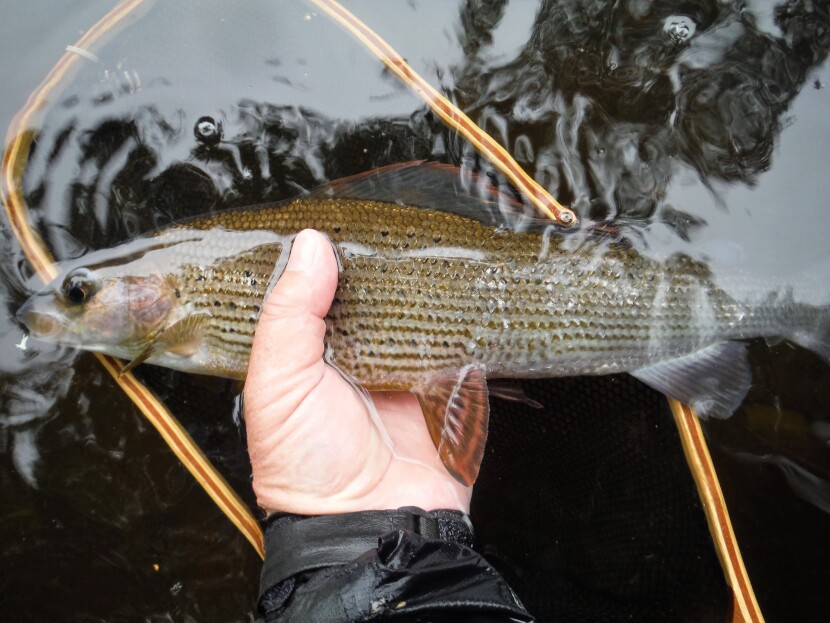 Upper Wye grayling
 The updated salmon rod catch figure for the whole Wye system during the season remains at 59. It tends to be more difficult to get figures for the Usk, although we do sometimes see catch reports for ISCA at the bottom end and I know that the Merthyr Tydfil Angling Alliance members recorded 5 fish from the middle river (3 from Kemys and 1 each from Ysbytty and Mardy). Jean Williams, formerly of Sweets Tackle Shop and writer of the Trout and Salmon column, reports the Usk total as 45, which is doubtless a pretty reliable figure. Sadly, people are starting now to talk about salmon as a “rare fish” on both rivers.
Here is a nice mid-winter interlude, reminding us again of warm days of summer: Lyn Davies buzzer fishing on Swiss Valley reservoir in SW Wales.
If on a very clear day you climb the Beacon peak of Pen y Fan in South Wales and look south still further, believe it or not you can sometimes make out, just beyond the smoky blue/grey line of the Bristol Channel, the tawny slopes of Exmoor. The Forest of Dean, which is where I still live today, and Exmoor, which is where I caught my first trout with a fly rod rather than a worm, are in fact not so very far apart in miles. However they are, or at least they used to be, very specific places each with a culture all of its own. One big difference: few strangers visited the Forest of Dean 60 and 70 years ago, but Exmoor was already a famous tourist destination and had been ever since RD Blackmore published his romance Lorna Doone in 1869.
I remember from my childhood the holidays we used to have on Exmoor, and there was a routine to the journey from the Forest. We crossed the Severn estuary by the turntable ferry at Aust (no bridges then unless you went up to Gloucester), later getting out of the old pre-war Morris with my mother and sister and walking so Dad could nurse its dubious brakes safely down the 1 in 4 gradient at Porlock hill. Then, with luck we would go for a cream tea in Lynmouth, after which up the narrow lanes onto the moor and to stay in a farmhouse at either Oare or Malmsmead. The journey took most of the day. We children fell asleep in attic rooms listening to the sounds of sheep on the pastures all around and in the morning there would be most wonderful porridge, bacon and egg breakfasts served by Biddy, a cheerful old soul bent over with rheumatism and with an almost impenetrable West Country accent who called everybody “M’dear”.
We had our different holiday interests on the moor. On reflection I am not sure what my mother got from the trip, but I think it must have been a “smart” enough destination for her to be able to talk about it at the Women’s Institute later, which would have been enough to content her. For my father and sister it was horses and they would ride most days. Exmoor with its wide skies and big hills is certainly the place for it and in those days a large part of the human population seemed to own a horse of some kind. It was quite common then to see a pony and trap still in daily use and we children used to take odd times off to watch the local farrier at work. Moreover, hunting was still in full swing and almost everybody locally from squire to farmhand seemed to enjoy it. Dad would take us to the meets to look at the tall horses and the fine hounds and he wasn’t above accepting one of the glasses of dark ruby port being handed around. One of the most beautiful sights I ever saw involved the Devon and Somerset Staghounds coming down off the moor on a day of rain and thunder; the black clouds parted for a while to allow a gleam of watery sunlight to illuminate the whole scene. I have never been particularly moved to take up a position on the morals of hunting – I’m against it if the quarry is a creature rare or threatened in its range – but I know a beautiful sight when it comes to me. Extra thoughts about hunting: I never wanted to do it, but I was not minded to oppose it. In much the same way, I feel that the corrida of bulls is a matter for Spain and the other Hispanic countries which like it and nobody else.
However, more to the point and unlike the rest of the family, horses were never really for me. On Exmoor I rode with my father and sister occasionally and years later in Afghanistan I sometimes had to ride a horse because there was no other alternative, but I never overcame my concern about something much bigger than me and nervous as well with potential for a bite at one end and a kick at the other. As far as I was concerned, Exmoor was all about trout fishing and I went out with the rod every day if I could. The moor with its bogs is seamed with rocky hill streams running off in all directions. I confess that I never fished the Barle system which drains Exmoor to the south. However, it’s worth noting that the famous American traveller and angling writer Negley Farson spent his retirement fishing the Barle, and very happily too by all accounts. I have written about him and Going Fishing before. Instead, I fished the Lyn river system on the north side of the moor, particularly the East Lyn and its tributaries, the Oare and Badgworthy Waters. A trout fishing day ticket then was to be had for a nominal price of a few shillings to be paid at the bailiff’s house, where in the hall I remember there was a wonderful chair made entirely of red deer antlers. I came back to the same water as an adult in the early seventies and according to my diary notes was quite offended to find that the day ticket price had risen to one whole pound. So much for inflation.
Once armed with a ticket, I had no end of pools to explore, particularly on the Badgworthy Water where I never did reach the top of the fishery. I had a 9 foot split cane rod in 3 pieces, a little Japanese click-check reel, a floating level line and some 9 foot leaders. Casting was not so difficult, because much of this moorland stream was open. I nearly always fished a pair of wet flies, as I recall, and the patterns which worked for me were Coachman, Greenwells, and Snipe and Yellow in size 14. I think I must have bought them in Lynmouth. All the fish were taken in the fast water and were pretty small, although remarkably beautiful. I can remember days when I returned 25 or 30. I don’t doubt that there were bigger fish in some of the still and deeper pools, but my level line tackle was probably a bit crude for such places. On a side-stream I encountered my first otter, actually carrying a spotted trout across his jaws. He stared at me for a moment before vanishing. Otherwise, in summer, a fairly steady procession of tourists came walking by along the river-side path up the Badgworthy Water. Most of these were looking for sites mentioned in Blackmore’s novel, such as the famous Waterslide which young John Ridd climbed while hunting loach with a fork. “Is this really the Doone Valley?” Americans would ask. The truth is that Blackmore had based his novel on a real landscape, but employed a pretty vivid imagination to boot. If there had once been remains of a 17th century brigands’ camp in this valley, it was probably buried under tons of rock from the floods of 1952 which killed 32 people down in Lynmouth.
There was also a possibility, theoretically at least, for some salmon angling, which involved the dark pools of the East Lyn below Watersmeet. This is a much bigger river falling steeply through woods towards the sea; the pools are deep and in those days you could clearly see the big grey salmon lying motionless far down like rows of slender U-boats moored in their pens. They had been there for weeks and they studiously ignored a little Devon Minnow I spun past them with the trout rod. Locals knew better than to bother fishing for salmon when the river was in this condition, but a few days later heavy rain came, the river coloured up and every pool had somebody worming on it. There was a palpable air of excitement and we watched fish after fish being landed, some of them fresh from the sea, while the rain continued to spatter down.
I am hardly up to date with the Exmoor trout fishing which you don’t hear so very much about, but people tell me the little spotted fellows are still there and I suppose that the moor is some kind of island refuge for them against the pollutions and pressures of more crowded landscapes. I know that we still get our rainbow trout today from a firm which breeds them in clean Exmoor water from the River Haddeo, free of the dreaded American signal crayfish. The green Exmoor Trout Fisheries truck with its row of tanks is a common sight on our local Forest roads. They claim to be the last firm in the UK actually breeding trout from selected adults rather than buying in fertilised eggs. Mike Weaver in The Pursuit of Wild Trout wrote about fishing the East Lyn below Brendon, usually with a dry fly but on one very successful day of declining flood he was using a team of wet flies fished down. This was at Rockford using a Silver March Brown and a Soldier Palmer. The other day I saw a letter in the angling press from the entomologist Dr Cyril Bennett describing a trip to Exmoor trying to find specimens of the Autumn Dun, which is apparently disappearing from the chalk streams. On September afternoons I occasionally used to see this large brown fly on the Usk above Brecon, but not recently.
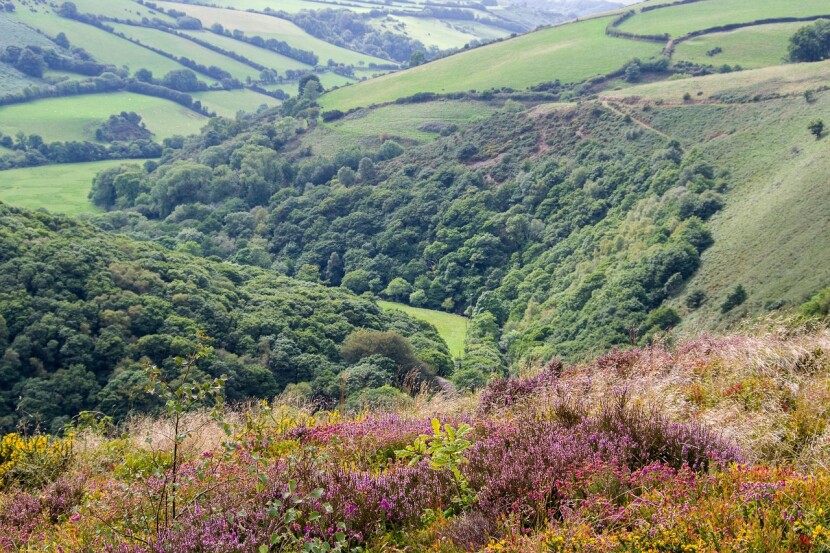 Exmoor coombes
 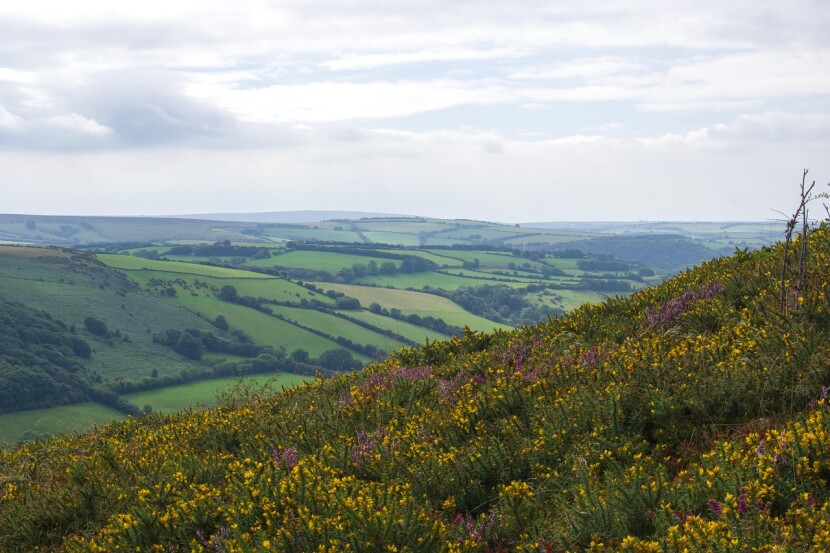 High on the Moor
 Otherwise there is a book available specifically about fishing on Exmoor in times past. This is Claude Fitzroy Wade’s Exmoor Streams: Notes and Jottings with Practical Hints for Anglers. Like many another good angling writer, Wade was a barrister in the real world, and he published his little book in 1903. A centenary edition was published by Chatto and Windus in 2003, so you can still get it. Wade wrote the book about his fishing 60 years before my day, a time when he was paying 2 shillings and six pence for his trout day tickets, but he had begun his own Exmoor fishing still 40 years earlier in 1861, when Lorna Doone was not even published and the crowds of Blackmore fans had yet to arrive. Wade described those quieter days on the moor before tourism with a definite sense of nostalgia. He ranged widely and walked prodigious distances across the hills between different tributaries, sometimes arranging to be delivered or met at a strategic point on the moorland road by a pony and trap. I don’t suppose Exmoor trout were much larger then than they are today, but Wade caught a lot of them, and he often had plenty to carry apart from his tackle:
“…only once have I exceeded one hundred and twenty-five, and that was on a good day above Chalk and the head of Badgworthy (walking from one to the other over the hills) when, fishing from 9 am to 5 pm, I got one hundred and sixty-seven. I remember coming home that day to Wellfield Cottage, above Brendon, with a large basket filled to the brim and both pockets of my coat, which I had lined with pocket handkerchiefs and newspapers, also full, and my people, too, well remember the number of plates and dishes which had to be brought to me as I turned all my catch out.”
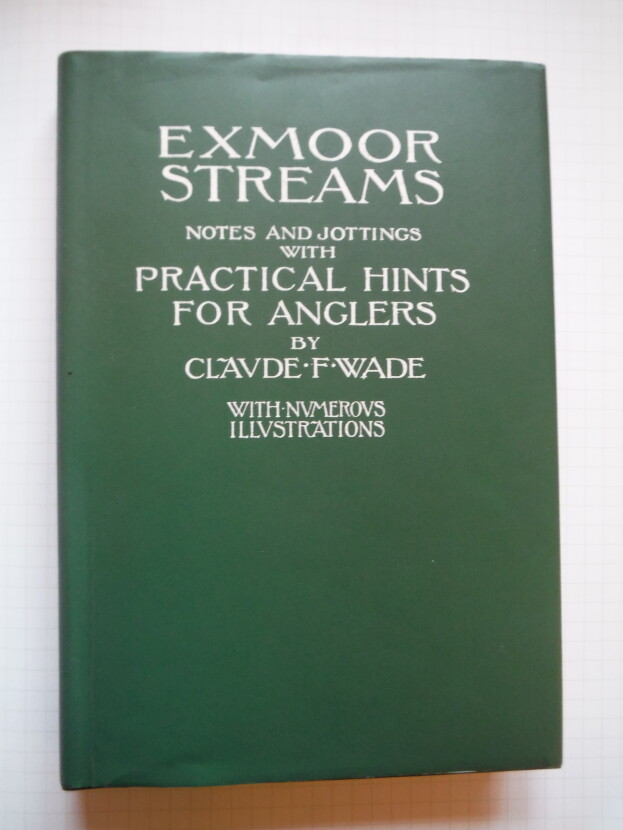 Exmoor Streams, Wade
 Wade generally fished two wet flies upstream. As usual with early writers, the advice on tackle is not so helpful to the modern angler. Wade didn’t like split cane and for the trout fishing he favoured a 9 foot 3 piece greenheart rod which he bought from Farlows in 1875: “…I still, after twenty-seven years, have the stops which fit into holes at the end of the joints. A top joint has snapped now and again through carelessness, but the rod is as straight as when I purchased it in the Strand, and it only cost twenty-five shillings.”` When it came to clothing, Wade recommended dull colours and he had a particular liking for a black bowler hat, because you could wind at least two collars (leaders) with flies attached around it. His list of flies is unexceptional, and he cites: Governor, Black Gnat, Blue Silver Twist, Water Cricket, Stone Fly and Blue Upright. But of the last pattern he remarked: “I know it’s rank heresy to say so [but] I don’t care for it one bit, and I am supported in this dislike by Willie Bale, the Lynmouth shoemaker, who knows more about fishing than most people in these parts.” He was similarly disparaging about Coachman, which was popular on the Moor when I fished there and certainly very kind to me.
Salmon fishing for Wade was all about worming the river from Lynmouth up to Watersmeet and these pools are all described in detail. Once into a salmon, the battle was likely to be fought out at close quarters because a run down to the pool below would very likely lose the fish: “For the last six or seven years I have used a fifteen foot sea trout rod by Forrest, of Kelso, much too good for the work of worm fishing, but more for the pleasure of handling the fish once I have hooked them. The rod I should really recommend for this sort of fishing would be a stiff one, almost like a jack rod, about twelve feet or even less in length, and with upright rings. I myself for years used a strong bamboo of these dimensions.”
Salmon of 15 or even 20 pounds could be encountered under the rod top in these rocky pools, so there was no room for light tackle. In a coloured flood Wade recommended using two pieces of whole gut knotted together for a short salmon leader. It was a rough kind of fishing with a considerable risk of falling into a flood while trying to gaff a fish alone: “I did once, and before I knew what had happened, I was overhead just at the edge of the waterfall. It would have very soon been all up with me, as the water was very high, and I should have been dragged down helplessly in the heavy rush, but I realised at once where I was, and struck out as hard as I could up the little creek, and crawled up the rock at the end of it drenched, but thankful. A friend of mine who was about 20 yards lower down, saw my rod floating towards him, and got hold of it before it went over the big fall into Peal Pool. On this occasion, and on one other, I have fallen into the river in full flood, and I pray that neither I nor any of my readers may ever do it at any future time, for it’s one of the nastiest things I know.”
There is also a certain amount about peal, which were usually fished for below the West Lyn junction, and for which he used a worm in a flood or a minnow, occasionally a wood-louse as bait during low water. The sea trout seem to have been more common then, particularly in the mile above the sea, and weighed an average ¾ pounds, although 4 pounders were not unknown. Wade used an 11 foot Farlows rod for his sea trout fishing while some of his friend used a 15 foot double hander. On occasions he would also fish fly by day as well as by night: “I think down and across is the best way to fish for peal, as you cover the water better, and if you view your fish you can work your fly down to and over him. This gives him a chance of seeing it better and then taking it strongly, for a peal is generally much more deliberate in his risings than a brown trout.”
Wade has some other descriptions of Exmoor amusements during the 19th century. He used to follow the hunt on foot and on occasion shot blackcock, hares and partridges. There was also cricket which used to be played in the Valley of the Rocks and he describes one “historic match” between Lynton and Minehead. There is also a good deal of romantic poetry in his book of a kind which leaves me slightly cold, but of course it was very much the fashion of the day. The past is a foreign country and they do things differently there, as we have been reminded more than once.
When rivers are in high flood, predators can be relied upon to show up on still water instead. There were 4 cormorants on our Forest Pool this morning and they didn’t want to leave. Normally they would be found on the Wye somewhere around Monmouth Bridge, but now they have come to harass our trout. The rainbows might be a bit large, even for cormorants, but the smaller native brownies and of course the roach are vulnerable to those stabbing beaks. The heron was there as usual and so were the dabchicks and the kingfishers. In fact the appropriate predator was hunting for any size of fish you might mention; only the goosanders were absent for once, although we have seen a lot of them this winter. The weather has remained relatively warm and I would welcome some more frost. I have found ways to winkle out the odd rainbow trout, but I am still hoping for the summer’s growth of weed covering our Forest Pool to die back.
We don’t yet have detailed reports for the holiday fishing, so I will include that in the February letter. My very best wishes to all and here is to a better 2026!
Oliver Burch