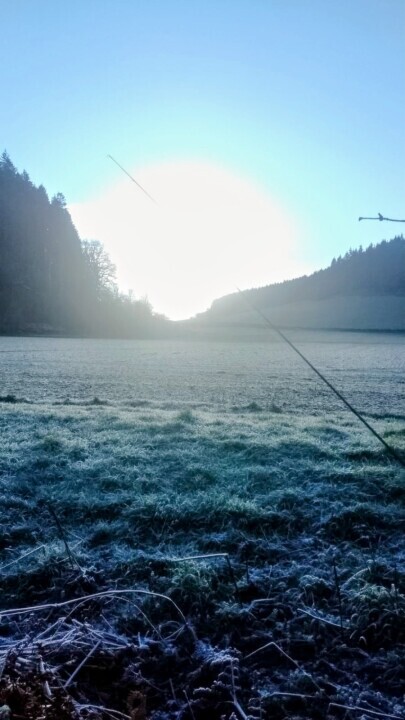
 Lyepole meadows - Andy Burgon
 Floods made the Wye system unfishable through most of December. Only as the Christmas holidays arrived did grayling and coarse anglers get a real chance at the water, even though air temperatures fell down to minus 4 or 5 degrees. This was the kind of cold and dry high pressure weather I always ask for during the winter period, even though iced rod rings are a trial. Be careful about what you wish for; this time most catches turned out to be quite modest. As early as 21st December, Rhodri Lewis from Neath with a friend visited the top of the Irfon at Melyn Cildu (the Irfon tends to come down first as floods recede) and found themselves beset with tiny grayling parr. This, from a water which was a few seasons ago gaining a reputation for “a few big ones,” was at least hope for the future. After Christmas Neil Guerin from Camberley caught 3 grayling from Craig Llyn on the main river while Justin Layne from Cambridge took 4 at Abernant. He appreciated the steep and narrow path contrived to the upper part of the beat.
On 29th December a visitor from Cambridge took 3 grayling from the Llynfi at Pontithel using nymphs while David Wright fished the Lugg in high water at Lypole. The Lugg and Arrow are usually the last tributaries to come down in level due their powerful and deep springs charged by rain falling on Radnor Forest. David caught 4 grayling to 1.25 pounds by trotting. Steve Bown from Solihull with a friend fished Lyepole the following day and caught 10 small grayling along with a lot of out of season trout, finding the water: “…6 inches high, but lovely and green.”
Andrew Smith with 4 friends from Harlow campaigned the lower river running clear at Middle Hill Court and accounted for 6 chub and 2 pike: “An enjoyable day, but hard as nails!” On the last day of the year two anglers from Llanhilleth took 7 Monnow grayling at Skenfrith: “…nice few hours out in stunning surroundings.”
The cold was really biting during the first days of 2026; the hills were white everywhere and eventually the valleys too. Schools were closed and road traffic reduced as snow-falls imposed silence on the landscape. Martin Griffiths from Pontypool caught 3 grayling by Euro-nymphing the Monnow at Skenfrith and with a friend the following day caught 3 more from the main river at Doldowlod up by Rhayader: “Very cold day.”
Andy Burgon from Bodenham was a bit more outspoken about fishing Lyepole on 4th January: “Midwinter madness! Minus 4 degrees when I turned up at 9 AM. Ice in the rod rings for the first hour…overall a bitterly cold day, but rewarding…” He caught 16 grayling from the Lugg by trotting with a centre pin. Incidentally, I think Mr Burgon must be a bit of a purist if I can use the word without seeming to be rude - note from the photograph the lack of handles on the spool of his reel, which is equipped with finger sized holes instead. This implies careful reel management and use of the check when playing a fish plus batting the rim of the spool in order to wind the tackle back for each new trot. I could never bring myself to remove the handles from my centre pin reels; I get overrun tangles easily enough…
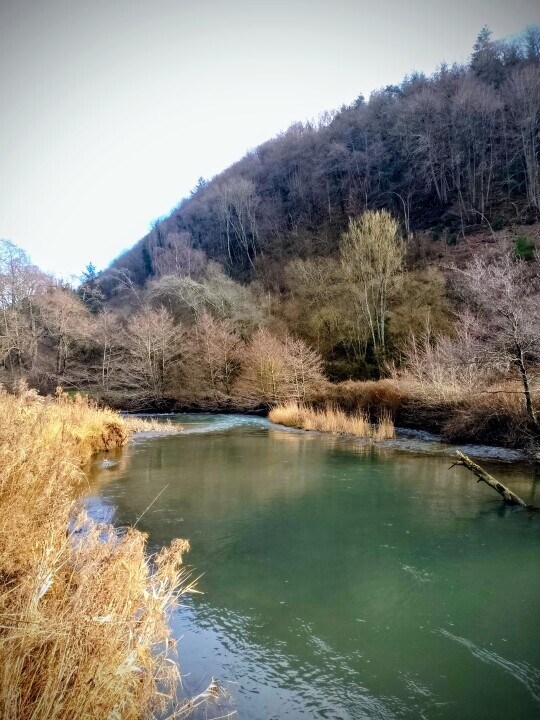 Lugg at Lyepole - Andy Burgon
 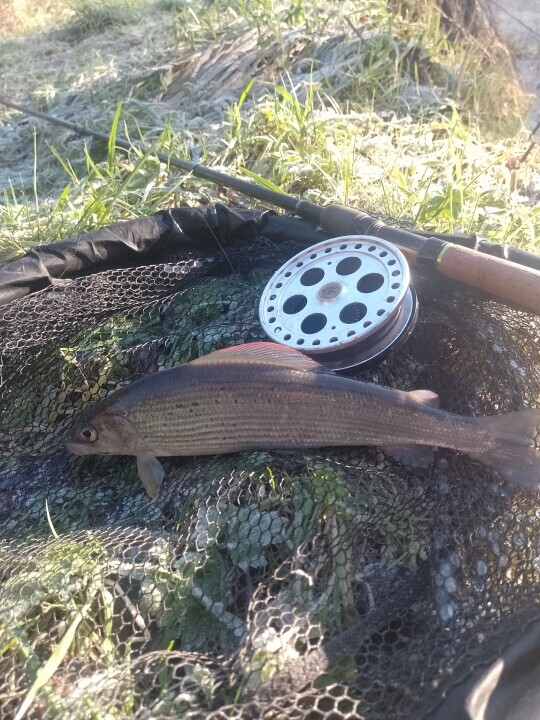 Grayling and a pin, no handles - Andy Burgon
 A Bristol angler reported 2 grayling on nymphs from the Bathing Pool of Ty Newydd on the main river: “Very, very cold day, minus 4 degrees when I started at 10 am.” By 4th January a Worcester angler reported from Court of Noke, the famous Arrow beat associated with an elegant house and the Bulmer cider family: “River fishable with 0.32 metres at Titley Mill, cold and clear.” The ground was frozen hard but he caught one good grayling by trotting and lost another. Peter Thomas from Kidderminster tried the Lugg at Eyton in the next valley: “Nice and clear and a reasonable level.” He caught 10 grayling and some out of season trout, while spotting an otter and the inevitable cormorants. On the 10th January, at minus 1 degree with snow lying on the ground, but the Irfon in reasonable condition, John Thomas with a friend from Ammanford fishing Melyn Cildu had one good grayling between them, caught on a nymph. The following days were lost due to floods as rain came in and the rivers rose again. Gareth Lewis from Abergavenny did manage to catch a couple of winter chub in high water at Foy Bridge on 12th January.
The rain kept coming and the rivers stayed up for many days. On 17th January BJ from Bristol with a friend took 5 chub at Middle Ballingham and Fownhope No 8. John Thomas of Ammanford tried the Irfon at Melyn Cildu again, this time on his own, and accounted for 6 grayling to a pound on nymphs. Ben Andrews with two friends from Epsom fished at Middle Hill Court and managed 15 chub, a barbel and a grayling. On the 19th January a visitor from London tried the Arrow on the famous Leen beat, blanked for grayling but was troubled by out of season trout. Bruce Elston from Beaworthy fished flood levels at Middle Hill Court and took a barbel and a chub. By 27th January Storm Chandra was sending river levels higher than ever and the usual flood warnings were affecting low-lying roads and housing. The water was too high for fishing during the rest of the month.
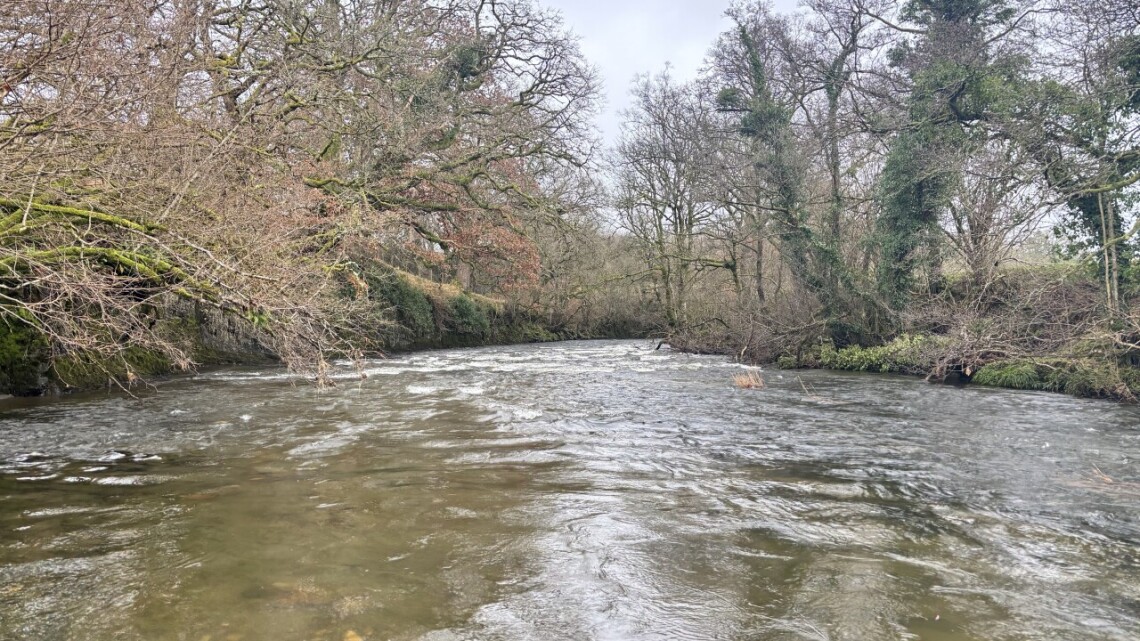 Melyn Cildu - Rhodri Lewis from Neath
 The latest salmon rod catch estimate I have heard for the mighty Severn is between 50 and 60. Perhaps another 50 for the Usk according to Dr Guy Mawle’s estimates. The updated salmon rod catch figure for the whole Wye system during the 2025 season remains at 59. As far as rod catches are concerned, the Wye and Usk always used to out-fish the Severn, despite its size and length. At the end of December, lave net fishers of Black Rock (just downstream of the motorway crossings) flagged a warning about possible pollution in the estuary. Just below their station they had found some 20 dead conger eels with red marks on the rear part of the body, along with a green eel and some white fish. Natural Resources Wales were not unduly impressed, making remarks about low oxygen levels linked to local pollution and adding that such deaths were not unusual at this time of the year.
The Cefnllysgwyne estate outside Builth Wells is for sale, either as a whole including the house, woods, farm lands and fishing with a guide price of 3 million pounds, or in lots. The Irfon fishing, which comprises about 4,697 metres of single and double bank, is lot 13. This is a beautiful valley and a river which used to be known for its late salmon run, but in modern times was more renowned as a grayling fishery, although recently catches of grayling have also dwindled. Contact: JM Osborne info@jmosborne.co.uk
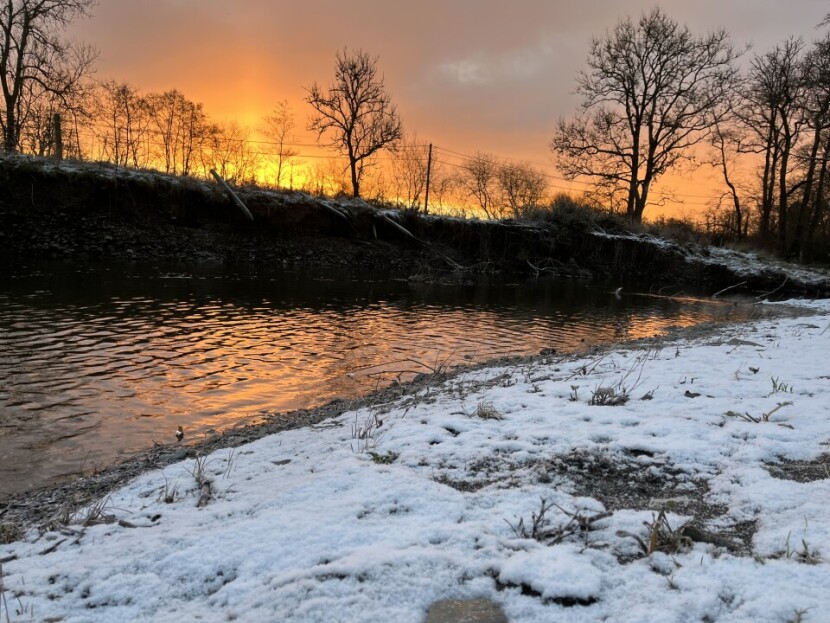 Llandewi - WP from Ludlow
 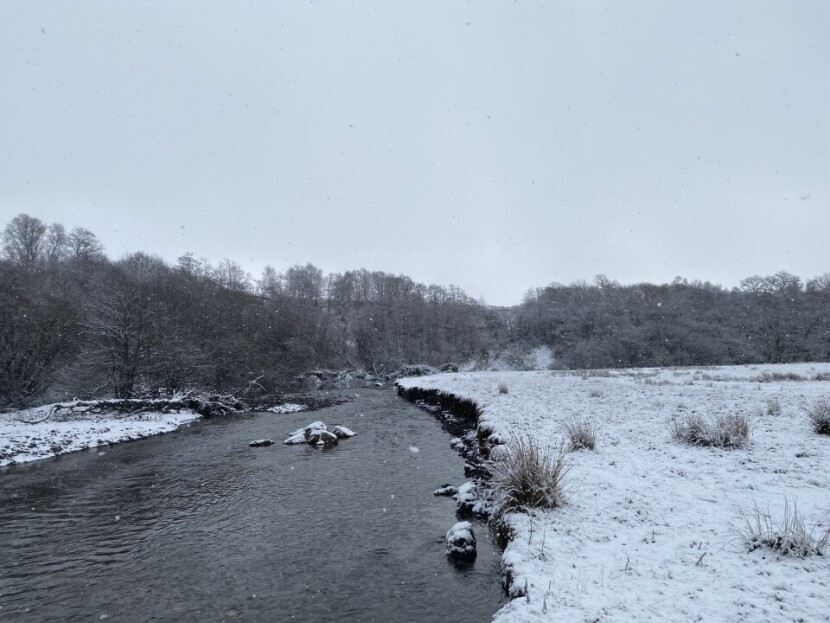 Colonel's Water - PM from Weobley
 Nerma and I were going to go shooting this morning. Rain was pouring down when I started packing the car in darkness, such that after a few minutes of drenching in a gale we decided to call the trip off. If there is one thing I hate it is trying to hit targets with slippery hands and wind blowing rain in my face. By 10 o’clock, when we might have been starting, the rain had mysteriously and in contradiction to the forecast, ceased. We might have gone after all. Very frustrating, but I am going to occupy my time by writing something instead. The question is, about what? We wait to see what will happen in the Middle East. Meanwhile during a fascinating and hardly to have been predicted first month of the year on the world stage, there has been very little real news about either fishing or the rivers. January and the New Year were generally marked by press statements from most of the various organisations claiming to be concerned about our rivers and bewailing their poor ecological status. I am afraid I do not detect much agreement yet on exactly what is wrong and what should be done about it. The present UK government apparently plans to revise the way the water industry is managed and “held to account.” I wonder if that actually means I will see any improvements in my own time? Ellie Chowns, the Green MP for North Herefordshire, which of course includes a big chunk of the Wye system, had the courage to stand up in parliament the other day and politely asked the PM why, in the recent White Paper on water, only one page was devoted to agricultural pollution which makes up 40% of the pollution total and would he commit to working with farmers to improve agricultural practices? What she got in reply was: “We inherited a real mess on water and we are taking strong means to deal with it.” Which opening line was followed immediately by a fairly vicious attack on the Green Party, its leadership and lack of commitment to NATO, finishing with informing Ms Chowns that her party was “high on drugs, soft on Putin!” Politics is known to be a rough game and forgive me if I seem jaded and cynical, but I can’t find it in my heart to feel much confidence these days when I listen to such political point scoring from Westminster. Whoever wrote that brush-off response for the PM clearly was not thinking much about the rivers of Herefordshire. Ms Chowns, who had asked a serious question, looked equally disappointed.
Meanwhile from across the border in Wales, NRW published a new assessment of Welsh species and habitats, this time covering the years 2019-24. This gives us a better understanding of the natural environment of Wales, including its rivers, and it makes depressing reading. Otters and common frogs seem to be doing well in the water but all fish species were assessed as in unfavourable condition and 3 as in bad condition. Agriculture was found to be causing the main pressure on 6 out of 9 fish species. Agricultural input was negatively affecting 52 out of 61 habitats assessed. New legislation is supposedly on the way with improved regulation, but will we see some results at last?
Afonydd Cymru has produced a manifesto with the 2026 Welsh Senedd elections in mind, which demands a strategy to improve rivers, catchment level planning, management and delivery, and for authorities to be tough on polluters. Afonydd Cymru also tell us that the Welsh public support all the above, but will they get the clean rivers they deserve at any time in the foreseeable future? I can only hope so.
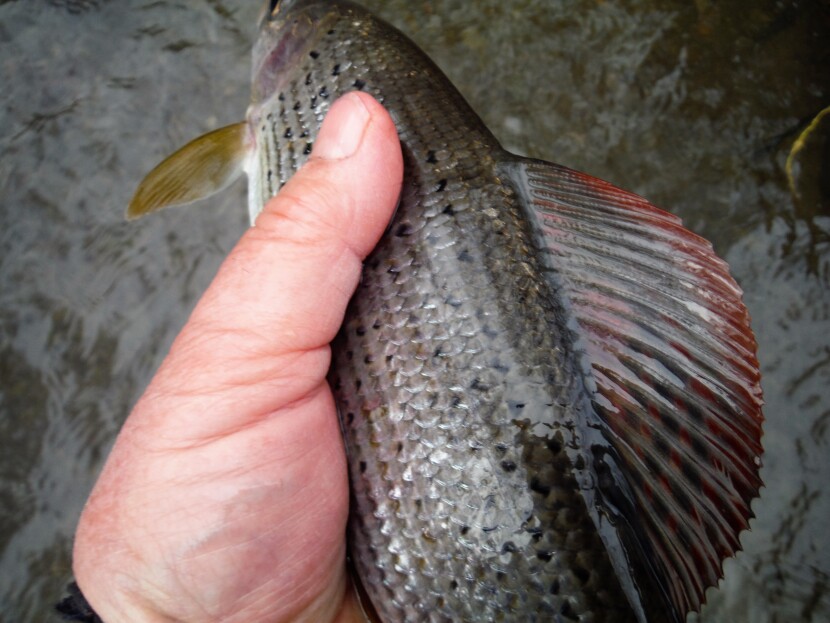 Court of Noke grayling
 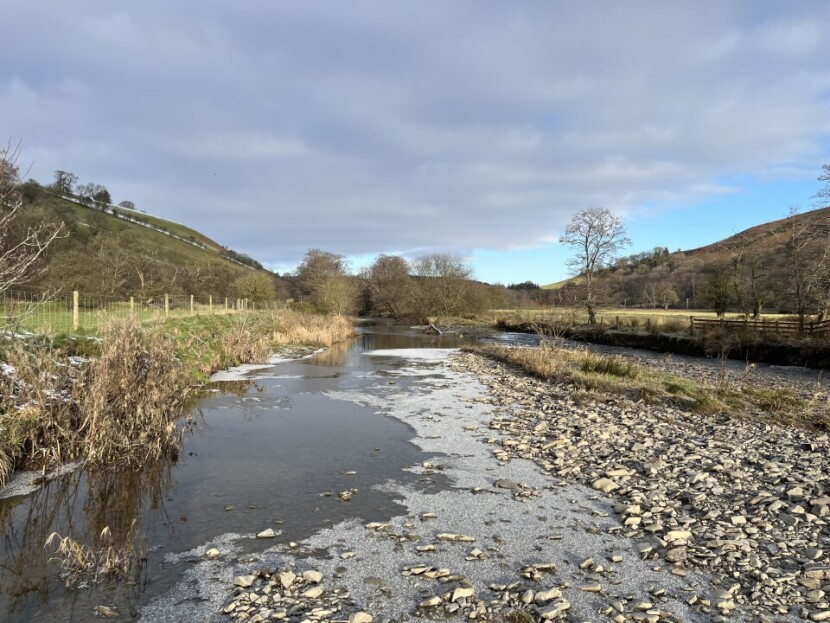 Ithon at Llandewi - WP from Ludlow
 I am going to try another direction while I am stuck indoors. Even if you can’t stand the cold well enough for border grayling fishing, or maybe you would like to be fishing but find the rivers in flood, here is something different to raise your spirits. When I was a boy, we fished for all the usual coarse species whenever we could get away from school. We also fished for trout when we were lucky enough to get near a fast running stream, which was mainly on family holidays. Nobody I knew in those early days could dream of ever fishing for such a noble (and expensive) species as salmon. But carp, even big carp in theory, were available to us in the various lakes and pools of the lowland counties. However, another theory was then in common currency, which was that the big ones were very difficult, indeed almost impossible to catch. I remember my father (who didn’t fish) telling me that, as far as he knew, carp fishing was a mysterious and almost clandestine activity, carried out secretly in the dead of night on reservoirs. This was slightly discouraging. It was easy to believe that myth about the big ones; I caught a lot of wild common carp of 4 or 5 pounds or so when I started, but it was years before I caught a double and that was quite unexpected when it came…it was actually a leather carp just under 30 pounds caught while tench fishing! Our boyhood heroes then were members of the Carp Fishers’ Club, including writers like Bernard Venables, Denys Watkins Pitchford, Fred Taylor, Maurice Ingham and, above all, Richard Walker.
I have no big desire to go back to carp fishing, but we did have fun for a few years. No bolt rigs or lying in bivouacs with rods wired up to electric alarms for us. Rather than fishing for hours and days in a static location, we used to rove around at dawn and dusk flicking baits under overhanging trees and looking for “bubbling” and “mudding” fish in gravel pits and ponds. By the time we were really getting into the business of it, we had acquired 10 foot split cane “MkIV” rods as designed by Dick Walker (I built mine from a kit) plus Mitchell 300 fixed spool reels loaded with 8 or 12 pounds breaking strain Bayer Perlon nylon. Thus with the addition of strong Model Perfect hooks we felt ready enough for powerful fish.
About the man himself, our guru, everybody knew the story. Dick Walker was the man who had caught the record carp of 44 pounds in 1952 from a mysterious pool somewhere in Herefordshire called Redmire. It was only later that I learned that “Redmire” was an invented and deliberately misleading name for what was actually Bernithan Pool, and that it was in fact not so very distant by only a few miles across the Wye from my grandmother’s home in the Forest of Dean. It was, and is, a small and weedy lake on a private estate, pretty much an ideal place for producing large carp. Importantly, it had been stocked back in 1932 with a strain of fast growing king carp from Donald Leney at Surrey Trout Farms, after which they had been left to their own devices.
By the time Dick Walker and his friends came across them after the war, some of these had grown into giants. Having negotiated access from the owners, the Carp Catcher’s Club, the first British group of dedicated big fish hunters, shared information by post amongst themselves, kept up a level of security which might have been appropriate for the D-day landings of a few years before, and so laid plans for a fishing campaign. It should be remembered that at this time the record British carp was one of 26 pounds from Mapperley Reservoir. Dick Walker later became the most famous of British angling journalists and took a great interest in the expansion of still water trout fishing. You may well know it, but for the sheer pleasure of reading it again, here is Dick Walker’s own account of his record carp:
“On 12th September 1952, Peter Thomas and I went to Redmire.
We left home in a downpour, but by the time we had reached our destination the sky had cleared and the stars were shining brightly. It was very cold indeed, but we fished until about 2 am, when we noticed a bank of black cloud coming from the north-west, and decided to pitch our tent before it began to rain again.
We chose a spot on the west side of the lake, in deference to a theory I have that when carp have been driven into deep water at night by lowering temperature, they usually move out of it again in the morning on the side which first catches the morning sunshine. Here we camped, pitching the tent with its open end about three yards from the water and directly facing it. Between the tent and the water’s edge a large groundsheet was spread.
Looking across the lake, about a hundred yards wide at this point, we could see a line of trees, which appeared as black shadows. To the left, ten yards along the bank, was a clump of weeping willows, whose branches trailed in the water, and beyond them was the tough pond-weed of which I spoke when describing the capture of Maurice Ingham’s fish. This extended about twenty yards into the lake, as did another bed of the same stuff on the right of our position. Beyond that, forty yards away, was the dam at the end of the lake, which runs at right angles to the bank from which we were fishing. Half-way along the dam were once some chestnut trees, which have long since been felled, but their stumps still live and a tangled mass of writhing roots trails in the water. Immediately to our right, on the bank from which we were fishing, was a mass of brambles hanging in the water and extending to the bottom, concealing an undercut bank hollowed-out to a depth of between three and four feet, a favourite haunt of moorhens and rats.
Having arranged our week-end home, we baited our hooks and cast out to the edge of the deep water, a few yards beyond the pond-weed; Peter’s to the left and mine only a few yards to the right of where his bait landed. Both baits consisted of balanced paste and breadcrust on No 2 hooks which had been carefully sharpened beforehand; mine was whipped direct to a 12 lb. B.S. plaited nylon line, of which I had 100 yards on a fixed-spool reel. Rods were the usual Mk. IV carp-rods, which have never failed us yet – ten ounces of hardened split-bamboo can be made to do surprising things. Electric buzzers were clipped to the lines between butt-rings and reels, and all was ready for the carp to bite; to attract them, mashed bread ground-bait was thrown out. By this time, the sky had clouded over completely, and instead of rain there was a decided increase in temperature, but the darkness was intense. I cannot remember ever being out on a blacker night. It was so dark that even the rats were less active than usual, and all I could see were the silhouettes of the trees opposite. The lake was completely still, its surface unbroken either by wind or the movement of fish; and so it remained, except for one heavy splash far out, and a brief spell of “flipping” by very small fish on the surface, until sometime between 4.30 am and 5 am. About that time one of the buzzers sounded, and we were both at the rods at once.
“It’s yours,” said Peter. I raised my hand under the rod to feel if the line was being taken, and felt it creep slowly over the hairs, an eerie but satisfactory sensation. In went the pick-up; a pause to make sure the line had been picked up properly, and then I struck hard and far back. I encountered a solid but living resistance, and Peter, needing no telling that a fish was hooked, reeled his line out of the way. I crouched so that I could see the curve of the rod against the sky – even that was difficult in the extreme darkness – and waited on events. I did not want a fresh fish brought too soon into the fifteen-yard wide channel between the weed-beds, and I determined that if possible the battle should be fought in the deep water beyond.
The fish moved slowly and solidly towards the dam. Every few seconds came a tremendous tug; it felt as if the rod had been struck with a sandbag. As the fish neared the dam, I remembered those chestnut roots. Four pounds or forty, it must not get amongst them, or all would be lost, so I increased pressure. At first it had no effect; then as I bent the rod more, the efforts of the fish became intensified. I knew only a few yards separated it from disaster, and hung on grimly. The rod bent as never before – I could feel the curve under the corks in my hand; but everything held for the two or three minutes that the fish continued to fight his way towards his refuge. Then suddenly he gave it up. He turned and forged into the weed-bed between me and the roots, and I was only just able to keep the line taut. Presently he stopped, and all was solid and immovable.
Peter said, “Take it easy. Wait and see if he’ll move.” I did. Nothing happened. I said, “I’ll try hand-lining.” Peter said, “All right, but take it easy. That’s a big fish, you don’t want to lose it.”
I had no idea how big a fish it was. I knew it was a good one, but all I could think of then was: “Maybe another twenty-pounder – I hope!” I pulled off a couple of yards of line, so as to be able to get the rod up quickly if the fish bolted suddenly; then I pointed the rod straight at the fish and began tugging. The first few tugs made no impression; then came a frantic pull, up went the rod, and out went the fish into deep water again. I let him go well out, and then tightened up firmly again, praying for him to move left; and he did. When he was opposite I gave him the butt and crammed on pressure to the limit; and in he came, grudgingly, pulling and boring every inch of the way, but always losing ground, until at last he came to the surface and rolled three or four yards out.
Peter was ready with the net, and as I drew the fish towards it, he switched on the electric lamp. We saw a great expanse of golden flank as the fish rolled. “Common carp,” said Peter. The fish rolled again, then righted itself, and suddenly, with a last effort, shot towards me, and to the right. I could do nothing to stop it, and to my horror it crashed through the fringe of trailing brambles; in the light of the lamp I could see the swirls as the fish tried to thrust even farther under; but though I put the rod-point under water and strained it as hard as I dare, nothing would shift the fish, which eventually settled down into an immovable sulk.
Peter climbed out to the edge of the overhang and put the big net, thong down, over the hole in the brambles where the fish had gone in. Then, feeling carefully down the line with his free hand, he reached the fish’s nose and pulled it round, steering it into the net. I saw vaguely a commotion; then Peter began to lift. He stuck half-way and called for me to take his lamp. I slackened line, put down the rod and went to his assistance. Once I had the lamp, he could grasp the mesh of the net, and with a tremendous heave he swung net and fish up and over the brambles and on to the bank.
We knelt side-by-side looking at it. I knew it was big, and suddenly it dawned on me it was more than that. It was tremendous! I cut a stick, notched its end, and with this Peter extracted the hook which was only lightly lodged in the roof of the mouth. Then we put the fish in a sack and lifted it on my spring balance, which goes up to 32 lb. The pointer came up against the stop with such a thump that we both knew at once that here was a new record; but we could tell no more; so we tied up the mouth of the sack and lowered it into the water.
Then we rebaited our hooks and cast out again. Peter went into the tent; but I knew that I could never sleep, and sat smoking and thinking till dawn. It was then that I resolved that, record or no record, that fish should not be killed. Many, many times I had wondered what I should do if ever I caught a record carp; now I had to decide, and kill it I could not.
At about ten-thirty I was able to telephone Mr HF Vinall, curator of the aquarium at the London Zoo. To cut a long story short, a van containing a vast tub and two good fellows, who gave up their Saturday afternoon for the purpose, came and fetched it; and it arrived alive and well. I asked that it should be accurately weighed on arrival, which was done, and the weight recorded at 44 lb. I thought the sack must have been included at first, but the matter was investigated, and it has now been established that the weight really was 44 lb to the dot, without the sack or anything else.
It is now living in a large tank at the Zoo aquarium.
Richard Walker, Still Water Angling, David and Charles, 1953
I like to think of Dick Walker, sitting and smoking at the gates of dawn, wondering if he could possibly kill that beautiful fish – which was the usual way of claiming a record in those days. There is a little more to add. According to legend, the telephone line was bad when Walker first got through to Mr Vinall at the Zoo, who responded like this: “A 14 pounds carp? That’s very kind of you, but we already have a big carp. What, 40 pounds, you say! Are you sure?” The carp was named Clarissa, lost a little of her weight over time, but lived in the aquarium until 1972.
For me, the high point of our own amateur carp fishing was the evening my 12 year old son Malcolm accidently hooked a 15 pounds mirror while float fishing with light tackle for crucians and small bream in a gravel pit near our home. He was using my 13 foot Sealey match rod and nearly an hour later, almost in darkness and after some drama in overhanging willows, I netted it for him.
Tight lines!
Oliver Burch http://wyevalleyflyfishing.com
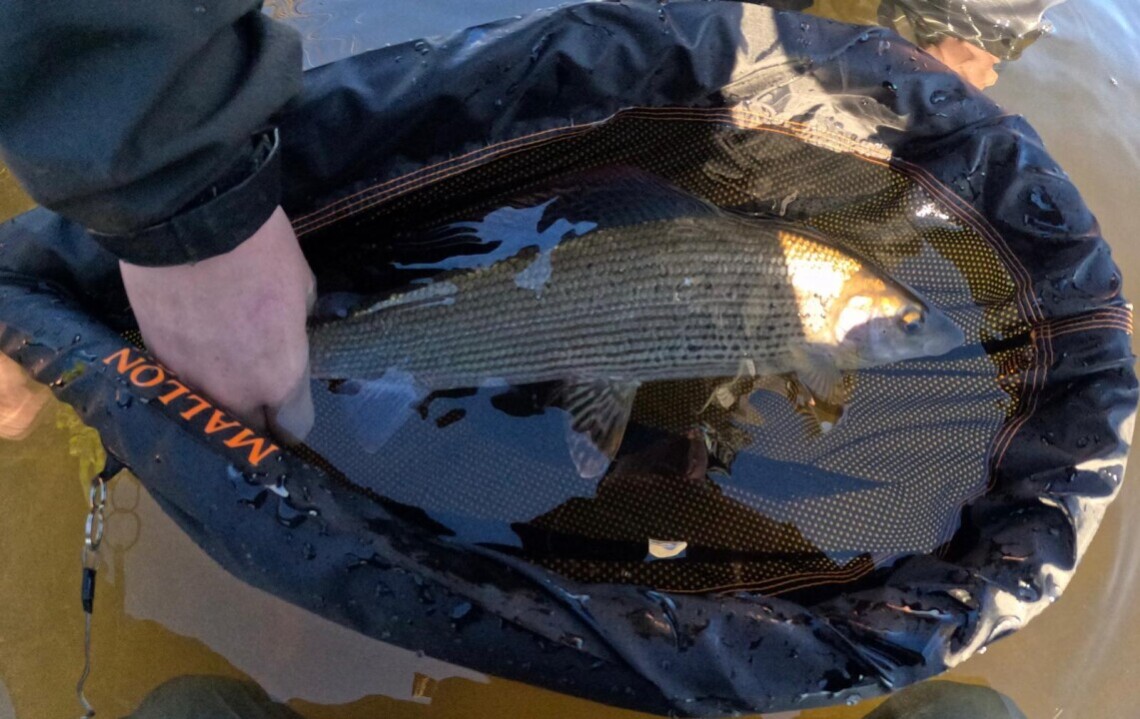 Melyn Cildu - John Thomas from Ammanford