 Dore on its bones - Seth Johnson-Marshall
 Further weather fronts from the Atlantic brought us a warm and wet period during early November with the rivers accordingly high and rising. Looking to the west, this already included some serious flooding in the valleys of the Loughor, Towy and Teifi. There were some exceptions locally with these early floods; as sometimes happens the Monnow valley seemed to miss the heaviest rain and Seth Johnson-Marshall sent me a photograph of the Dore at Peterchurch in the Golden Valley which had remained virtually dried up.
Similarly my local Forest of Dean streams did not rise much at first, which made some off-season trimming sessions easy. The air temperatures remained those of an Indian summer. At this stage water levels and temperatures on the main Wye were not enough to prevent the barbel, including some big ones, from feeding. Chris Duller from Ystrad Meurig fished with a float at Fownhope 5: “I was happy picking off chub trotting a small lump of meat along a crease line in the swim in the woods when I hit the barbel right at the end of the run with a size 14 hook and 5 pounds hook length…it took me a while to coax it to the net. 15 chub and 1 barbel, 10 pounds 6 ounces.”
Matthew Wood from Salisbury had a barbel and 13 chub from the same beat the next day. Nick Fowles with a friend from Redditch fished at Holme Lacy 3 and Lechmere’s Ley: “The river was carrying about 1.5 metres and starting to rise a little in the afternoon. 8 chub and 2 barbel all caught on feeder and meat. Chub were in the 2.5 to 4.5 pounds region. Barbel at 8 pounds 2 ounces and 11 pounds 5 ounces.” On Guy Fawkes Night MN from Stratford on Avon with a friend had this to report about flood fishing at Middle Ballingham and Fownhope No 8: “We arrived on a rapidly rising river where the Mordiford gauge was on 4 metres when we left. 5 barbel and a chub caught from the first and second fields. Whole trees were coming down with the flood water making this an interesting day and topped off by a couple of typhoons flying overhead.” I take it MN was referring to Britain’s agile Eurofighter jet rather than to the weather!
 Flood fishing at Middle Ballingham - James Robb
 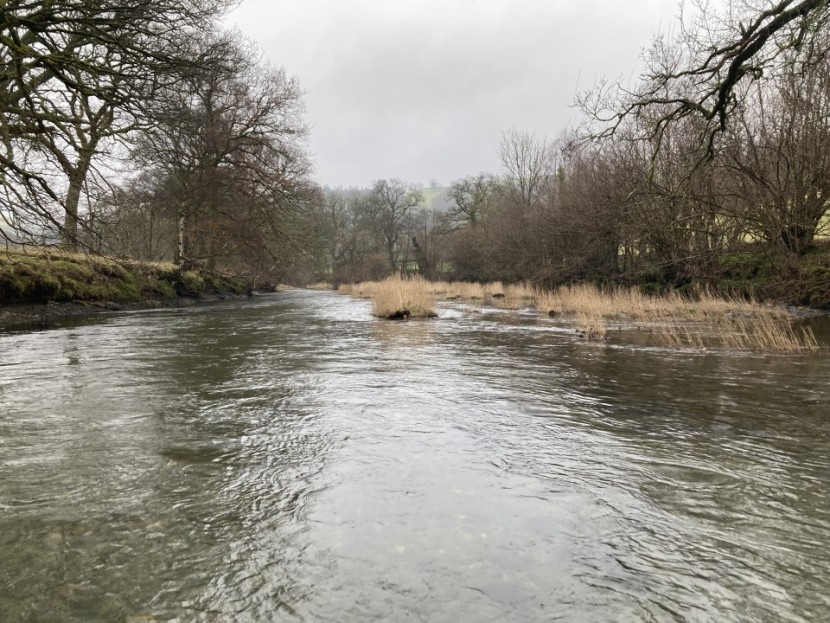 Aberbwtran Irfon - W from Ludlow
 Next day Jim Clarke with a friend from Alcester were at Middle Hill Court: “The river shot from 1.2 to 3.61 metres overnight. The water was out the banks near the car park area, just in over the rest of the stretch. We managed 3 barbel on the bank, biggest being 8.15 pounds. We lost more tackle than caught fish, due to snags moving in the swim during the day.” On 10th November David Morris led a party of three fishing at Middle Hill Court. Due to high water they settled for fishing at the bottom of the beat under the battlements of Goodrich Castle – which makes quite a backdrop. They caught 8 barbel, 15 chub and a pike. Lee Clarke from Bulkington with a friend caught a barbel of 9 pounds 7 ounces plus 7 chub at How Caple Court. In high water conditions they strongly recommended a dog spike and rope for getting up and down slippery banks. Meanwhile the grayling fishing upstream was relatively slow with small numbers of fish taken.
More very heavy rain during the night and through the morning of 12th November resulted in serious floods everywhere. Kevin Speight fished the high water at White House and caught a pair of barbel at 7 and 9 pounds plus a chub and an eel. He warned that there is no practical vehicle access to the water in heavy rain; best to park in the farmyard and walk down. Harry Turner with a friend fished at How Caple Court for 4 barbel, including fish of 8 and 8.3 pounds. Stephen Grigor from Ryton fished at Middle Ballingham and Fownhope No 8 on 13th November and caught a barbel of 9 pounds: “…good result for 3 hours fishing.”
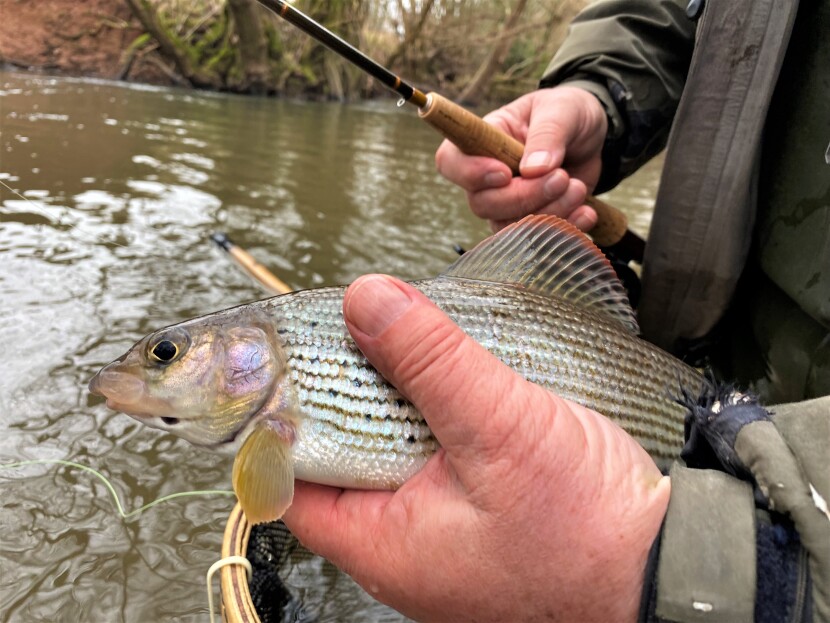 Golden Valley grayling
 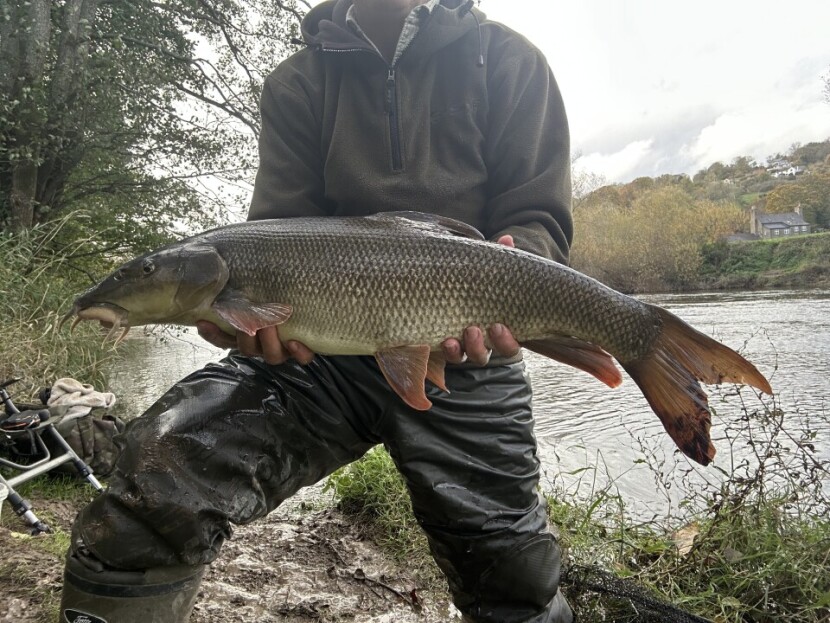 9 pounds barbel from Thomas Wood - GT from Ros on Wye
 My own life gets a little quieter as the season winds down through October and November. I get the occasional opportunity to go fishing for myself and there is shooting available somewhere most days. Autumn or winter is also the time to do a little maintenance on the Wild Streams and I usually give a trim to the three Severn tributaries near to my home. You could probably do the same to your local one if you have a mind to, provided you clear it with the owner. I did the Bideford Brook the other day, just before the leaf fall and while the main Wye was in flood, and it was really just as pleasant and not much more time consuming than it would have been to fish a dry fly up the same stretch. I have been pruning this particular section for years. On this day, the warm sunshine and the yellow light with trees looking like burning torches really made me wish for a moment that I had a fly rod with me rather than a pole saw and a pruning knife. Only for a moment; the season is gone and the brook will still be here next spring. I have paid very little attention to these streams during this past summer of drought, preferring not to trouble them by fishing while they were at their worst. Now it was a pleasure to find the brook running full with cold water and no remaining slime on a clean gravel bed. Only one short piece of this section is fully open to the sun and I was pleased and surprised to see this area has recently developed a stand of vivid green ranunculus weed along with a bed of reed mace in the marsh which has been left by the stream changing its bed over time. In fact I calculate that in this spot the main flow has moved about 40 feet sideways in 20 years, cutting its way into a fresh pasture to farmer Martin’s displeasure and leaving wetland and bog behind on the inside of the bend. It’s a lovely place for ducks.
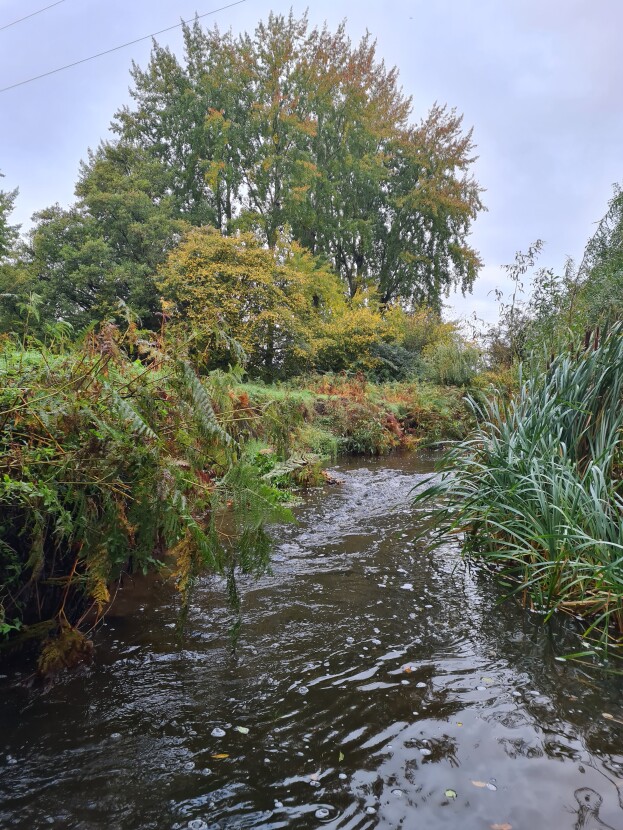 Bideford autumn triming
 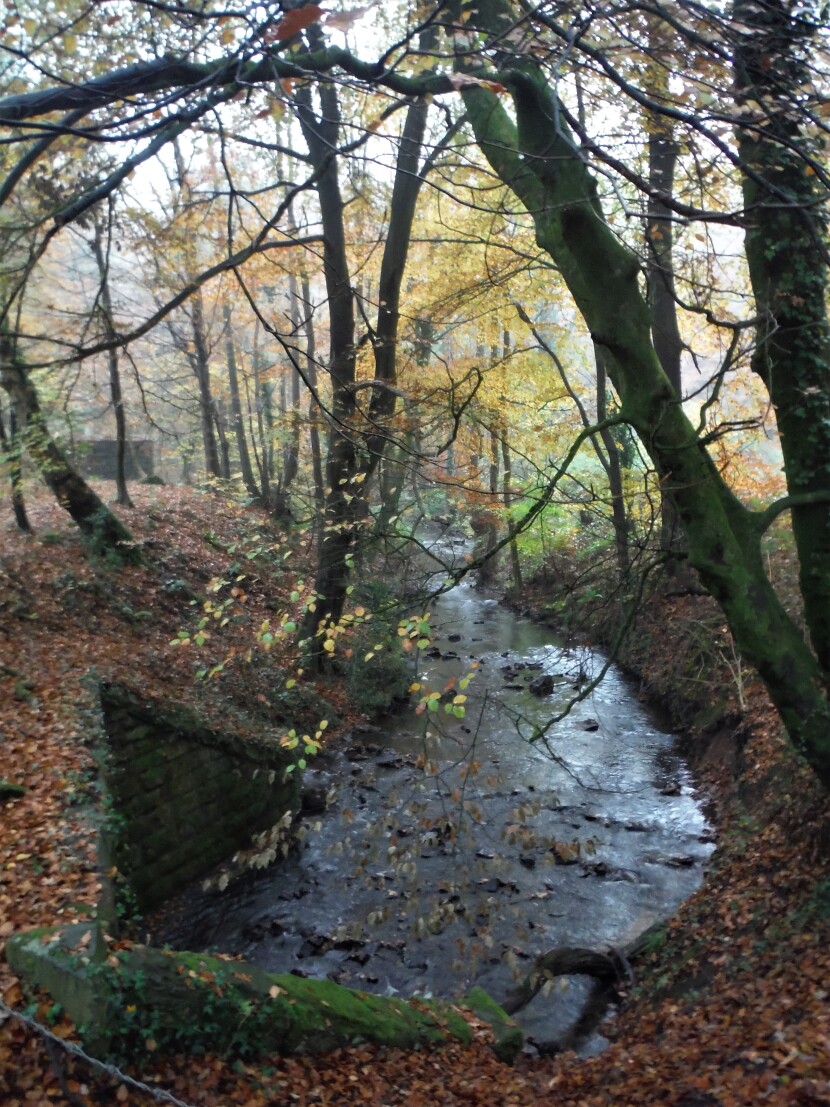 Blackpool Brook - former railway bridge and lime kiln
 Elsewhere the stream is almost entirely enclosed by trees, including some fine beeches and chestnuts. Even the lesser growths of alder and willow, providing of course I keep up with the annual pruning, are tending now to form a high canopy, so that on some of the pools one fishes as up a tunnel or inside a long hall with light slanting in from gaps above. A 7 foot rod casting tight loops is the right tool for such places. Where the water runs shallow over the stones and no fish will lie, I don’t bother to prune – what would be the point? Here the shoots and branches can be allowed to have their way and drop their freight of insects into the water while they are at it. You can push past them on your way upstream. In any case it’s a great mistake to cut away too much in the name of maintenance. We don’t have to cast everywhere and fish need refuges. One main blockage remains which I cannot deal with: here a live willow has created a massive arch across the stream before heading for the sky. The arch covers a deep scouring hole which constantly jams with timber so that one must get out of the water and drop back in a few yards above when progressing upstream. Look out for barbed wire. Otherwise, saving fresh tree falls during winter storms, the brook is all ready for the new season.
On 6th November I also trimmed the Cannop Brook between Whitecroft and Parkend. The situation was much the same, with all the main rivers in high flood, but the Forest streams running low and clear. The weather was unusual for this time of year, with air temperatures well over double figures night and day. This one involved a certain amount of co-ordination with the Forestry Commission and the Flood Risk Management people at the County Council, because measures are also being taken to increase the water retention of the brook and slow down flash floods. As I live near the flood plain you would in any case expect me to approve of that aim, but anglers need not be unduly concerned about the river. No canalisation is involved, but the removal of some gabion sections and leaving plenty of woody debris to encourage meandering of the channel…which is already happening, as you might guess. A lot of trees have fallen across lately, but mostly in a section of about 150 yards in the middle of the beat. That has produced a jumble of water and heavy timber which will stay and which I think makes a good fish refuge. The rest of it is challenging, but allows you casting room if you are careful. Blackpool Brook the following day was much easier as a high canopy has developed here many years ago.
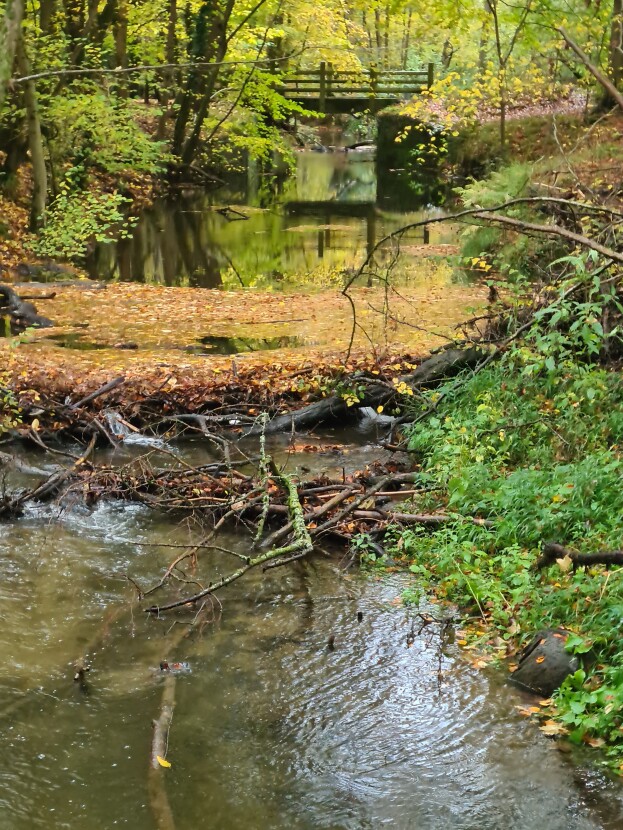 Cannop Brook
 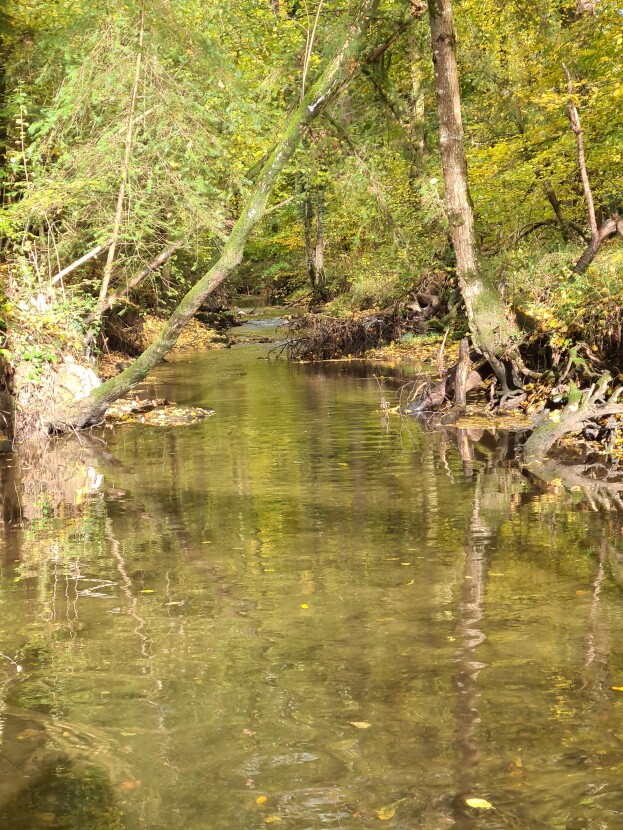 Cannop Autumn
 It has been a strange fall, this year. It started early with some leaves colouring early and dropping due to drought rather than frost, then slowed down as the awaited rains arrived at last. 2025 grain crops were poor but it has been an extraordinary year for nuts and fruit with record quantities of acorns and beech mast on the ground. Gloucestershire and Worcestershire are full of apples, and market gardening friends in the Vale of Evesham talk about bumper fruit and greenhouse crops. All that sunshine must have done some good.
However, by late October or early November we find ourselves taking what we can get in terms of weather. In sunshine it can be glorious although there is a certain overlay of sadness knowing there are darker days coming soon. One of my favourite drives at any time is down out of the Forest to cross the Wye at Bigsweir Bridge and then through Llandogo village, by the faded leaping salmon sign on the old Brown’s Stores, up again on a narrow winding road, past cottages notched into the hillside, through more woods on the Welsh side giving glimpses of the river far below. At this season the trees all look to be on fire and pheasants seem to be all over the place, because there are shoots feeding up poults on both sides of the river. On such days I always appreciate why the Valley is an AONB and in fact has been a popular place of tourism since the 18th century. Then I wonder why the equally beautiful adjoining Forest cannot be included too. Finally I emerge from the woods at over 800 feet above sea level to Keeper’s Lodge, which is on a ridge open to any winds blowing. Beyond this, the land falls off gradually in folds towards the valley of the Usk. On a windy day with the turbine blades by the farmhouse whirling I know the targets I shoot at will jinx, hold up or drop suddenly in all sorts of gusts. Proper windy weather while shooting clays is likely to spoil the score card, but I find these days tremendous fun.
Back to the drama of rising rivers. By the night of 14th / 15th November Storm Claudia was living up to the amber warning given in advance. As often the case, it was the ditches and tributaries which rose first, then the larger rivers. The Forest of Dean is almost nowhere flat, consisting of a great dome with a hollowed summit seamed by valleys and “tumps.” 24 hours of heavy and continuous rain combined with drains blocked by fallen leaves quickly produced a series of “no-go” sumps of deep water making local roads impassable during that first night. Not for the first time, I wished we still had our old Landrover while I was trying to work out how to collect my wife from friends a few miles away across a flooded Forest. Further afield, extensive floods in Monmouth were declared a major incident by emergency services at 1.30 in the morning. It was difficult to work out at first whether to blame the Wye, already at the top of the bridge arches, and which must have back-filled the tributary, or was it the Monnow itself which came creeping up the high street flooding shops on the way. In fact it was the Monnow and a sort of tidal wave had come down the valley from Skenfrith. The water reached a depth of nearly 6 feet at the bottom of the town and cars were washed away. It was said to be the worse Monmouth flood for 40 years. Abergavenny on the Usk was also reportedly flooded by morning. Herefordshire was affected in a number of places by flooding from the Monnow, Lugg and Arrow systems. Apart from Skenfrith and Monmouth, even Ewyas Harold experienced a rise in the little Dulas brook, normally so harmless looking, which formed a 2 or 3 foot deep torrent romping down the main street. Locals must have been depressed to learn that The Dog and The Temple Bar Inn had both flooded. The Bridge Inn at Michaelchurch Escley under the Black Mountains, normally approached by a back road and a ford and pipe bridge arrangement, was understandably cut off. Trains between Hereford and Birmingham ceased to run, then the line to Shrewsbury. Before long fallen trees were down closing roads and railway lines all over the region. Up in Shropshire, communities like Leintwardine were defending themselves from a flooding Teme, while the flood-prone towns of the Severn valley used a brief warning delay to put up the barriers and flood gates ready for predicted high water the next day.
You would think such conditions over the Marches would put paid to fishing for a bit, but Stephen Thorburn with two friends from Warminster fished all through the day on the 14th at Middle Hill Court. “We fished during Storm Claudia. Driving rain, high winds and the odd big tree…coming down into the river. Usual barbel tactics were employed and (3) fish mid-singles were caught on pellets.” Allan Trevett from Basingstoke showed up at How Caple Court at 7 am on the 17th to find the air temperature at zero with a ground frost and the water at 9 degrees, coloured, but dropping (2.92 metres at the Mordiford gauge). The trip was worth his while, he thought, and he caught 9 chub and 3 accidental eels. Meanwhile Andrew Penton with a friend from Haverfordwest tried some grayling fishing on the Irfon’s Lower Serenity House beat. This was not a bad plan as the Irfon usually drops about a day before the main Wye, just as it rises in advance of the main Wye. The level at Cilmery was around 0.85 metres, which really still constitutes a flood, but the water was clear. The flow was too fast and dangerous for wading and fly-fishing, but they tried trotting with red maggots and caught a brace: “…a lively, cold, clear, crisp day and very enjoyable despite the river height.”
 How Caple Court 16th November - Mark Liggins
  How Caple Court 17th November - Allan Trevett
 With a wind blowing from the North, the weather now became quite harsh and wintry, hovering around zero for a few days. Grayling anglers appreciated the sun when it was out, but the fishing was not particularly good. Simon Cooley of Llandeilo Graban blanked at Llanfechan and pointed out that the access stile is completely broken. He also lost a Snowbee retractable wading staff in the strong current. Andy Freeman came from Lymington and caught 6 chub at Fownhope 5, followed by 7 more at Whitney Court the following day. Glen Palmer of Lowestoft had 7 chub at Fownhope 5. Otherwise the coarse anglers faced with cold temperatures and high water fared little better than the grayling anglers upstream. The barbel seemed to have switched off. Presumably due to a combination of high levels and low water temperatures, the fishing remained poor for the rest of the month.
It’s worth asking ourselves, as we recover from a very difficult season of drought in our area, just how much damage has been done? It would be easy to imagine that now we have experienced floods and the rivers are full again, everything will immediately go back to normal. I hope no stocks were wiped out, but invertebrate numbers seem to be down and I have certainly seen some lean and badly conditioned fish of different species as we go into the autumn. One hopes – one can only hope – that a nice dry and frosty winter with good spawning conditions followed by a few moderate floods next spring and summer will go some way to putting the situation back to normal.
This year some of the clubs have had a difficult time trying to manage fishing lakes stocked with rainbows. I know the commercial pool fisheries have suffered badly and some are even now waiting for water supplies to increase once more. Few of the rainbow trout, even if newly stocked, look completely healthy. Our Forest Pool has been problematic through the summer and we lost some fish when the temperature went over 20 degrees C. Now water and air temperatures are much cooler, but the damaged fish don’t recover. In addition we have been cursed with a growth of lagarosiphon pondweed right across the lake. This has never happened before, but the lake is comparatively shallow now with a bed of thick silt deposited over the decades. In previous years it has been quite easy to deal with marginal growth, but this year’s sudden bank to bank coverage of the surface is unprecedented. A members’ work day throwing grapnels and rakes out on ropes had only limited success. Now there is some hope of die-back as temperatures drop and winter frosts arrive, but will it all grow back next year?
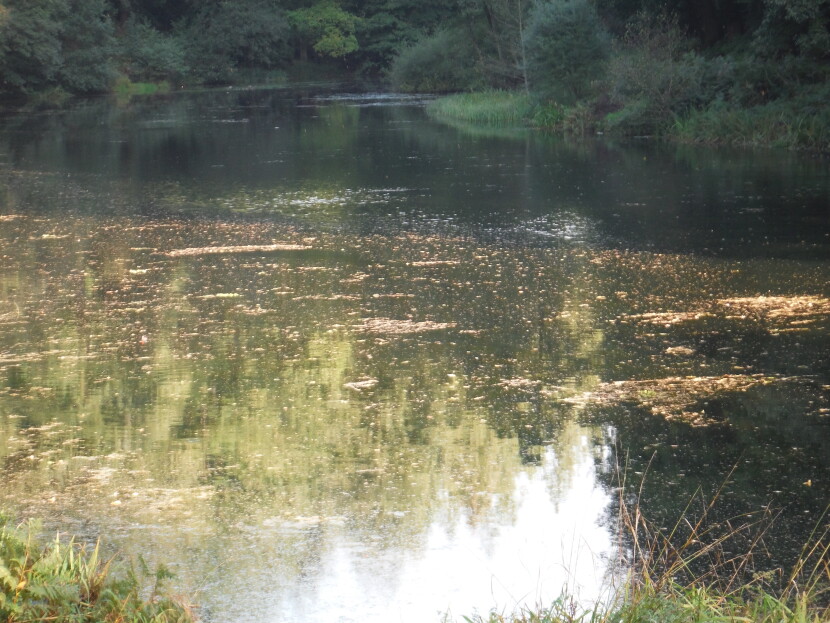 Forest pool weeded
  Sawyer's Killer Bug
 Meanwhile I have figured a way to fish the lake, but it isn’t exactly pleasurable. The thing to do is to roam the bank until you find a group of rainbows circling in a clear patch somewhere in the middle of the pond. Then lob out a weighted nymph to drop amongst them. I used a Sawyer’s Killer Bug, which to me looks something like a grub or a maggot, and it was quickly seized as soon as I began a steady retrieve. Once a rainbow was hooked, there came the rather crude business of holding the thrashing fish hard on the surface before persuading it over the weed. If it dived into or under the weed, there was nothing left to do but hand-line and skull haul the fish and torn clump of weed out in a tangled mass and sort everything out in the net. With a 6 weight rod and 3X leader this was all just about possible, but hardly sporting or fun. I got 4 this way on the first morning and 3 on the second, but hardly wished to carry on with it.
At the time I was surprised at the speed at which the Tenkara phenomenon in the UK came and went. At one point everybody seemed to be using Japanese-style Tenkara rods both long and short, on every kind of running water from small streams to large rivers, and with spiders and dry flies. Reels and rod rings were out of fashion. A couple of years later it was all over and I doubt you would be able to buy a new Tenkara rod in the UK today. However, Nick Thomas has a useful article in the December edition of Fly Fishing and Fly Tying, pointing out that a Tenkara rod is a very good way to fish a team of heavy nymphs along the bottom. He writes specifically about the Taff for winter grayling, but you could apply the tactics anywhere. I always thought that heavy nymphing was an obvious use for Tenkara, probably the most obvious, simply because lacking the weight penalty of rod rings and attached reel, the Tenkara system and a long rod gives you a lot more reach and therefore control over the flies. I am surprised that more of the Euro-nymph enthusiasts have not cottoned on to this before now, but this may be because the development of heavy nymphing techniques has been very much driven by match fishing, and of course the Tenkara system is outside the match fishing rules.
There is no reason why pleasure anglers should be so inhibited. Nick had to obtain a rod called of all things a Dragontail Hellbender from the USA which can apparently be used at 11 feet or extended to 13 feet. For years I have owned a 12 foot long Seiryu with the action rated at 6:4 and had a lot of fun with it fishing for winter grayling on rivers large and small (it is not too long, for example, for the Monnow or the lower Llynfi). It gives you the needed reach and is perfectly capable of playing large grayling, not off the tip, but by bringing the butt section into action using two hands. I have a choice of leaders for it: furled tapered ones of several lengths and a coloured level line with sighter markings to which I attach a fluorocarbon tippet section via a mini ring. Whether you use an indicator or not and which kind is up to you as we aren’t match fishing, and the same goes for the flies. Nick gives a list of winter Tenkara patterns, but I would suggest any favourite bugs in which you have confidence should fish well by this method.
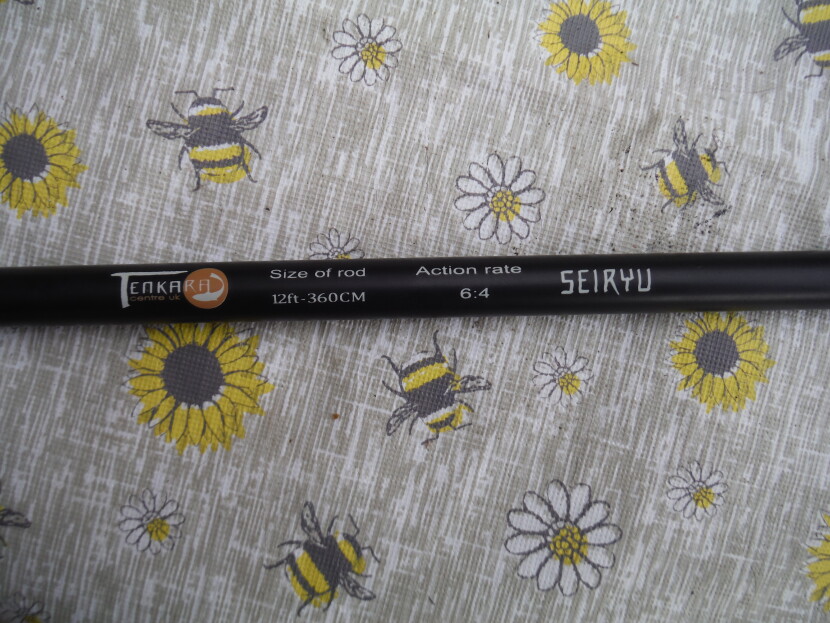 Seiryu
 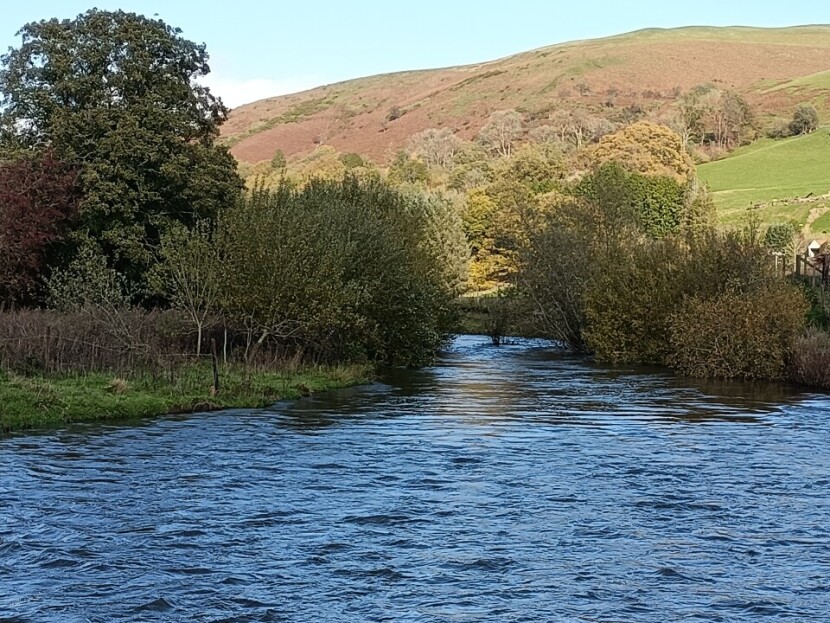 High water at Llandewi - Nick Burdekin
 Dark days and this is a slightly dangerous time of the year on the roads. Road kill affecting wildlife is always upsetting and it is a significant risk while driving anywhere in the countryside, but especially around dawn and dusk in the Forest. You can reduce the risk by cutting your speed, but on the odd occasion there is nothing to be done. Feral boar are a menace on dark mornings and evenings, as everybody in the area knows. A lot of young badgers meet a grisly end on the roads during the spring and early summer. Foxes are more rarely caught out. Personally, I dread the thought of hitting a deer. Yesterday, in the middle of the afternoon, a melanistic fallow buck came trotting across the road ahead of me, a fine beast bearing aloft a wonderful set of antlers and probably intent on chasing up his wives. He looked to be on a mission. Fortunately there was room to spare and no harm was done on this occasion. However while driving up the Severn valley through Maisemore the other day, two birds engaged in some kind of close quarters aerial combat suddenly tumbled into the road in front of me and I heard a sickening thump as they went together under the car. I had seen just a glimpse of barred feathers, so I guessed it must have been a sparrow hawk and its prey, presumably some kind of song bird. Nothing was to be found when I stopped. Pigeons I never think of as particularly bright and they are certainly not street wise although those who try to control their numbers by shooting them from a hide would probably say otherwise. One flew suddenly over a hedge and straight into my windshield this summer while I was driving in the valley of the Edw. I thought the screen would crack and was glad when it didn’t, but I am afraid the pigeon did not survive the encounter. There is one night bird which is surprisingly vulnerable to traffic: this is the barn owl which sometimes swoops silently out of the darkness, presumably after prey, but right into the path of a car or truck. You occasionally see a dead one on the A40 which has late night traffic from the Irish ferry ports. I hope I have not given the impression of engaging in what used to be called in the police courts “furious driving”… I do take as much care as I can while covering my rural patch.
I was sorry to learn of the death in late October of Geoff Franks, former chairman of the River Wye Gillies Association. Geoff was known as a man of strong views and some of his social media comments about other anglers and organisations could and did set off fireworks. However, nobody could deny his deep and passionate commitment to the River Wye and restoring its salmon run. On a personal level he could be quite charming. I didn’t know him well, but I do recall a chance meeting on a frosty winter day at Glanwye. I was grayling fishing on a day ticket and he came down about lunch-time to see if he could spot some salmon redds. We had a long talk, about sea trout fishing for some reason, and I recall now that he used to tie some beautiful sewin patterns on Waddingtons for his good friend the Welsh sea trout expert Malcolm Edwards to use on his local Rheidol. I also recall that at the end of our talk that day he put me onto a grayling run under the bank which I had not figured out for myself and I caught fish from it for the rest of the short afternoon. Wherever Geoff is, I hope that he has the sight of some fresh-run salmon to keep him company.
Through darkness and rain to the Wye and Usk Foundation’s public meeting in Talgarth. Every year, the picture painted by those who work on our rivers and river valleys becomes more complex and some of the facts revealed by the science are unexpected. Meanwhile we have reached a situation where the world knows there is something wrong with the Wye and probably the Usk as well. The world in its simplistic way thinks it knows what the problem is and so some savvy lawyers together with a group of well-meaning supporters are beginning a crusade in the courts against publicly identified villains, evil chicken farmers and polluting water companies.
Angling interests probably have a slightly less over-simplified view, but still many of us are floundering while trying to understand exactly what has happened over the last few years. Our knowledge of the rivers is of course anecdotal rather than scientifically quantifiable and anglers can be regular or occasional, skilled or unskilled, lucky or unlucky. The electro-fishing team are recording what is there in terms of young fish while we record the larger ones we catch – not the same thing. Nevertheless, anglers are out and about on the rivers more than most and their observations should not be discounted. Without assigning reasons and based only on impressions, if asked to give a sort of “state of the nation” summary of the fish stocks and fishing sport on our rivers this year, my response would go something like this:
Wye salmon catch: 59 salmon taken by the rods on the Wye for 2025 is a stark figure and by the standards of the past it is a disaster. Obviously I have a strong impression that the run was very poor with few fish seen in the usual places. The Usk results also seem to have been poor as were the migratory fish results from the sewin rivers further west. I worry about what will happen if it is decided that these low runs are unsustainable; a moratorium on angling would not be an unimaginable decision for the authorities to take.
Wye coarse fishing: This is actually thriving, a fact which perhaps should be emphasized more often. The lower and middle Wye continue to offer some of the best barbel and chub fishing available in the UK, which has a strong commercial benefit to local businesses.
Wye system grayling: Our grayling fishing seems to be in trouble at the moment and this also should be emphasized. Grayling catches from the famous Irfon tributary have been very poor for several seasons, and there also seems to have been a reduction in catches below Builth on the main river. Upstream of Builth grayling catches have been better and the Lugg population seems to be holding its own with good results from beats like Lyepole and Eyton. The Arrow is doing less well for both trout and grayling. Most of the Ithon has been poor for a long time, although there are some good grayling in pockets at the top end. Grayling numbers do naturally fluctuate, but they also are very pollution sensitive.
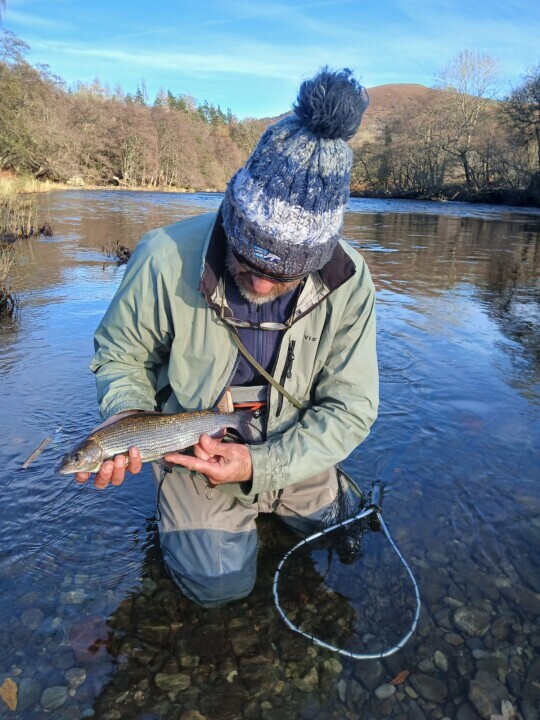 Craig Llyn - JH from Chemlsford
 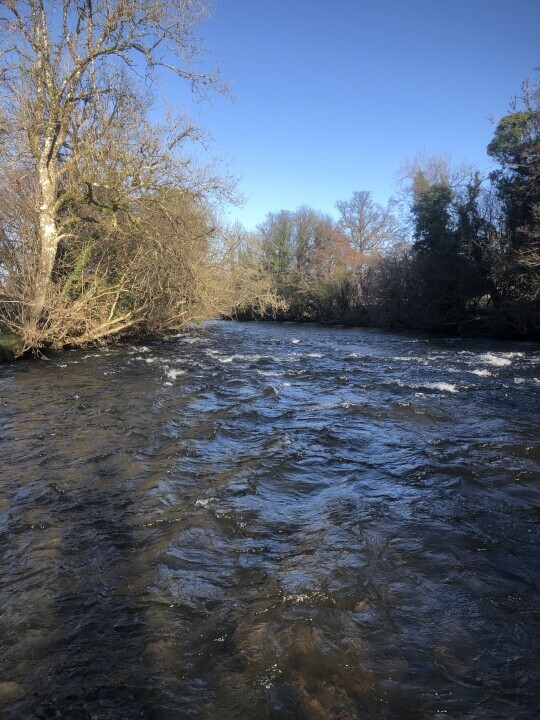 Serenity House Irfon - Andrew Penton
 Wye system trout: Numbers in the upper Wye seem relatively unchanged, but results from the tributaries have been very varied. In particular numbers of brown trout (and grayling) in the main Monnow have apparently plunged over the last 5 years. Better results can still be had in the remote Monnow tributaries under the Black Mountains.
Usk brown trout: Despite poaching raids and other problems including lack of water, the upper part of the main Usk continues to provide some surprisingly excellent brown trout fishing during the spring. The lower river is not holding up quite so well and most of the Usk tributaries have problems.
The WUF presentations reminded us of the general direction of the organisation along with a mass of new information. Familiar work such as tree planting, source liming and pleaching goes on. A young and energetic WUF team continues to sample the network by electro-fishing, 5 minute surveys taken in the riffles, while a large network of citizen – scientists sample the water quality. Three sondes are now in the Usk recording water components and temperatures, and new eDNA techniques make it possible to make even more accurate observations about species present. The citizen volunteers have proved to be quite an asset and their sampling methodology has been found to be of a similar standard to that used, much more infrequently, by professional scientists. Some of the electro-fishing results have been intriguing; I would not have guessed that that bullheads are the numerically most prevalent fish species in the Usk, or that stone loaches are found in the main stem but for some reason not in the tributaries. Generally the 2025 electro-fishing readings for juvenile fish have not been as good as in 2024. The excellent result for 2024 is believed to be due to the gentle rains of the previous autumn, which produced levels to encourage salmon onto the spawning beds without subsequently washing out of redds. By contrast the 2025 sampling indicated recruitment collapse in most of the upper Usk tributaries except for the Crai, which is of course protected from extreme flooding by the reservoir upstream. Results in the lower Usk tributaries and main stem to Crickhowell were much as before. Good results were obtained for fry if not for adult fish in the main Wye, Irfon and (slightly surprisingly to me) Ithon tributaries. By contrast results were very poor on the Monnow, Lugg and Arrow.
Most of the discussion at Talgarth centred on rain-fall patterns, soil absorption characteristics and catchment based partnerships. The floods of times past are now believed to have been more damaging overall than more visible pollutant spills. Changing crop planting with potatoes and winter corn plus extreme weather have combined to damage both land and water. The light soils of the Monnow valley make this very risky. Some of the potential partners for catchment work might not have been immediately obvious: for example Network Rail with concerns about floods in the Monnow valley undermining railway tracks. The farmers, including chicken farmers, are actually being helpful. As an example of the problems anglers and valley dwellers face, there was much discussion of the recent Storm Claudia flood and tremendous amounts of water which drowned all the houses in Skenfrith and rose 6 feet into the lower streets of Monmouth. This particularly heavy storm of rain came from the east and so the well-known rain shadow effect of the Black Mountains did not come into play.
I was reminded too of the difference between phosphorous and phosphates, and that most of the phosphorous load laid down in the soils dates from farming during the 70s when fertilising was even more enthusiastic than today. This of course pre-dates the chicken era. I also learned that the disappearance of ranunculus from the Wye is believed to be due to the strength of the 2020 floods tearing out the roots and subsequent floods preventing re-establishment. There tends to be an assumption that pollution has killed the ranunculous, but the opposite is more likely: ranunculus, where present with its cargo of micro-organisms, acts as a filter, even a phosphorus stripper, to clean up pollutants. Flow rates, heat and light levels with the presence of small quantities of ammonia are what is believed to trigger the recent explosions of algae growth. Again we come back to climatic fluctuations, heat, light, drought and flood.
Questions from the floor raised more familiar angling concerns, including the numbers of fish eating birds, particularly cormorants and goosanders, which we have all become used to seeing in our pools. This is an old chestnut, but still a glaringly obvious problem. The point was made that however successfully we improve living conditions in our rivers for juvenile salmon, once the smolts head for the sea they are already facing a believed marine survival rate of no more than 2%. Surely it is illogical to tolerate goosanders reducing that figure even further by wolfing them down in hundreds as they travel towards the sea. NRW has special obligations to protect the salmon on the upper Wye as it is a Special Area of Conservation. Would the WUF challenge NRW on permits to cull fishing eating birds now damaging fisheries, and to provide for control in numbers which might actually be effective? The WUF stated that they are in the process of asking for greater culling measures. A zero tolerance for goosanders on the Wye for one year was suggested.
Another matter raised was that a block on the lower part of the Usk’s Grwyne tributary which went unseen for a number of years has apparently resulted in the extinction of the salmon run on that tributary. It might take decades for nature to make this up. Would that not make a good case for seeding that particular location with artificially raised salmon parr? It was conceded that it might be. And so the meeting broke up.
Through rain and darkness we drove home again. It rained all the next morning and the rivers were in flood once more.
My best wishes for Christmas and the New Year,
Oliver Burch